Following my academic suggestion yesterday, today I present an idea for a very exciting film, should anyone reading this be looking for such a thing.
I got it from the 28 April issue of the London Review of Books, which carried a review by RW Johnson of a number of books dealing with the subject of nuclear weapons. As well as inadvertently providing a possible - if rather radical - solution to global warming, via a war between Pakistan and India:
'If they were to throw all their nuclear weapons at one another, with a total yield of around 1.5 megatonnes - less than that of many individual thermo-nuclear weapons in the American and Russian arsenals - the smoke from the fires would rise into the atmosphere and take ten years to dissipate. The earth would be returned to the conditions of the "little Ice Age" in Europe between the 16th and mid-19th centuries...'
the article also contains an account of the Allied attempts to foil the Nazis' nuclear programme, parts of which I can imagine becoming a thrilling action film (although that, I have to admit, is not actually a genre about which I know anything much at all):
'A key part of the Nazis' nuclear programme was the heavy water production facility at the Norsk Hydro fertiliser plant [yes, I know it doesn't sound very riveting just yet, but be patient] near Rjukan in the wilds of Norway. The British did their utmost to destroy it. The first recourse was to get Norwegian Resistance sympathisers at the plant to sabotage it by pouring castor oil and cod liver oil into the electrolyte. The Special Operations Executive, however, had not told the several saboteurs of one another's existence, with the result that they overdid it. The whole plant had to be shut down in April 1942 and the Germans discovered the sabotage, which made it harder to do again.
By this time Churchill and Roosevelt had designated the Norsk Hydro a top priority target. The Resistance strongly counselled against a bombing raid because it would lead to major civilian casualties. But a commando raid would be difficult: in winter it would be prohibitively cold and in summer there wouldn't be enough hours of darkness. In November 1942, two British bombers towed in a 34-strong commando force in gliders [imagine that as a cinematic image]. They were to be met by a Resistance group and would then attempt to demolish the plant. It was a complete disaster. One plane and both gliders crash-landed, with many casualties. The survivors were all caught, interrogated and executed by the Gestapo: some were shot; others were throttled with straps and had their chests crushed before being killed by having air injected into their bloodstreams [personally I would have this all happen off-screen, but I suppose it depends on your style as a director].
In February 1943 [and this is where, I think, the action of the film should really begin, if you want sheer joyous adventure] a smaller team of specially trained Norwegian commandos was parachuted onto the desolate Hardanger Plateau in temperatures of -30 degrees Centigrade. The Hydro plant had to be approached across a suspension bridge over an unclimbably steep ravine. If they attempted to storm the bridge, the shoot-out with the guards would raise the alert. The answer, it was decided, was to climb the unclimbable - down into the ravine and up the other side - then set explosives all round the plant and escape via the same impossible route. The operation worked and they all got away safely. The German commander, surveying the damage, said it was "the finest coup I have seen in this war".'
But stop, there is more. Hidden away within the same review I see the makings of a potentially interesting play or long television drama as well. It concerns Werner Heisenberg who led the Nazis' bomb programme. After the end of the war in the European theatre, 'the British put him and most of his nuclear co-workers together at Farm Hall, a country house near Godmanchester, and bugged their conversations as the news of the Hiroshima and Nagasaki bombs came through.' The threads of that could make for some quite interesting drama - the Germans in the house, possibly their encounters with the locals in Godmanchester, and the listeners and their evolving understanding of those they were listening to.
So there you are: two ideas for free. Just a small credit is all I ask, if anyone ever gets any of them up and running.
Oh, and did you know that 'Nuclear weapons require a lot of maintenance: they cost the US alone $50 billion a year'? It's quite a lot of money, when you think about it.
Wednesday, 31 August 2011

Tuesday, 30 August 2011
Have You Got the Bottle?
Should you be a student of literature casting about for a dissertation topic, may I suggest 'The Milk Bottle in the 20th Century Novel' as an idea? It came to me when I was reading A Fairly Honourable Defeat, which includes milk bottles as a recurring motif.
They are first introduced about halfway through the text:
'The kitchen smelt of decaying matter. It was difficult to trace the source. "I must get rid of all those milk bottles", thought Tallis. Some of them contained weird formations resembling human organs preserved in tubes. It was quite difficult to get these out of the bottles and the last time he tried to he stopped up the sink.'
They recur later, functioning as a measure of one character's energy:
'He did not feel strong enough to tackle the milk bottles',
and again, further on, compounding the breakdown of his marriage:
'They staggered together, knocking over a row of half empty milk bottles ... The kitchen floor was covered with broken glass and stinking yellowish milky mess ...Tallis stared at jagged glass and crumpled newspaper and milk which had already dried into thick yellowish pats and errant gleaming globes of wine-dark Baltic amber. He stared down into a world that had been utterly changed.'
Eventually, they are noticed by another, stronger character:
'Julius scrutinized the kitchen with a faint frown, noting the milk bottles.'
It is he who, by the end of the novel, manages to overcome them:
'"What did you do with all those milk bottles?" said Tallis. "I washed a few and put them outside and I put the rest in the rubbish tip across the road."'
In Barbara Pym's Quartet in Autumn, milk bottles play an even more prominent role. Indeed, one of the characters is so in thrall to them that she fills her shed with the things:
'Then, as the day was fine, she went into the garden and picked her way over the long uncut grass to the shed where she kept milk bottles. These needed to be checked from time to time and occasionally she even went as far as dusting them. Sometimes she would put out one for the milkman but she mustn't let the hoard get too low because, if there was a national emergency of the kind that seemed so frequent nowadays, or even another war, there could well be a shortage of milk bottles.'
This character becomes so concerned when an acquaintance inadvertently leaves an alien milk bottle in her possession that she wraps it up and seeks her out in a library to return it:
'Marcia crept up behind [Letty] as she browsed among the biographies.
"This is yours, I think, " said Marcia in an accusing tone, thrusting the wrapped milk bottle towards her.
"A milk bottle?" Of course, Letty did not remember the occasion and Marcia had to explain it, which she did, loudly, so that other people turned round and the young blond-haired library assistant seemed about to make some kind of protest.
Letty conscious of tension in the air, accepted the bottle without further question.'
If someone as ill-read as me can find two instances so easily, I'm sure there must be many more references to this quintessentially English obsession scattered through the fiction of the twentieth century. I look forward to following the glittering academic career of whichever enterprising young scholar chooses to investigate this fascinating and thus far thoroughly overlooked area of research.
They are first introduced about halfway through the text:
'The kitchen smelt of decaying matter. It was difficult to trace the source. "I must get rid of all those milk bottles", thought Tallis. Some of them contained weird formations resembling human organs preserved in tubes. It was quite difficult to get these out of the bottles and the last time he tried to he stopped up the sink.'
They recur later, functioning as a measure of one character's energy:
'He did not feel strong enough to tackle the milk bottles',
and again, further on, compounding the breakdown of his marriage:
'They staggered together, knocking over a row of half empty milk bottles ... The kitchen floor was covered with broken glass and stinking yellowish milky mess ...Tallis stared at jagged glass and crumpled newspaper and milk which had already dried into thick yellowish pats and errant gleaming globes of wine-dark Baltic amber. He stared down into a world that had been utterly changed.'
Eventually, they are noticed by another, stronger character:
'Julius scrutinized the kitchen with a faint frown, noting the milk bottles.'
It is he who, by the end of the novel, manages to overcome them:
'"What did you do with all those milk bottles?" said Tallis. "I washed a few and put them outside and I put the rest in the rubbish tip across the road."'
In Barbara Pym's Quartet in Autumn, milk bottles play an even more prominent role. Indeed, one of the characters is so in thrall to them that she fills her shed with the things:
'Then, as the day was fine, she went into the garden and picked her way over the long uncut grass to the shed where she kept milk bottles. These needed to be checked from time to time and occasionally she even went as far as dusting them. Sometimes she would put out one for the milkman but she mustn't let the hoard get too low because, if there was a national emergency of the kind that seemed so frequent nowadays, or even another war, there could well be a shortage of milk bottles.'
This character becomes so concerned when an acquaintance inadvertently leaves an alien milk bottle in her possession that she wraps it up and seeks her out in a library to return it:
'Marcia crept up behind [Letty] as she browsed among the biographies.
"This is yours, I think, " said Marcia in an accusing tone, thrusting the wrapped milk bottle towards her.
"A milk bottle?" Of course, Letty did not remember the occasion and Marcia had to explain it, which she did, loudly, so that other people turned round and the young blond-haired library assistant seemed about to make some kind of protest.
Letty conscious of tension in the air, accepted the bottle without further question.'
If someone as ill-read as me can find two instances so easily, I'm sure there must be many more references to this quintessentially English obsession scattered through the fiction of the twentieth century. I look forward to following the glittering academic career of whichever enterprising young scholar chooses to investigate this fascinating and thus far thoroughly overlooked area of research.
Monday, 29 August 2011
Battered Penguins XI

The novel opens with 20-odd pages of straight dialogue, which is quite a daring way to begin a novel. Unfortunately, the experiment is 'brave', as Sir Humphrey would say, rather than particularly successful, partly because Murdoch has to burden it with slabs of exposition, which make the conversation flow in an unnaturally orderly way, rather than meandering about with endless broken sentences and countless digressions, as actual speech tends to do.
Similarly, while Murdoch's characterisation (notable for its unusually detailed visual descriptions; she supplies us, in a slightly Constable Plod kind of way, with hair colour, height, eye colour and even, bafflingly, in one case, something she designates as a 'slightly prissy mouth'), is admirably fertile and inventive, the structure of the novel creaks a fair bit. She creates seven very vivid main characters but then proceeds to shove them in and out of situations that, while they highlight the points she wants to make about the nature of good and evil, love and illusion and humanity itself, do not entirely convince.
The book contains some good insights and is remarkably advanced about homosexuality (possibly the most sympathetic of the characters are the homosexual couple). At moments - for instance, when we are told of one character, 'He sat down on the divan bed and began to pick his nose' - it takes realism to extremes I have not encountered before.
It has some wonderfully comic moments - including a farcical sequence involving the disposal of a large pink teddy bear. The figure of Tallis's father, who, when he says to his son, 'I wish you were five again. I'd give you something. Not that beating ever did you any good. But my God I enjoyed it,' reminded me of Dudley Moore as the angry working-class father telling his effete son, Peter Cook, never to darken his own doorstep again, is consistently amusing, (I particularly like it when he tells his son he should get a shave, because, 'you look like something growing on the side of a tree trunk.')
However, too much is left to the reader's kind indulgence, particularly when it comes to putting up with the idiotic pseudo-mystical thread that runs through the text. The final revelation of terrible violence hidden in the past of two characters is probably meant to be shocking, but I found it merely gimmicky.
All in all, the book, though entertaining, is flawed and has, somehow, a hollow ring. I suppose it could therefore be described as a rare example of honesty in advertising. After all, the title tells any prospective reader the absolute truth: as a piece of fiction this novel is a fairly honourable defeat.
Friday, 26 August 2011
Grasping the Past
When I was a child, we would often leave London for the weekend, and the road we took in those days ran past Runnymede, where the Magna Carta was signed. Whenever I saw the sign for Runnymede, I always thought about how, when I was old enough to do things on my own, I would come back and walk very slowly, putting my feet down in front of each other, heel to toe, all over the entire tract of land, so that I would be able to be absolutely sure that I had definitely trodden on the same spot that Bad King John, as we were taught to call him, (I suspect such 'judgemental' terminology has vanished from primary schools since then; in fact, the whole package - King John, the Magna Carta and Runnymede itself - may well have been excised from the curriculum by now, replaced by more topical subjects) had once stood.
I was reminded of this by an interview on the radio this morning with Barry Jones, a former Australian federal government minister, who, it turns out, is also a collector of the signatures of famous people. I imagine he is driven to amass these things by the same desire that made me hatch my - as yet unfulfilled - plan to plod up and down that rather dull stretch of grass next to the A308. For me at least, it was the hopeless but not quite stiflable desire to somehow touch the past that was at work.
The same impulse probably motivated the people whose odd collection I saw in a dimly lit room at Schloss Neuwaldegg in Vienna years ago. I can't remember the name of the exhibition but it was composed purely of objects that had been discarded by famous people. The items themselves were not just trivial; they were pieces of rubbish. The only thing that gave them any importance was who they had belonged to, who had touched them. The two I remember most clearly were some clippings of Beethoven's hair, which someone had swept up from a barber's floor, and a toothpick that Chopin had once used (there was no explanation about who had kept it or where they had retrieved it from.) I like to think there was also someone famous's carefully preserved snotty handkerchief, but this is where my fondness for exaggeration has, I'm fairly certain, kicked in.
Barry Jones explained this morning, when talking about his collection, that he does not collect mere signatures, but signed documents. According to him, 'in the nineteenth century people sometimes would get a handwritten letter from somebody like Tennyson and they'd thoughtfully clip off the signature and chuck away the letter, although it's the content that's important.' He's right, of course, but he's ignoring the almost magical quality that some of us can't quite resist bestowing on mere objects and places. I know perfectly well that I cannot pass back through time, but somehow, in the back of my mind, there is some strange, almost medieval belief, that, by standing on Flodden Field or touching the Alfred Jewel - this last is an ambition not a reality for me, sadly (I've always loved that thing) - I am in direct touch, however briefly, with the past.
I was reminded of this by an interview on the radio this morning with Barry Jones, a former Australian federal government minister, who, it turns out, is also a collector of the signatures of famous people. I imagine he is driven to amass these things by the same desire that made me hatch my - as yet unfulfilled - plan to plod up and down that rather dull stretch of grass next to the A308. For me at least, it was the hopeless but not quite stiflable desire to somehow touch the past that was at work.
The same impulse probably motivated the people whose odd collection I saw in a dimly lit room at Schloss Neuwaldegg in Vienna years ago. I can't remember the name of the exhibition but it was composed purely of objects that had been discarded by famous people. The items themselves were not just trivial; they were pieces of rubbish. The only thing that gave them any importance was who they had belonged to, who had touched them. The two I remember most clearly were some clippings of Beethoven's hair, which someone had swept up from a barber's floor, and a toothpick that Chopin had once used (there was no explanation about who had kept it or where they had retrieved it from.) I like to think there was also someone famous's carefully preserved snotty handkerchief, but this is where my fondness for exaggeration has, I'm fairly certain, kicked in.
Barry Jones explained this morning, when talking about his collection, that he does not collect mere signatures, but signed documents. According to him, 'in the nineteenth century people sometimes would get a handwritten letter from somebody like Tennyson and they'd thoughtfully clip off the signature and chuck away the letter, although it's the content that's important.' He's right, of course, but he's ignoring the almost magical quality that some of us can't quite resist bestowing on mere objects and places. I know perfectly well that I cannot pass back through time, but somehow, in the back of my mind, there is some strange, almost medieval belief, that, by standing on Flodden Field or touching the Alfred Jewel - this last is an ambition not a reality for me, sadly (I've always loved that thing) - I am in direct touch, however briefly, with the past.
Thursday, 25 August 2011
Filial Respect
My daughters are such kind creatures. They know I miss them when they're away and so, when they are at home, they go to lots of trouble to hide little reminders - souvenirs or keepsakes, I suppose you could call them - of their existence, apple-based talismans dotted about under sofas and beds and on sidetables, just to keep me cheerful until they come home:


Tuesday, 23 August 2011
More Bush Gems
I somehow left these two pretty flowers out of my post about the charms of the bush:

 I assume they are natives of Australia but I'm ashamed to say I don't know for sure. Nor do I know what their names are. I would like to have these facts at my fingertips, although I'm not sure why. They are not the kinds of thing that would come in handy on a daily basis, but I'm always impressed when people do possess unusual and slightly pointless bits of knowledge. Maybe it's because I imagine that one day I might have to provide someone with an education about the world and will be found wanting in some areas, like Mr Watts in Lloyd Jones's beautiful novel Mr Pip::
'There were gaps in Mr Watts' knowledge. Large gaps, as it turned out, for which he apologised. He knew the word "chemistry" but could not tell us much more than that. He handed on the names of famous people such as Darwin, Einstein, Plato, Archimedes, Aristotle. We wondered if he was making them up because he struggled to explain why they were famous or why we had to know them. Yet he was our teacher and he never relinquished that status. When an unfamiliar fish washed up on the beach it felt right to ask Mr Watts to come and identify the strange eel-like serpent. It didn't matter that he would end up standing over the creature with the same blank face as the rest of us.'


'There were gaps in Mr Watts' knowledge. Large gaps, as it turned out, for which he apologised. He knew the word "chemistry" but could not tell us much more than that. He handed on the names of famous people such as Darwin, Einstein, Plato, Archimedes, Aristotle. We wondered if he was making them up because he struggled to explain why they were famous or why we had to know them. Yet he was our teacher and he never relinquished that status. When an unfamiliar fish washed up on the beach it felt right to ask Mr Watts to come and identify the strange eel-like serpent. It didn't matter that he would end up standing over the creature with the same blank face as the rest of us.'
Monday, 22 August 2011
Behind the Iron Curtain
As well as learning how to be a bloke, I spent the weekend catching up on old copies of the London Review of Books. In the 19 May 2011 issue, a review of a book about Western visitors to Communist China called Passport to Peking (whose title the reviewer informs us 'uses the old spellings for period effect' but which I think is probably a play on the film named Passport to Pimlico) contained the diverting information that Stanley Spencer spent his entire trip to China (courtesy of the Britain-China Friendship Association) wearing his pyjamas as underclothes under his suit, 'the cord ... trailing from the bottom of his trousers', flatly refused to touch Chinese food, living 'on boiled eggs and toast ... sometimes demanding fish and chips' and refused an invitation to a meeting from Zhou Enlai, on the grounds that 'he was too busy with a drawing', but then relented 'on condition that "politics are not mentioned."'
The review also noted that, 'Stanley Spencer explained to Zhou that China was like Cookham. The Ming Tombs reminded him of the village of Wangford, where he had married his first wife. Morgan Phillips found that Beijing was much like Bedford. The physician Derrick James noted that Prague, visited on the way to Beijing, resembled Maidstone [!?]. Hugh Casson compared Moscow to Manchester a hundred years earlier; the great scientist Joseph Needham mystifyingly thought that Kunming was a bit like the vicarage at Duxford near Cambridge; the artist Paul Hogarth wrote that travelling from Beijing to Shanghai was much the same as going from Sheffield to Manchester.'
I think this comparing thing must be a particularly British pheonomenon - certainly, we travelled about Yugoslavia and its neighbours in the early eighties with a book written by a man who could not resist relating the Balkan landscape to one or other of the counties of England. He seemed to have no way of explaining things, other than to say, 'The Vojvodina [or wherever] is reminiscent of Warwickshire, with a touch of Wiltshire, and a splash of the most southeastern tip of Dorset thrown in.'
The most interesting thing in the review as far as I was concerned though, in the light of my mixed emotions about the apparent improvements in daily life in Moscow, was this quote from Hugh Casson (who, I gather, was in charge of architecture during the Festival of Britain):
'Today, once behind the Iron Curtain, every building ... even such prosaic objects as trolley-buses or chocolate cake ... are invested with a new mystery, an atmosphere of the other side of the looking-glass which gives a keener edge to everything.'
It seems to me that Casson perfectly articulates something that I have always felt uneasy about, even though I've never been able to put it into words - the fact that the pleasure one got from being allowed a glimpse of that secret, menacing world, which other human beings had to put up with as a permanent reality but which Westerners could pop in and out of, was at least partly voyeuristic. It was the same kind of thrill that people were seeking when they used to peer through the rails at Bedlam.
And, in case anyone has been too influenced by our friend's positive comments about the dazzling present day reality in what was the old Eastern bloc, I urge them to buy this new thriller, written by Gaw, of Ragbag and the Dabbler. Inter alia, the book describes in vivid detail just what a mistake dipping your toe into the post-Soviet world can be, all proceeds from its sale go to the British Legion and it is a snip at under five quid.
The review also noted that, 'Stanley Spencer explained to Zhou that China was like Cookham. The Ming Tombs reminded him of the village of Wangford, where he had married his first wife. Morgan Phillips found that Beijing was much like Bedford. The physician Derrick James noted that Prague, visited on the way to Beijing, resembled Maidstone [!?]. Hugh Casson compared Moscow to Manchester a hundred years earlier; the great scientist Joseph Needham mystifyingly thought that Kunming was a bit like the vicarage at Duxford near Cambridge; the artist Paul Hogarth wrote that travelling from Beijing to Shanghai was much the same as going from Sheffield to Manchester.'
I think this comparing thing must be a particularly British pheonomenon - certainly, we travelled about Yugoslavia and its neighbours in the early eighties with a book written by a man who could not resist relating the Balkan landscape to one or other of the counties of England. He seemed to have no way of explaining things, other than to say, 'The Vojvodina [or wherever] is reminiscent of Warwickshire, with a touch of Wiltshire, and a splash of the most southeastern tip of Dorset thrown in.'
The most interesting thing in the review as far as I was concerned though, in the light of my mixed emotions about the apparent improvements in daily life in Moscow, was this quote from Hugh Casson (who, I gather, was in charge of architecture during the Festival of Britain):
'Today, once behind the Iron Curtain, every building ... even such prosaic objects as trolley-buses or chocolate cake ... are invested with a new mystery, an atmosphere of the other side of the looking-glass which gives a keener edge to everything.'
It seems to me that Casson perfectly articulates something that I have always felt uneasy about, even though I've never been able to put it into words - the fact that the pleasure one got from being allowed a glimpse of that secret, menacing world, which other human beings had to put up with as a permanent reality but which Westerners could pop in and out of, was at least partly voyeuristic. It was the same kind of thrill that people were seeking when they used to peer through the rails at Bedlam.
And, in case anyone has been too influenced by our friend's positive comments about the dazzling present day reality in what was the old Eastern bloc, I urge them to buy this new thriller, written by Gaw, of Ragbag and the Dabbler. Inter alia, the book describes in vivid detail just what a mistake dipping your toe into the post-Soviet world can be, all proceeds from its sale go to the British Legion and it is a snip at under five quid.
Sunday, 21 August 2011
Blokemanship
This weekend I have been taking a crash course in how to be a proper Australian bloke. This is what I've learnt so far:
1. Always talk with complete confidence - make sure your voice booms, never allow yourself quiet asides or conversations that are not performances aimed at the largest audience possible;
2. Ensure you have an unshakeable opinion on every subject. The following statements capture the kind of tone you want to achieve: 'Oh mate, Johnno was a legend'; 'Fuck no, you don't want to get the AX59, it's a piece of shit, mate; you've got to go for the SL70'; 'The selectors should never have gone for Sitrione, he's always been a numpty';
3. Try to restrict your conversation to the topics of sport and consumer goods. If you do allow yourself to wander off into areas such as the arts - 'AC-DC are the best thing Australia ever produced', for example - maintain the correct degree of vehemence and do not allow irritating facts, eg the UK origins of the AC-DC band members, to deflect you for an instant from your position;
4. Always have an ample supply of anecdotes about yourself at the ready. Ideally, these should involve stories about stupid, dangerous activity, involving a group of reckless, possibly inebriated, blokes, with you as the central figure, (although you must always play down your own importance and bravery - and, vitally, the whole escapade, no matter how much pain may have been suffered by you or others as a result, should be presented as a huge joke). If you have an impressive scar, it can be a useful opening gambit for the telling of this kind of tale. Don't point it out yourself though; just yawn or stretch or remove your jumper in such a way that it is suddenly revealed. Someone will then be sure to ask you how you got it, and you're away.
If you really cannot muster anything at all in this vein, (in which case you are starting your quest for blokedom with a considerable disadvantage), at least make the effort to present the events of your life - no matter how dull - in such a way that they are transformed into episodes in a kind of mythologised odyssey.
For example, if someone asks you why you support a particular team, don't say, 'They've got a player I like.' Instead, shape a saga round your decision: "Oh, well, it was about twelve years ago now, when I was still working over at Mudgee, and my boss at the time - Eric Musselton, top bloke, really top bloke, once you got to know him - he said to me, 'Barnesy, d'you want to come round and watch the soccer at my house?' and I said, 'I'm not watching that shit, mate, that's for wogs' and he said, 'Mate, you're talking through your arse,' and I said, 'You must be joking,' and he said, 'I'll throw in free beer,' and I said, 'You're on,', because, me, I'll go anywhere for a free beer, (everyone knows that). And so I go round to his place, and he has this unreal TV - one of those really massive jobs, it must have been 90" easy, I am not kidding ...." (story goes on for 15 minutes, with many colourful twists and turns re who drank what, who else qualified as a top bloke and who didn't, who claimed what about which player and which player turned out to be definitively the best, leading you to select his team as the one you would honour with your support).
Of course, all this newfound knowledge is never going to be of any use to me, since I am, after all, a girl. It is for this reason that I am now passing it on. I know there are people out there who can only dream of blokedom at the moment and so I hope what I've discovered may help them.
In saying that, I feel I should also add a warning, which is this: it seems to me that being a bloke is a tough and demanding role. It involves vigilance and considerable strain, if you are to consistently maintain the correct appearance. Most importantly, intimacy of any kind is out of the question for true blokes, because they must never let their guard down. That makes blokedom a lonely road to choose.
In conclusion, I suppose if I had to boil down what I've learnt to one central all-embracing piece of advice, it would be this: never for one fraction of an instant allow anyone to detect a scintilla of vulnerability in your personality (or, to put it possibly more blokishly, 'Never, ever let the buggers get a glimpse of the whites of your eyes.')
1. Always talk with complete confidence - make sure your voice booms, never allow yourself quiet asides or conversations that are not performances aimed at the largest audience possible;
2. Ensure you have an unshakeable opinion on every subject. The following statements capture the kind of tone you want to achieve: 'Oh mate, Johnno was a legend'; 'Fuck no, you don't want to get the AX59, it's a piece of shit, mate; you've got to go for the SL70'; 'The selectors should never have gone for Sitrione, he's always been a numpty';
3. Try to restrict your conversation to the topics of sport and consumer goods. If you do allow yourself to wander off into areas such as the arts - 'AC-DC are the best thing Australia ever produced', for example - maintain the correct degree of vehemence and do not allow irritating facts, eg the UK origins of the AC-DC band members, to deflect you for an instant from your position;
4. Always have an ample supply of anecdotes about yourself at the ready. Ideally, these should involve stories about stupid, dangerous activity, involving a group of reckless, possibly inebriated, blokes, with you as the central figure, (although you must always play down your own importance and bravery - and, vitally, the whole escapade, no matter how much pain may have been suffered by you or others as a result, should be presented as a huge joke). If you have an impressive scar, it can be a useful opening gambit for the telling of this kind of tale. Don't point it out yourself though; just yawn or stretch or remove your jumper in such a way that it is suddenly revealed. Someone will then be sure to ask you how you got it, and you're away.
If you really cannot muster anything at all in this vein, (in which case you are starting your quest for blokedom with a considerable disadvantage), at least make the effort to present the events of your life - no matter how dull - in such a way that they are transformed into episodes in a kind of mythologised odyssey.
For example, if someone asks you why you support a particular team, don't say, 'They've got a player I like.' Instead, shape a saga round your decision: "Oh, well, it was about twelve years ago now, when I was still working over at Mudgee, and my boss at the time - Eric Musselton, top bloke, really top bloke, once you got to know him - he said to me, 'Barnesy, d'you want to come round and watch the soccer at my house?' and I said, 'I'm not watching that shit, mate, that's for wogs' and he said, 'Mate, you're talking through your arse,' and I said, 'You must be joking,' and he said, 'I'll throw in free beer,' and I said, 'You're on,', because, me, I'll go anywhere for a free beer, (everyone knows that). And so I go round to his place, and he has this unreal TV - one of those really massive jobs, it must have been 90" easy, I am not kidding ...." (story goes on for 15 minutes, with many colourful twists and turns re who drank what, who else qualified as a top bloke and who didn't, who claimed what about which player and which player turned out to be definitively the best, leading you to select his team as the one you would honour with your support).
Of course, all this newfound knowledge is never going to be of any use to me, since I am, after all, a girl. It is for this reason that I am now passing it on. I know there are people out there who can only dream of blokedom at the moment and so I hope what I've discovered may help them.
In saying that, I feel I should also add a warning, which is this: it seems to me that being a bloke is a tough and demanding role. It involves vigilance and considerable strain, if you are to consistently maintain the correct appearance. Most importantly, intimacy of any kind is out of the question for true blokes, because they must never let their guard down. That makes blokedom a lonely road to choose.
In conclusion, I suppose if I had to boil down what I've learnt to one central all-embracing piece of advice, it would be this: never for one fraction of an instant allow anyone to detect a scintilla of vulnerability in your personality (or, to put it possibly more blokishly, 'Never, ever let the buggers get a glimpse of the whites of your eyes.')
Saturday, 20 August 2011
Pike
One of my favourite of Ted Hughes's poems is Pike:
Pike
Pike, three inches long, perfect
Pike in all parts, green tigering the gold.
Killers from the egg: the malevolent aged grin.
They dance on the surface among the flies.
Or move, stunned by their own grandeur,
Over a bed of emerald, silhouette
Of submarine delicacy and horror.
A hundred feet long in their world.
In ponds, under the heat-struck lily pads-
Gloom of their stillness:
Logged on last year's black leaves, watching upwards.
Or hung in an amber cavern of weeds
The jaws' hooked clamp and fangs
Not to be changed at this date:
A life subdued to its instrument;
The gills kneading quietly, and the pectorals.
Three we kept behind glass,
Jungled in weed: three inches, four,
And four and a half: red fry to them-
Suddenly there were two. Finally one
With a sag belly and the grin it was born with.
And indeed they spare nobody.
Two, six pounds each, over two feet long
High and dry and dead in the willow-herb-
One jammed past its gills down the other's gullet:
The outside eye stared: as a vice locks-
The same iron in this eye
Though its film shrank in death.
A pond I fished, fifty yards across,
Whose lilies and muscular tench
Had outlasted every visible stone
Of the monastery that planted them-
Stilled legendary depth:
It was as deep as England. It held
Pike too immense to stir, so immense and old
That past nightfall I dared not cast
But silently cast and fished
With the hair frozen on my head
For what might move, for what eye might move.
The still splashes on the dark pond,
Owls hushing the floating woods
Frail on my ear against the dream
Darkness beneath night's darkness had freed,
That rose slowly toward me, watching.
Ted Hughes
I wonder if the pond he refers to in this 1968 letter to Assia Wevill was what he had in mind when he wrote it:
'Yesterday Gerald & I drove to Mexborough & to the pond where I used to catch all the pike. The lodge, where my friend had lived, was a ruin. The garden was a forest. We went down to the pond and it had shrunk to an oily puddle about twenty feet across in a black basin of mud, with oil cans & rubbish. Nicky had brought the fishing rod and he made a few casts into the poisoned looking water among the rubbish. It was horribly depressing. My name carved on the trees. It began to pour with rain. Then I made one token cast - a ceremonial farewell - and there among the rubbish I hooked a huge perch. The biggest I ever caught. It was very weird, a complete dream.'
Sad, if so.
Pike
Pike, three inches long, perfect
Pike in all parts, green tigering the gold.
Killers from the egg: the malevolent aged grin.
They dance on the surface among the flies.
Or move, stunned by their own grandeur,
Over a bed of emerald, silhouette
Of submarine delicacy and horror.
A hundred feet long in their world.
In ponds, under the heat-struck lily pads-
Gloom of their stillness:
Logged on last year's black leaves, watching upwards.
Or hung in an amber cavern of weeds
The jaws' hooked clamp and fangs
Not to be changed at this date:
A life subdued to its instrument;
The gills kneading quietly, and the pectorals.
Three we kept behind glass,
Jungled in weed: three inches, four,
And four and a half: red fry to them-
Suddenly there were two. Finally one
With a sag belly and the grin it was born with.
And indeed they spare nobody.
Two, six pounds each, over two feet long
High and dry and dead in the willow-herb-
One jammed past its gills down the other's gullet:
The outside eye stared: as a vice locks-
The same iron in this eye
Though its film shrank in death.
A pond I fished, fifty yards across,
Whose lilies and muscular tench
Had outlasted every visible stone
Of the monastery that planted them-
Stilled legendary depth:
It was as deep as England. It held
Pike too immense to stir, so immense and old
That past nightfall I dared not cast
But silently cast and fished
With the hair frozen on my head
For what might move, for what eye might move.
The still splashes on the dark pond,
Owls hushing the floating woods
Frail on my ear against the dream
Darkness beneath night's darkness had freed,
That rose slowly toward me, watching.
Ted Hughes
I wonder if the pond he refers to in this 1968 letter to Assia Wevill was what he had in mind when he wrote it:
'Yesterday Gerald & I drove to Mexborough & to the pond where I used to catch all the pike. The lodge, where my friend had lived, was a ruin. The garden was a forest. We went down to the pond and it had shrunk to an oily puddle about twenty feet across in a black basin of mud, with oil cans & rubbish. Nicky had brought the fishing rod and he made a few casts into the poisoned looking water among the rubbish. It was horribly depressing. My name carved on the trees. It began to pour with rain. Then I made one token cast - a ceremonial farewell - and there among the rubbish I hooked a huge perch. The biggest I ever caught. It was very weird, a complete dream.'
Sad, if so.
Friday, 19 August 2011
Untold Stories
I don't read biographies, but I love reading letters. The collection I'm going through at the moment is Letters of Ted Hughes, edited by Christopher Reid, who is a wonderful poet in his own right and also an extremely nice person (I worked with him briefly many, many years ago).
In the book, I've just come across a letter from Hughes to Anne Stevenson, in response to a draft of something she wrote about Sylvia Plath. He remarks interalia:
'...the whole motive of writing finds perfect and satisfying expression in fishing. Fishing is a substitute symbolic activity that simply short-circuits the need to write.'
So, next time you are strolling along a river bank or beach and see men with buckets of bait and rods setting up for an afternoon's angling, just think how many books are being lost with each cast of that fine, almost invisible line.
In the book, I've just come across a letter from Hughes to Anne Stevenson, in response to a draft of something she wrote about Sylvia Plath. He remarks interalia:
'...the whole motive of writing finds perfect and satisfying expression in fishing. Fishing is a substitute symbolic activity that simply short-circuits the need to write.'
So, next time you are strolling along a river bank or beach and see men with buckets of bait and rods setting up for an afternoon's angling, just think how many books are being lost with each cast of that fine, almost invisible line.
Thursday, 18 August 2011
Words and Phrases - a Continuing Series
After our roofer talked about 'closure' the other day, I was interested to hear a woman who helps the parents of missing children say this on the radio this morning:
'I absolutely hate the word closure - it's really about the platitudes that some of us use when we get uncomfortable. Using words like closure to help package things up and make them a little bit more neat allows us to think we are helping a little bit, but really we are not.'
I think that phrase 'it's really about the platitudes that some of us use when we get uncomfortable' applies to many of the usages that I don't like. I don't know if it is a recent trend or whether it's always been the case but it seems to me that too often language, rather than being used for its real purpose - describing reality - is used instead to cloak and obscure the truth.
'I absolutely hate the word closure - it's really about the platitudes that some of us use when we get uncomfortable. Using words like closure to help package things up and make them a little bit more neat allows us to think we are helping a little bit, but really we are not.'
I think that phrase 'it's really about the platitudes that some of us use when we get uncomfortable' applies to many of the usages that I don't like. I don't know if it is a recent trend or whether it's always been the case but it seems to me that too often language, rather than being used for its real purpose - describing reality - is used instead to cloak and obscure the truth.
Wednesday, 17 August 2011
Mysteries of the Universe II
As you drive towards the centre of Goulburn - or any town really - you are also moving back through the decades, at least in architectural terms. What I notice in Australia, whenever I time travel in this way, is how pretty our domestic buildings, even the smallest and cheapest of them, always used to be:


So why did we suddenly abandon all standards and decide to build ourselves dreary things like these instead:


 I blame the architects. These ones, for example, given the choice of a street full of pretty buildings - indeed, a town full of them - decided to set up in this:


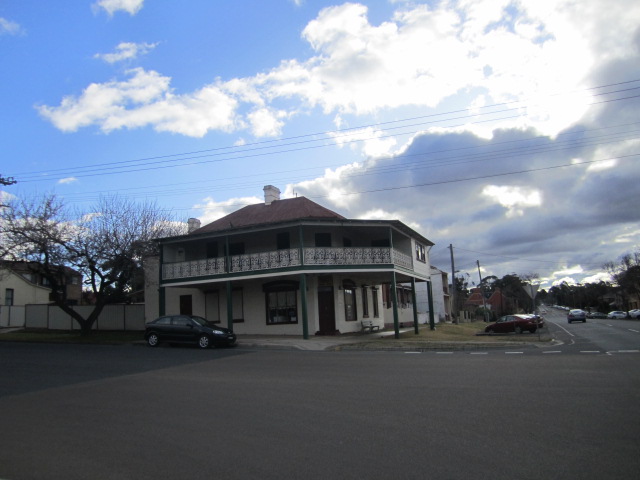


So why did we suddenly abandon all standards and decide to build ourselves dreary things like these instead:


Tuesday, 16 August 2011
Never Go Back
I must be one of the few people in the world for whom Moscow is a city of romance. This is purely because I met my husband there. The place itself is not without charm, but it is a very grim variety of charm - or at least it was on the two occasions I went there, both of them during the long, grey Brezhnev years.
My husband has never had any desire to revisit the place. I, however, toy with the idea from time to time. At least I did until yesterday, when a friend, back from a visit to Warsaw and Moscow sent my husband an account of his trip.
Apparently, things have changed. I knew this, of course, but what particularly caught my eye was my husband's friend's comment that in Moscow 'the atmosphere of mutual hostility between consumers and shop employees seems to have largely disappeared.'
This made me feel absurdly disappointed. Unpleasantness was part of the flavour of Moscow. Rudeness was woven into the traveller's experience of the place. It wasn't surliness alone that made things feel exotic, but it was certainly an important ingredient in the mix.
If sullen, unsmiling so-called 'service' has vanished, replaced by the 'have a nice day' cheerfulness of home, then what is the point of traipsing back again? Sure, I hated Moscow when I went there earlier, but I would hate it even more now for not being the Moscow that I used to hate.
My husband has never had any desire to revisit the place. I, however, toy with the idea from time to time. At least I did until yesterday, when a friend, back from a visit to Warsaw and Moscow sent my husband an account of his trip.
Apparently, things have changed. I knew this, of course, but what particularly caught my eye was my husband's friend's comment that in Moscow 'the atmosphere of mutual hostility between consumers and shop employees seems to have largely disappeared.'
This made me feel absurdly disappointed. Unpleasantness was part of the flavour of Moscow. Rudeness was woven into the traveller's experience of the place. It wasn't surliness alone that made things feel exotic, but it was certainly an important ingredient in the mix.
If sullen, unsmiling so-called 'service' has vanished, replaced by the 'have a nice day' cheerfulness of home, then what is the point of traipsing back again? Sure, I hated Moscow when I went there earlier, but I would hate it even more now for not being the Moscow that I used to hate.
Monday, 15 August 2011
Loaves and Fishes for Me Please
As you leave the main body of Seville Cathedral and enter the side chamber where they now keep the silver and papal bling, you pass under an archway whose interior surface is covered with plaster reliefs. Looking at them more closely, I couldn't help wondering if the room the archway led to was originally used for a purpose other than display. Could it once have been a canteen for monks or worshippers and were those decorations the world's first ever illustrated menu:

Saturday, 13 August 2011
Horribly True
After reading In-laws and Outlaws, I looked up its author on Google and discovered various lists of his aphorisms. The one that struck me most forcefully - and that seems most pertinent to an understanding of recent events in London - is this one:
'The chief product of an automated society is a widespread and deepening sense of boredom.'
'The chief product of an automated society is a widespread and deepening sense of boredom.'
Friday, 12 August 2011
Battered Penguins X

The book, it turns out, is intended as a guide to success, aimed not at the energetic, intelligent, painstaking and pleasant, who will not need it, but at those who are 'below average - stupid, idle, careless, uncooperative, ill-tempered and disloyal'. Northcote-Parkinson feels such people needs his advice for, 'after all, this is a democratic country. Why shouldn't [they] succeed like anyone else?' He also defines success in the 'material sense' and points out that 'all will end, if successful, at a desk.'
Northcote-Parkinson goes on to explain that he is assuming that his reader has already got as far as cheating in Intelligence Tests and dodging personality screening - 'all this is chilidishly easy, the tests being designed merely to exclude (and very rightly) those to whom even cheating is too much bother' - and, having got himself 'a desk of sorts', is now wondering what to do next.
The first thing Northcote-Parkinson recommends is that the reader provide himself with 'Background'. The book is clearly aimed at the English market, so his prescription is as follows:
'For the first five years of your career you should spend the annual two-week holiday as follows: the first two near Eton, Winchester, or Rugby, the last three near Oxford, Cambridge, or University College ...Take with you, on one or two of the visits, some ambitious friend who has changed his name to Astor or Cholmondeley. Then begin, very lightly, to touch in the background with snapshot and indirect reference...On no account must you tell a lie. Nothing could be more wicked, or indeed more foolish. You should aim rather to build up atmosphere. When you say, "I did no rowing at Cambridge - I dare say I worked too hard" you will be telling the truth. When you refer to your friend, Archie Cholmondeley, and add, "We were at Eton together," you will be strictly accurate.'
If this is not absurd enough, he then suggests that you should go travelling to a remote place and write some kind of a book about your experiences, in order to give yourself added colour:
'Make an early decision as to whether there should or should not be tigers. As you are not a big-game hunter, you can well do without them. If, however, you think one essential, a good plan is to ... take a stuffed tiger's paw with [you]... for making tracks in the mud. This is a perfectly sound scheme, for only a trained zoologist will notice that your tracks are all made with the near hind paw: and no zoologist is likely to read your sort of book.'
Your linguistic ability, it is pointed out, should be attested to by 'a series of modest disclaimers ..."Any smattering I may have of Urdu was severely tested that day"'. You should also follow up 'a frank confession of ignorance by a scene from which your conversational fluency can be readily inferred.' More importantly, Northcote-Parkinson advises, 'Always bear your scholarship lightly, as a foible, of which you are half-ashamed'.
The earnest tone combined with the dottiness of the advice continues into the next section where Northcote-Parkinson reveals that, while having established a background for yourself will give you a considerable advantage, it is not enough to guarantee success:
'Your main difficulty', he points out, 'as you will by now have discovered, is not in forming the right judgement but in reaching a first position in which judgement is required.'
To resolve this, apparently, it is necessary to marry well. 'The fact for a rising man to grasp is that your father is given you and there is little you can do about it; but your father-in-law you can choose.' Northcote-Parkinson then lays out a ridiculous plan of action, which begins with the solemn drawing up of a list of possible fathers-in-law, bearing in mind that it 'must be confined to men who have daughters.'
The next important part of the strategy is subtlety. 'To charge up to the Earl and say "I want to marry one of your daughters" would be a tactical error', Northcote-Parkinson confides. Instead, you must do complex research into the family you decide to target, compiling a card index of near relatives, based on what you find out - 'their names, whereabouts; their special interests; and whether they are on speaking terms with the family concerned.'
He provides a sample of the kind of thing he has in mind:
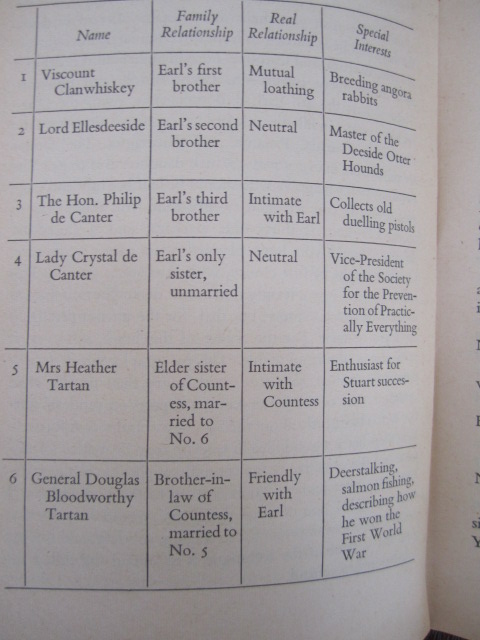

and goes on to explain how to use it. 'Let us suppose', he writes, ''that it is the Earl you chiefly have to conciliate. The possiblities between which you have to choose appear to be these:
1. You can write an article to prove that the breeding of angora rabbits is a vice beside which the crimes of Nero fade into insignificance.
2. You can find an unusual pair of duelling pistols and ask No. 3 to identify them.
3. You can join the Jacobite Society and ingratiate yourself with No. 5
4. You can write to No. 6 and ask his opinion as to how the First World War was won.
5. You can allege that No. 7 has never been to Tibet, or
6. You can lecture to the College for Young Ladies of which No. 8 is the Headmistress.
There is nothing to prevent you trying all these approaches simultaneously. The artistic touch would be to lecture to the Young Ladies' College on Old Firearms, ensuring that Nos 3,5,6 and 7 are present. Use the rare duelling pistols to illustrate the lecture, with an angora rabbit as the target. Kill the rabbit with the first shot and wound Aunt Ailsa accidentally with the second. End the lecture by pointing out that the Stuart kings never bred angora rabbits and that World War I was nearly lost by the kind of people who do, but won at the eleventh hour by people with experience of deerstalking. If you are not invited to Clanwhiskey Castle after that, it will be clear to you that the family is not worth bothering about.'
The book continues in a similar vein, although, sadly, it becomes rather wiser and less silly as it approaches the more familiar world of committees and office life in later chapters. All the same, Northcote-Parkinson is a witty companion throughout, and the illustrations by Osbert Lancaster only add to the book's humour.
Thursday, 11 August 2011
Words and Phrases that Surprise and Charm
During the usual disproportionately lengthy sports segment at the end of the news, a burly footballer/rugby/AFL player was asked to comment on his appointment as captain of his team: 'When I get home, mum'll probably hug me guts out,' he told the reporter.
Wednesday, 10 August 2011
Nuttier by the Day
Having established that MalAdjusted had gone the predictable way of a bicycle repair shop with such a silly name, I took my bike down to a street a little further away from my house where I'd noticed another repair shop had opened recently.
What I wanted was to have a flat tyre mended. When I explained this, the assistant told me I should learn to do it myself. I pointed out that I was wearing a shirt I'd made myself (at the same time hastily adjusting my scarf, so that he wouldn't see quite what a hopeless job I'd made of the collar area). I said this didn't mean that I expected everyone else to know how make their own clothes. He parried, rather cleverly, I have to admit, by saying that that was true but that he would expect people to know how to sew a button on. I left.
Luckily, just a little further down the street I found a place where they were prepared to actually do what the sign over the door said they did - repair bikes - so now I can ride about Canberra again. Unfortunately, my trips are spoiled by a new feeling of guilt about my lack of skill in the bicycle maintenance area. Do I have a moral duty to learn how to fix my bike and if so, why?
What I wanted was to have a flat tyre mended. When I explained this, the assistant told me I should learn to do it myself. I pointed out that I was wearing a shirt I'd made myself (at the same time hastily adjusting my scarf, so that he wouldn't see quite what a hopeless job I'd made of the collar area). I said this didn't mean that I expected everyone else to know how make their own clothes. He parried, rather cleverly, I have to admit, by saying that that was true but that he would expect people to know how to sew a button on. I left.
Luckily, just a little further down the street I found a place where they were prepared to actually do what the sign over the door said they did - repair bikes - so now I can ride about Canberra again. Unfortunately, my trips are spoiled by a new feeling of guilt about my lack of skill in the bicycle maintenance area. Do I have a moral duty to learn how to fix my bike and if so, why?
Tuesday, 9 August 2011
More Mad Marketing
The bicycle repair shop closest to me decided to change its name to MalAdjusted. Needless to say, it has now closed.
Monday, 8 August 2011
Department of Mad Marketing
Thinking about punnets of strawberries yesterday reminded me of the time my father and I were going to visit his sister, a woman for whom the word 'redoubtable' was invented.
Ten minutes from her house, it suddenly occurred to my father that we should not arrive empty handed. Seeing a sign by the side of the road, advertising strawberries for sale, he swerved into the lay-by where someone had set up a stall.
There was nobody there when we arrived, except a rather unkempt looking woman standing behind a makeshift counter. The only thing on the counter was a black tin cash box.
'Hello,' said my father, 'I'd like four punnets of strawberries - I need a present for my sister.'
'We've got no more strawberries,' the woman answered, 'but we've got plenty of potatoes - I could put a couple in a punnet and you could take her them instead.'
Ten minutes from her house, it suddenly occurred to my father that we should not arrive empty handed. Seeing a sign by the side of the road, advertising strawberries for sale, he swerved into the lay-by where someone had set up a stall.
There was nobody there when we arrived, except a rather unkempt looking woman standing behind a makeshift counter. The only thing on the counter was a black tin cash box.
'Hello,' said my father, 'I'd like four punnets of strawberries - I need a present for my sister.'
'We've got no more strawberries,' the woman answered, 'but we've got plenty of potatoes - I could put a couple in a punnet and you could take her them instead.'
Sunday, 7 August 2011
Policies that Might Make Me Vote for the Greens: No. 1
I might vote for the Greens if they banned the plastic boxes that tiny tomatoes, strawberries, blueberries and many other fruit and vegetables are now sold in and returned to the little wicker punnets of my youth.
Friday, 5 August 2011
Neater Abroad
In response to this, Umbagollah sent me a link to a poem by Les Murray - I was going to say a lovely poem by Les Murray but the lovely goes without saying really - that I hadn't read before. Here it is:
They've had so many jobs:
boiling African porridge. Being printed on.
Paving Paris, flying in her revolutions.
Supporting a stork's nest in Spain.
Their suits are neater abroad,
of denser drape, unnibbled:
they've left their parasites at home.
They flower out of bullets
and, without any taproot,
draw water from way deep.
When they blow over
they reveal the black sun of that trick.
Standing round among shed limbs
and loose slabbings of bark
is homeland stuff
but fire is ingrained.
They explode the mansions of Malibu
because to be eucalypts
they have to shower sometime in Hell.
Their humans, meeting them abroad,
often grab and sniff their hands.
Loveable singly or unmarshalled
they are merciless in a gang.
Eucalypts in Exile
Les Murray
They've had so many jobs:
boiling African porridge. Being printed on.
Paving Paris, flying in her revolutions.
Supporting a stork's nest in Spain.
Their suits are neater abroad,
of denser drape, unnibbled:
they've left their parasites at home.
They flower out of bullets
and, without any taproot,
draw water from way deep.
When they blow over
they reveal the black sun of that trick.
Standing round among shed limbs
and loose slabbings of bark
is homeland stuff
but fire is ingrained.
They explode the mansions of Malibu
because to be eucalypts
they have to shower sometime in Hell.
Their humans, meeting them abroad,
often grab and sniff their hands.
Loveable singly or unmarshalled
they are merciless in a gang.
Nudging Opinion
In an article on European postal services (no, really, it was actually very interesting - chiefly because it explained to me how a lot of them are being out-sourced to home-workers, who are paid badly and cannot keep up with the number of deliveries they are expected to make) in the London Review of
Books, a rising star in the Post Office in Britain is described thus:
"Michael Fehilly, Gatwick's manager, strode around in a grey pinstripe suit, brown loafers and an open-necked pink shirt."
When I read that, I immediately thought, 'Why am I being told about what he's wearing?' The information adds nothing at all to the strength of the writer's argument that the changes in 'work practices' are not entirely positive for everyone. However, it is possible these details are meant to shape my opinion about one of the people behind the changes.
Leaving aside the fact that I'm not quite sure in what way my opinion is supposed to be shaped - should I disapprove of Mr Fehilly's decision to combine a grey suit with brown shoes (and from there should I make the leap to deciding that, if he makes bad dress choices, he is therefore going to make bad business choices?); is a pink shirt some kind of obscure code for 'irredeemably naff''?; or have I got things quite wrong, (is the description of his outfit actually supposed to indicate the man's excellent taste?) - I don't like being manipulated. The article is supposed to be about the consequences of a shift in the way business is being done across Europe, rather than about a particular individual, and I want to be presented with arguments, not ad hominem attacks through the medium of clothing.
The writer's defence for including these details would probably be that he was adding colour to his story. However, I think he's just trying to colour the way I think.
Another example, taken from a recent edition of the New Yorker, illustrates this even more clearly. At the start of an article about a woman who has been diagnosed as mentally ill but challenges the diagnosis, readers are told:
"A tall, athletic fifty-one-year old, with blue eyes and a bachelor's degree in art history from the University of New Hampshire, Linda had been admitted to the hospital in late October, 2006, after having been found incompetent to stand trial for a series of offenses."
Readers have to wade through three more pages before they are allowed to discover what the offences were that the woman had committed, even though that information, it seems to me, is far more relevant to an understanding of what she is like than the fact that she has an art history degree, blue eyes and looks athletic. However, being told upfront that she flipped her car while drunk, threw a cup of urine at a corrections officer and struck someone with a broomstick would be unlikely to make us enormously sympathetic to her cause.
But those are the things she did, however blue her eyes may be. Eye colour has nothing to do with mental illness (I hope, since I also have blue eyes.) Shoe colour has nothing to do with moral strength. The things that are worth reporting are words and actions. They provide genuine insights. For instance, later in that LRB postal article, the chief executive of UK Mail, Royal Mail's competitor, comments on the pre-tax wages - 20,000 pounds per year for a 40-hour week - of a Royal Mail postman:
"'That's a lot of money in current terms,'" he says.
There is really no need to tell us anything extra about his physical features, his higher education or his clothing. We can already guess what his salary is - or at least that it is several multiples of the one he describes as 'a lot of money' - and we can be certain he would not enjoy trying to live on a postman's salary, let alone working that physically hard. Without reference to cravats or cuban-heeled Oxford brogues or subtle, but bright green, highlights, the writer has conveyed the man.
Books, a rising star in the Post Office in Britain is described thus:
"Michael Fehilly, Gatwick's manager, strode around in a grey pinstripe suit, brown loafers and an open-necked pink shirt."
When I read that, I immediately thought, 'Why am I being told about what he's wearing?' The information adds nothing at all to the strength of the writer's argument that the changes in 'work practices' are not entirely positive for everyone. However, it is possible these details are meant to shape my opinion about one of the people behind the changes.
Leaving aside the fact that I'm not quite sure in what way my opinion is supposed to be shaped - should I disapprove of Mr Fehilly's decision to combine a grey suit with brown shoes (and from there should I make the leap to deciding that, if he makes bad dress choices, he is therefore going to make bad business choices?); is a pink shirt some kind of obscure code for 'irredeemably naff''?; or have I got things quite wrong, (is the description of his outfit actually supposed to indicate the man's excellent taste?) - I don't like being manipulated. The article is supposed to be about the consequences of a shift in the way business is being done across Europe, rather than about a particular individual, and I want to be presented with arguments, not ad hominem attacks through the medium of clothing.
The writer's defence for including these details would probably be that he was adding colour to his story. However, I think he's just trying to colour the way I think.
Another example, taken from a recent edition of the New Yorker, illustrates this even more clearly. At the start of an article about a woman who has been diagnosed as mentally ill but challenges the diagnosis, readers are told:
"A tall, athletic fifty-one-year old, with blue eyes and a bachelor's degree in art history from the University of New Hampshire, Linda had been admitted to the hospital in late October, 2006, after having been found incompetent to stand trial for a series of offenses."
Readers have to wade through three more pages before they are allowed to discover what the offences were that the woman had committed, even though that information, it seems to me, is far more relevant to an understanding of what she is like than the fact that she has an art history degree, blue eyes and looks athletic. However, being told upfront that she flipped her car while drunk, threw a cup of urine at a corrections officer and struck someone with a broomstick would be unlikely to make us enormously sympathetic to her cause.
But those are the things she did, however blue her eyes may be. Eye colour has nothing to do with mental illness (I hope, since I also have blue eyes.) Shoe colour has nothing to do with moral strength. The things that are worth reporting are words and actions. They provide genuine insights. For instance, later in that LRB postal article, the chief executive of UK Mail, Royal Mail's competitor, comments on the pre-tax wages - 20,000 pounds per year for a 40-hour week - of a Royal Mail postman:
"'That's a lot of money in current terms,'" he says.
There is really no need to tell us anything extra about his physical features, his higher education or his clothing. We can already guess what his salary is - or at least that it is several multiples of the one he describes as 'a lot of money' - and we can be certain he would not enjoy trying to live on a postman's salary, let alone working that physically hard. Without reference to cravats or cuban-heeled Oxford brogues or subtle, but bright green, highlights, the writer has conveyed the man.
Thursday, 4 August 2011
Words and Phrases that Cause Me Pain
On the news yesterday, they said, 'Small business is hurting', and 'New South Wales and the ACT are hurting.' I know this is quicker than saying 'Small business is having a difficult time' and 'Things in New South Wales and the ACT are tough just now,' but sometimes making things shorter doesn't mean making things clearer, in my view. 'Hurting' in this context hurts my brain.
While on painful subjects, what did we say, before we talked about 'self-harm'?
While on painful subjects, what did we say, before we talked about 'self-harm'?
Wednesday, 3 August 2011
Gum Love
Last year I went to see an exhibition of paintings by Hans Heysen, a German who migrated to Australia in the late nineteenth century. Heysen's paintings fetch enormous prices - in fact, an old schoolfriend of mine used the proceeds from one, bequeathed to her by a godmother, to buy a dear little Victorian house in Sydney's Double Bay ( moral of the story - choose your children's godparents with care.)
All the same, Heysen's paintings have always puzzled me, because, despite their value and popularity, I have never liked them. Until I went to that exhibition last year, I could never understand why. It was only when I got the opportunity to look at lots of them, all collected together, that I at last recognised what my problem with them was.
Even though Heysen's representations of the bush - particularly his renderings of gumtrees - are very observant and superficially accurate, it seemed to me that he hadn't accepted what he saw in front of him on its own terms. While trying to produce a likeness of the landscape of Australia, he was still attempting to shape it to an idea of how he thought it ought to look, which derived from the appearance of the continent in which he'd been born. He couldn't resist peachifying the colours of Australia and bosoming out the spikiness of our trees and bushes. He couldn't help nudging the utter muddle that is a stand of gumtrees into something just a little cosier and neater than reality. He couldn't help trying to make the bush charming, just like home.
But the Australian bush is not - and never will be - charming. It is messy and untidy. It is, at first sight, predominantly grey and dusty. It is crowded with trees that spend most of their time imitating slovenly drunks at the end of an evening, dropping their bark, like discarded clothing, in dishevelled heaps about their feet:


 And it is all too easy to assume that that's all there is to it, to focus on the mess, which admittedly is worse than a teenager's bedroom, to see nothing but a blur of broken sticks and dirt, to mistake the riotous tangle of dull leaves and branches and layered bark for unattractiveness, especially when comparing it with the obvious prettiness of lush green meadows and hedgerows criss-crossing a carefully tilled valley. However, the bush, while not charming, is actually full of beguiling features; its charms are abundant but they are not always instantly noticeable. Its beauty is subtle, not cloying; it surprises you rather than shoving itself in your face.
Those trees in the pictures are actually a perfect illustration of what I mean: while the first thing to strike you about them might be the untidy heaps piled about their feet, they are also extremely lovely. If you divert your attention from the chaos at ground level and look upwards, the stretch of silken trunk that is the result of all that discarded rubbish is hard not to admire:

In this respect, the bush reminds me of those people you meet from time to time in life - well, I do, anyway - who at first appear grumpy and prickly and difficult to get to know but who on closer acquaintance (these people are usually work colleagues, I find, since, if it weren't involuntary you probably wouldn't bother to pursue their company) turn out to be hilarious, intelligent and invaluable friends. In the same way, the bush requires time and attention. Only then will it reveal itself, surprising you one morning by sending out shoots of new life from apparently dead branches:


 covering dark tough foliage with tender new growth:


producing delicate flowers in the midst of detritus and twigs:


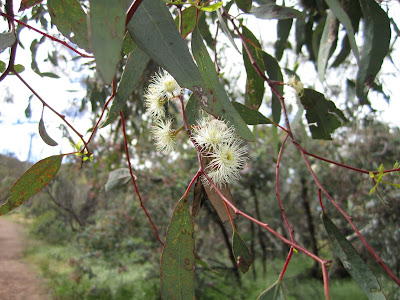


and, of course, creating delicate sprays of budding wattle, (no, I could not leave that out, despite the prominence I've given it in earlier posts - wattle is always too lovely to ignore):


All the same, Heysen's paintings have always puzzled me, because, despite their value and popularity, I have never liked them. Until I went to that exhibition last year, I could never understand why. It was only when I got the opportunity to look at lots of them, all collected together, that I at last recognised what my problem with them was.
Even though Heysen's representations of the bush - particularly his renderings of gumtrees - are very observant and superficially accurate, it seemed to me that he hadn't accepted what he saw in front of him on its own terms. While trying to produce a likeness of the landscape of Australia, he was still attempting to shape it to an idea of how he thought it ought to look, which derived from the appearance of the continent in which he'd been born. He couldn't resist peachifying the colours of Australia and bosoming out the spikiness of our trees and bushes. He couldn't help nudging the utter muddle that is a stand of gumtrees into something just a little cosier and neater than reality. He couldn't help trying to make the bush charming, just like home.
But the Australian bush is not - and never will be - charming. It is messy and untidy. It is, at first sight, predominantly grey and dusty. It is crowded with trees that spend most of their time imitating slovenly drunks at the end of an evening, dropping their bark, like discarded clothing, in dishevelled heaps about their feet:


Those trees in the pictures are actually a perfect illustration of what I mean: while the first thing to strike you about them might be the untidy heaps piled about their feet, they are also extremely lovely. If you divert your attention from the chaos at ground level and look upwards, the stretch of silken trunk that is the result of all that discarded rubbish is hard not to admire:

In this respect, the bush reminds me of those people you meet from time to time in life - well, I do, anyway - who at first appear grumpy and prickly and difficult to get to know but who on closer acquaintance (these people are usually work colleagues, I find, since, if it weren't involuntary you probably wouldn't bother to pursue their company) turn out to be hilarious, intelligent and invaluable friends. In the same way, the bush requires time and attention. Only then will it reveal itself, surprising you one morning by sending out shoots of new life from apparently dead branches:


producing delicate flowers in the midst of detritus and twigs:


and, of course, creating delicate sprays of budding wattle, (no, I could not leave that out, despite the prominence I've given it in earlier posts - wattle is always too lovely to ignore):


Subscribe to:
Posts (Atom)