Wednesday, 1 April 2026

Recent Reading - March of the Long Shadows by Norman Lewis

Moderately entertaining, well-written, faintly surreal novel set in post-war Sicily. Certain characters seemed to have appeared direct from a Wes Anderson movie, but since the book predates Wes Anderson, perhaps he has read it and drawn inspiration from it - or possibly he could make a movie based on it. 

Lewis has a strong sense of the absurd and there are a lot of laughs in this novel, if you like fairly dark humour. Examples chosen at random:

a) one character announcing "To really enjoy a war...you have to be as far from the action as possible and of course on the winning side. Given those two essentials the experience is incomparable"

b) this description: "Marinella, a small manic seaside town of a kind only to be found in Sicily, with a wild mixture of crenellations, Moorish arches, stained glass, crazy pavement and broken statuary. People went there to fornicate surreptitiously in the vicinity of a ruined temple of Venus, to gape at an angel's footprint in the rock, to cuddle the polished shaft of a prehistoric phallus and sometimes to commit suicide by sliding down an increasingly steep grassy slope which finally precipitated them into a deep sea saturated with the benign magic of coral."

c) a character described thus: "He was a tactless man who had ruined his career by criticising people it would have been safer to leave alone, including Mussolini for seducing every woman who ever came to see him, Marshall Badoglio for losing battles and the Pope for his alleged possession of a gold telephone. As a result, having once been a consultant in urinology [stet], he now presided over a unique collection of fossilized toads and several cases of pickled exhibits demonstrating the growth of the foetus in the horse."

The book, via this passage, also led me to finally understand why I could never live among high mountains:

"I had been offered a remarkable house on a cliff's edge near Ragusa. 'Buy it', the locals said, 'It's going for nothing.' I took a friend along to ask his advice. The view everyone raved about was of a rock pinnacle known as U Vicchione (the Old Man) rising a thousand feet sheer from the sea. I handed my friend a pair of 12-power binoculars at the precise moment when one of Europe's last sea eagles perched on its summit drew the wedge of its tail-feathers tight and unfolded its enormous wings, about to take off. He passed the glasses back and shook his head. 'Overpowering', he said, 'it is far too beautiful.' 'Is that possible?' 'You want to settle permanently in a place like this?' 'That was my intention.' 'After three months this view would overpower you. You'd sit with your back to it, and then you'd move into a room facing the other direction. To live in a house you don't need eagles. You need swallows under the eaves. Forget about it. This isn't for you. What's wrong with a moment of calm in one's life?'

I also liked this description of the sensation of knowing you are soon to leave a place in which you have been living - and to which you will probably never return:

"I was attacked by a feeling of impending loss. It was describable as a kind of anxiety to fill in every minute of what was left of time in Palma [the town where the novel is set], to imprint its scenes on the mind, to gather up as a matter of urgency the last of the Sicilian experiences and sensations that would soon be beyond reach. 'When the tree is gone', says their proverb, with its memory of Arabian sands, 'we appreciate its shade.' This was a preposterous island, but enslaving as well, and I had developed an addiction to its hard flavours, its theatricalities and its restlessness. Everything had to be salvaged, nothing squandered of these last hours. Running a bath I listened to the throaty outpourings of water brought from some ancient conduit, feeling its coolness flood into every corner of the room, and sniffing its odours of ferns and earth. I pushed open the window and a blade of sunlight sliced through into the room's twilight. The pigeons were clapping their wings in the courtyard, and a girl on a rooftop sang an African song ..."

Sunday, 29 March 2026

What Do We Think of This? (a New Series)


To my astonishment, this orange contraption appeared in a quiet street in Bristol the other day.

What I think about it:

Not very long ago (possibly during COVID lockdowns?) I wasn’t overjoyed when masses of under-paid men* began hurtling about the streets and pavements of European cities on bikes and scooters, carrying soft cube-shaped* boxes on their backs - but this new wheeled object is not an improvement. At least there was human interchange with the cube-people - and you could give the poor fellows a decent tip when they turned up at your door.

This machine, which presumably seeks to replace them, must have used up masses of energy in its construction (in China, I’m guessing, therefore possibly its construction was carried out by Uighur slaves). It probably also caused masses of soil and water pollution while being made - and almost certainly continues to burn up fuel of some kind in its operation as well (a lot of energy is needed for a machine to be able to think well enough to go where it’s sent, without a human to drive it). And I bet it is not free of rare earths, with all that they entail (child labour springs to mind, plus the scarcity their name implies).

The suggestion painted along the box’s metal side is that we should “just eat” and the plan is to remove obstacles to doing that. In an age of over-eating, is this not unwise? Even if it isn’t, is the pleasure of eating food delivered in plastic boxes really greater than the pleasure of food made at home, having exercised the uniquely human ability to plan and prepare a meal, (not to mention the business of shopping for the ingredients, with all the small experiences you have along the way - think Vonnegut’s post office outing).

This glorified wheelie-bin cuts out one more person-to-person interaction in daily life. Its introduction is fuelled by greed - not just the greed for food, but the greed for profit that is also behind the drive to get rid of people on tills in supermarkets, enlisting customers to do that work themselves, and the removal of staff to take your money at boomgates on European motorways, which relies on the computerised system working smoothly (you should see the chaos when it doesn’t) and the disappearance of bank branches where you can talk to a human being - and so on and so on.

People somewhere far away, whose names we may never know and whose faces will almost certainly never be revealed to us, are dedicating their energies to devising ways to make more and more money by depriving others of work and the chance to feel worthwhile and part of a community. I hate it.

What do you think?

*interestingly, there does seem to be a females-need-not-apply element to this new, (potentially fleeting) field of employment

*if we can say ‘tubular’, why can we not say ‘cubular’?


Thursday, 5 March 2026

Literary Meals: Madam, Will You Talk by Mary Stewart


Admittedly this 25p bargain might at first glance be taken for a Mills & Boon offering. However, when I saw it I remembered that my mother and her friends used to love Mary Stewart and, whatever their other faults, they weren't happy to read trash. So I bought the book, despite its lurid cover, curious to find out what it was that they had enjoyed about the author. I am so glad I did.

Madam Will You Talk? is set in an English person's dream of France, where it is extremely easy to find inexpensive, quiet and comfortable hotels, where Provencal towns are not choked with coaches full of tourists and where the kinds of restaurants Elizabeth David seemed to find waiting round every bend are indeed waiting round every bend. I had begun to think lately that David had been romanticising France in much of her writing, but Stewart describes the same world as David vividly and convincingly. By the end of the novel, my faith was restored and I believed once again that for a decade or two after the war that lovely French world did indeed exist. 

The book is a thriller but a highly literate one. In one conversation, characters casually swap lines from Macbeth; in their milieu, it seems, such things are part of the average person's normal store of knowledge. Additionally, at the start of each chapter the reader finds a quotation:  Stewart chooses to recruit for this purpose Chaucer, Spenser, Browning, Coleridge, Marvell, Blake, Lewis Carroll and Shakespeare, among others. I suspect that fragments from such authors rarely grace the pages of contemporary "chick lit". 

When I finished the book, I looked up Mary Stewart, to find out more about her. She was a vicar's daughter who seems to have been a brilliant English literature student, which explains the quotations. The poor woman had an ectopic pregnancy, which led to infertility. Whether that alone led to the writing of many novels, I don't know.

Anyway, Madam, Will You Talk?, despite a slightly unconvincing plot twist you can sense coming almost from the first page, is charming and enjoyable. It also has a scene with an hors d'oeuvre trolley in it. I have never forgotten the hors d'oeuvre trolley in a station hotel in Scotland my father took us to one evening while we waited for a train to travel further north. It was as delightful as Stewart's and, like the setting of her book, it belonged to what was very shortly to become a lost world:

"Presently at my elbow I heard the chink of silver, and opened my eyes to see the big glittering trolley of hors d'oeuvre, with its hovering attendant...The man served me from the tray. I remember still those exquisite fluted silver dishes, each with its load of dainty colours...there were anchovies and tiny gleaming silver fish in red sauce, and savoury butter in curled strips of fresh lettuce, there were caviare and tomato and olives green and black, and small golden-pink mushrooms and cresses and beans. The waiter heaped my plate and filed another glass with white wine. I drank half a glassful without a word, and began to eat...The waiters hovered beside us, the courses came, delicious and appetising, and the empty plates vanished as if by magic. I remember red mullet, done somehow with lemons, and a succulent golden-brown fowl bursting with truffles and flanked by tiny peas, then a froth of ice and whipped cream dashed with kirsch, and the fine smooth caress of the wine through it all. Then, finally, apricots and big black grapes, and coffee...and...liqueur brandy...swimming in its own fragrance in the enormous iridescent glasses. For a moment I watched it idly, enjoying its rich smooth gleam."

Madam, Will You Talk?, which was Mary Stewart's first novel was published just after the end of rationing in Britain, which, given the long time between manuscript completion and publication, makes me wonder whether Stewart wrote it hungrily, in the midst of Britain's austere rules. 

Monday, 2 March 2026

Recent Reading - The Mushroom Tapes: Conversations on a Triple Murder Trial

The Mushroom Tapes is a book made up of transcripts of conversations between three writers about the trial of Erin Patterson in the Australian state of Victoria for the murder by poisoning of several of her husband’s relatives - on 29 July, 2023, she had them round for lunch and gave them a dish called beef Wellington, having, almost certainly intentionally, used death-cap mushrooms in the dish’s preparation.

The transcripts are linked by interconnecting segments written by an unidentified narrator who describes things like the courtroom and its protagonists, the view through the car window en route to the small town where the trial takes place and other extraneous details. Perhaps all of the three collaborators wrote these bits, perhaps just one of them, perhaps someone in the publishing house - either way, I felt that this element of the book’s structure did not quite work.

The three writers involved in the project are Helen Garner, Chloe Hooper and Sarah Krasnostein. The last on that list I had not heard of before. I have read a couple of books by Chloe Hooper, but largely forgotten them, and I have read many of Helen Garner’s books, including Joe Cinque’s Consolation, her account of the trial of Anu Singh for the killing in Canberra of her boyfriend Joe Cinque, and This House of Grief, her account of another Victorian murder trial, this time of a man called Robert Farquharson, who, after being discarded by his upwardly mobile wife, seems to have deliberately driven his car into deep water with his children inside it, making an escape, but leaving them to drown.

Those books by Helen Garner are very disturbing, but each achieves something that takes it out of the realm of voyeurism: Joe Cinque’s Consolation delivers a kind of justice for Anu Singh’s victim, Joe Cinque, and his family, particularly his mother, providing them with the dignity of being seen and recognised as victims and portraying Singh, who was convicted only of manslaughter, (mental health, innit), with a clarity that exposes the strong possibility that Joe Cinque did not get true justice from the legal system; in the case of Farquharson, Garner’s account goes a long way toward unlocking the mystery of how a man would reach a point where he thought drowning his children was a solution to anything - it provides understanding for the reader, transforming the alleged perpetrator from a demon into the lost, confused human that he almost certainly is.

This collaborative effort, by contrast, provides very little insight into anything except the curiosity of the three writers, and it therefore struck me as less successful, and possibly not really defensible. The book is dealing with reality, but it is unmethodical, impressionistic and for the most part little better than gossip. I felt grubby by the time I finished reading it.

Perhaps it was the book’s collaborative nature that was the problem - reading transcripts of the obsessive chats of three people about a senseless murder, I kept thinking of Gogglebox, with Sarah and Chloe and Helen as a posse of Goggleboxers on a sofa, lapping up the latest show, while readers look on. At one point Chloe Hooper herself says, “This trial is being used for public entertainment. I feel squeamish about joining the pile-on”, but of course in the end she overcomes her scruples. And, to be fair, I suspect that, if you were in Australia during the trial, unless you made a very deliberate decision to turn away and not be drawn into seeing the trial as a spectacle, it would have been all but impossible not to be swept along on a wave of ghoulish voyeurism.

Not that the authors set out deliberately to be ghoulish: indeed, they claim, in the curious third person plural narratorial voice that comes and goes during the book, that they only half want to write about the subject at all: “None of us wants to write about this. And none of us wants not to write about it.” Whatever the truth of that, in the end they cannot resist. And, having given in to the urge to write about the murder, they then publish what they have written - which means they finish up cashing in.

Of course, what I imagine they hoped to do - what anyone who looks at the case for half a moment would like to do - was to understand Erin Patterson and what might have motivated her to kill several members of her husband’s family. In this pursuit, each of the three writers is from time to time perceptive, particularly in highlighting the very contemporary way in which Patterson led her life: she had few in-person interactions, her real-life community appears to have been replaced by online ‘friendships’ with people most of whom she had never met face-to-face. As Krasnostein observes: “Her life was online. It was a fantasy life”.

One aspect of the case that the trio do not examine closely, (possibly they are not equipped to), is the role Christianity plays within it. The victims of Patterson’s murder were all devout Christians - unusually devout within the context of Australia, which is increasingly un-Christian. Patterson toyed with her victims’ religion, at one point she even claimed to have had some kind of epiphany, but in the end she drifted away from the church. Those she killed were kind to her. They prayed for her and urged her to pray when she was in difficulty. This is all mentioned in The Mushroom Tapes, but barely discussed.

It is true that on one occasion Garner does raise the question of evil - “I don’t really believe in the devil, but I do believe that people become possessed by evil”, she says, wondering whether this is what happened to Patterson: “There’s this great wretched darkness that she seems to reveal”, she muses, adding, “I have a horrible sense of her as a kind of black hole, a vortex” - but the book, being a twenty-first century book, published in Australia, does not pursue the question of evil much further than that. Indeed, Hooper at one point swaps out the word “evil” in Hannah Arendt’s banality observation and replaces it with “sociopathy”.

This is frustrating as I suspect that Erin Patterson’s crimes did arise from evil. Consequently, the nature of evil is the thing that needs looking at in the aftermath of her crimes. But instead the writers deflect, musing about whether fungi are the secret rulers of the world, talking about their dreams, wondering about the advantages and disadvantages of reporting the case as women, complaining about being old and feeling invisible, asking each other questions about the experience of reporting itself - what it was like to be in the media scrum after the verdict, for example - and ending up with a muddled sense of sympathy for the murderer, because the courtroom has, they feel, at times had the aspect of a “witch-trial”. Garner finishes by objecting to some of the photographs released of Patterson, because they are unflattering, while Chloe Hooper describes the decision by members of the families of the victims not to turn up for the verdict as “a power move”, which I think suggests a deep misunderstanding of their actions - and emotions.

The book is very readable, but it does not provide the reader with any greater understanding of why on earth this horrible event took place. Therefore it ends up being an entertainment and nothing more. Creating from an infinitely sad event something that is simply an entertainment does seem to me to be morally questionable. I realise what I am saying is that if this book were morally instructive I would find it less disturbing - and that may be for many a preposterous, old-fashioned proposition. But as the book, in the final analysis, is trivial and lacks any moral purpose, I do question its existence, and feel the time I spent reading it may have been wasted.

———

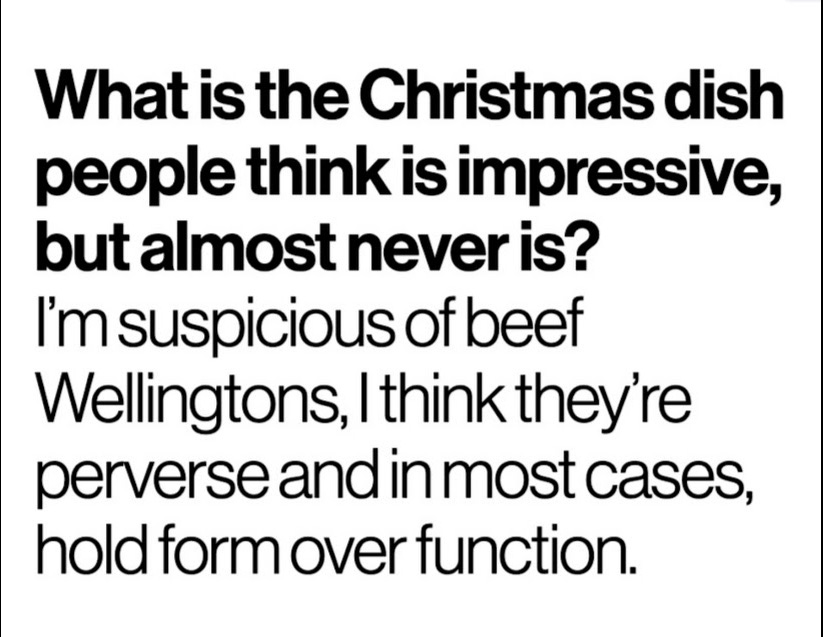
On a lighter note, (if dark humour can be light), reading an article about a young chef this morning, I came across this advice about beef Wellington, and thought, “If only Erin Patterson’s guests had read this before they sat down at her table”:

Thursday, 26 February 2026

Not My King

There is an alternate world where we would have King Edward on the throne of England: it is the world where any divorced member of the British royal family would be barred from taking the throne. It was the world that existed at the time of the Abdication.

Why is divorce now okay for Britain's monarchs? Is it because the Church of England decided to allow divorced people to remarry in church, even if their first husband or wife was still alive? No one mentioned at the time that this meant the monarchy was suddenly free of ancient obligations.

It seems so odd that Edward VIII had to abdicate to marry a divorced woman and yet now we have a monarch who has himself chosen to divorce and who has gone on to marry someone else who has also ended her marriage through divorce.

Who among the monarch's subjects was consulted about what is a very radical change in the way that things are done? 

At its best, a constitutional monarchy can create a rather lovely illusion, provided all those within the gilded cage stick to majestic rules, behaving well (including not divorcing) and never sharing their views (about anything). The goal is to set an example of serene dignity and relatively selfless fortitude, to create a dream of an ideal family. The current Danish Queen Mary is marvellous at sustaining the illusion - and Catherine Middleton, although sometimes a bit sugary, understands the basic principles.

The British monarchy is perpetuated only with the consent of the monarch’s subjects - and the change with regard to divorce was never requested nor consented to, merely imposed. Now we are saddled with a right Charlie, who will be followed by a tiresome climate zealot.

The only undivorced child of Queen Elizabeth II, meanwhile, seems ideally suited to be King - Edward appears to be very dutiful, entirely without opinions and unracy in the extreme. His older brothers probably think they are cleverer than he is - and his nephew William may think he is too. Perhaps it is Edward's apparent lack of arrogance that makes him the least likely to try the public's patience. His sister also seems to have learnt how a royal figure needs to behave in recent years, but she is divorced, and tends to seem impatient - and anyway, under the old rules of succession, Edward is ahead of her

POSTSCRIPT

Well - as if on cue, an article emerges revealing that Prince Edward was once mildly racy - but only in a rather sweet way, apparently.

What a world we live in, where people happily profit from publishing private letters entrusted to them long ago by those still living. Is the word ignoble right in this context? I must look it up. Adopting Humpty Dumpty's approach - he used words to mean whatever he chose - I think it is an ignoble (meaning contemptible, low, graceless, tasteless, treacherous) thing to do.

Tuesday, 3 February 2026

Recent Reading - Crime and the Academie Francaise by Patrick Marnham (Dispatches from Paris)


Why would anyone buy a 1993 collection of columns about France? Surely it would be completely outdated? Who cares. It's by Patrick Marnham, whose writing is worth reading at all times.

This volume contains pieces by Marnham from the 1980s on criminal proceedings in France; the French Communist Party; French politics more generally, (then, as now, prominently featuring a Le Pen); French attitudes to Britain; and much else besides, including a chapter on the fascinating "Black Museum", and accounts of various peculiar French criminals (notable among them, for someone like me who finds themselves suddenly in the category of "the elderly", one Simone Weber who, on discovering an elderly and wealthy man, marries him without his consent or knowledge, substituting him at the ceremony with "another old man who was on day release from a nearby asylum", forging his will and then, it appears, poisoning him and grabbing his wealth). Above all, the section devoted to the celebrations to mark the anniversary of the French Revolution is worth the price of the book on its own.

I cannot list every single one of the many amusing and interesting things the book includes, but here is what might be called a limited taster menu:

1. Jean Paul Sartre's mother kept his hair in ringlets, dressed him in frocks and called him Poulou. This explains a lot I think, although Marnham doesn't reveal exactly how old Sartre was when he took to trousers and a more severe approach to hairstyling.

2. Between March 1980 and November 1987 an anarchist group called Action Directe terrorised France. Its bomb-maker was a man called Maxime Frérot. Action Directe was a murderous organisation but it was also at times comically incompetent. Marnham describes one of its less successful operations, a bank robbery that took place in Lyon on 12 July, 1985:

"One member of the 'commando' came down on the TGV fast train from Paris already wearing the wig he was supposed to put on for the raid. Later he produced a notice reading 'Closed for Holdup', but hung it on the back door upside down. When he got to the safe it was empty, and his false nose fell off. Outside a passing fire-engine blocked the passage of the getaway car."

Marnham also tells of another Action Directe bank break, in which "Frérot misjudged the strength of the explosives at a savings bank and blew down so much rubble that the money was buried beneath it."

3. During the 1992 campaign on the Maastricht Treaty, Mitterand announced that he must have an urgent operation. When Jean-Marie Le Pen suggested in a debate on television that the operation was not urgent but a campaigning ploy, (an accusation that Mitterand's doctors much later revealed was accurate), "it provoked a walk-out by several leading partisans of the 'Yes' vote. Led by the Socialist prime minister Laurent Fabius, they formed a dignified procession and moved towards a side door. Unfortunately this proved to be a false door which did not open. As they searched around in some confusion for a door which would let them out of the studio the raucous voice of M. Le Pen continued to bellow his bar room insults through the microphone. It was a farcical climax to the national debate, the great and the good of France, attempting a principled gesture, in fact groping around for an exit while being showered with verbal abuse by the leader of the extreme-right." And there was me believing the accepted line that French television is boring.

4. In 1987, when Jean Marie Le Pen went to Lourdes while campaigning, he was abused by a priest for profaning the Grotto. "Typically", Marnham tells us, "Le Pen enjoyed the last word. 'I am here to talk to God, not to his intermediaries', he said." (The book has a great deal on Le Pen, all of it interesting and perceptive, including the assertion that Mitterrand 'invented' Le Pen in 1983 by introducing proportional representation - read the book to get the full argumentation.)

5. "One of those who escaped the guillotine [during the Terror] was an aristocrat called M.de St-Cyr, and it would be nice to think that the story of how he did so was true. Dragged before a Revolutionary tribunal he was asked his name. 'De Saint-Cyr,' he replied. 'Nobility has been abolished', said the president. 'Well then, Saint-Cyr', he said. 'The time of the saints is passed', said the president. 'All right then, Cyr', said the aristocrat. 'We no longer use the word "sire" since the execution of the king', said his tormentor. At this point, the aristocrat lost his temper. 'Since I have no name I must be an abstraction and since there is no law allowing you to try an abstraction I must be acquitted', he shouted. The judge then said, 'Citizen Abstraction, you are acquitted but you had better choose a good Republican name in the future if you wish to escape suspicion.'"

If these examples appeal, I recommend getting hold of the book. It is packed with so many more interesting passages and hilarious anecdotes. I loved it.


Why would anyone buy a 1993 collection of columns about France? Surely it would be completely outdated? Who cares. It's by Patrick Marnham, whose writing is worth reading at all times. This volume contains pieces by Marnham from the 1980s on criminal proceedings in France, the French Communist Party, French politics more generally (then, as now, prominently featuring a Le Pen), French attitudes to Britain, and much else besides, including a chapter on the fascinating "Black Museum" as Marnham calls it, and accounts of various peculiar French criminals (notable among them for an elderly woman like me one Simone Weber who, on discovering an elderly and wealthy man, marries him without his consent, substituting him at the ceremony with "another old man who was on day release from a nearby asylum", forging his will and then, it appears, poisoning him). The section devoted to the celebrations to mark the anniversary of the revolution is worth the price of the book on its own. 

I cannot list all the many, many amusing and interesting things the book includes, but here is what might be called a limited taster menu:

1. Jean Paul Sartre's mother kept his hair in ringlets, dressed him in frocks and called him Poulou. This explains a lot I think, although Marnham doesn't reveal exactly how old Sartre was when he took to trousers and a more severe approach to hairstyling. 

2. Between March 1980 and November 1987 an anarchist group called Action Directe terrorised France. Its bombmaker was a man called Maxime Frérot. As Marnham remarks, "One quickly forgets the fear that spreads through a city during a well-organised bombing campaign." Action Directe was a murderous organisation but it was also at times comically incompetent. Marnham describes one of its less successful operations, which took place in Lyon on 12 July, 1985:

"One member of the 'commando' came down on the TGV fast train from Paris already wering the wig he was supposed to put on for the raid. Later he produced a notice reading 'Closed for Holdup', but hung it onthe back door upside down. When he got to the safe it was empty, and his false nse fell off. Outside a passing fire-engine blocked the passage of the getaway car."

He also tells of another occasion upon which "Frérot misjudged the strength of the explosives at a savings bank and blew down so much rubble that the money was buried beneath it."

3. During the 1992 campaign on the Maastricht Treaty, Mitterand announced that he must have an urgent operation. When Jean-Marie Le Pen suggested in a debate on television that the operation was not urgent but a campaigning ploy, (an accusation that Mitterand's doctors much later revealed was accurate), "it provoked a walk-out by several leading partisans of the 'Yes' vote. Led by the Socialist prime minister Laurent Fabius, they formed a dignified procession and moved towards a side door. Unfortunately this proved to be a false door which did not open. As they searched around in some confusion for a door which would let them out of the studio the raucous voice of M. Le Pen continued to bellow his bar room insults through the microphone. It was a farcical climax to the national debate, the great and the good of France, attempting a principled gesture, in fact groping around for an exist while being showered with verbal abuse by the leader of the extreme-right." And there was me believing the accepted line that French television is boring.

4. In 1987, when Jean Marie Le Pen went to Lourdes while campaigning, he was abused by a priest for profaning the Grotto. "Typically", Marnham tells us, "Le Pen enjoyed the last word. 'I am here to talk to God, not to his intermediaries', he said." (The book has a great deal on Le Pen, all of it interesting and perceptive, including the assertion that Mitterrand 'invented' Le Pen in 1983 by introducing proportional representation - read the book to get the full argumentation.)

5. "One of those who escaped the guillotine was an aristocrat called M.de St-Cyr, and it would be nice to think that the story of how he did so was true. Dragged before a Revolutionary tribunal he was asked his name. 'De Saint-Cyr,' he replied. 'Nobility has been abolished', said the president. 'Well then, Saint-Cyr', he said. 'The time of the saints is passed', said the president. 'All right then, Cyr', said the aristocrat. 'We no longer use the word "sire" since the execution of the king', said his tormentor. At this point, the aristocrat lost his temper. 'Since I have no ame I must be an abstraction and since there is no law allowing you to try an abstraction I must be acquitted', he shouted. The judge then said, 'Citizen Abstraction, you are acquitted but you had better choose a good Republican name in the future if you wish to escape suspicion.'"

If these examples amused you, I recommend you get the book. It is packed with so many more interesting passages and hilarious anecdotes. I loved it.

Monday, 2 February 2026

Recent Reading - The Favourite by Meredith Daneman


My reading is largely dictated by what I find in a bin at a local secondhand shop where there is a four-books-for-a-pound offer, (what I find that I think might be interesting I suppose I should say, for strict accuracy). "A masterful portrayal of a woman trapped in a web of self-perpetuating emotional triangles, of suicide and, most courageously, of psychic incest" is the description Faber and Faber, in its wisdom, placed on the back cover of this novel, presumably on the assumption that this was bound to entice readers to buy. 

Ugh. Luckily, I didn't read that blurb before I handed over my money. Instead, I flicked through the book's pages and saw that it is partly set in Sydney. I used to live in Sydney and love descriptions of it in fiction. Therefore, that was enough for me. 

How fortunate. The book is exceptional, brief and beautifully written - and nothing like that back cover explanation. The main character is a person whose life is overshadowed by the wounds inflicted by emotionally irresponsible, thoughtless parents. Meredith Daneman evokes beautifully what it is like to try to construct a life on foundations that are fragile, where a memory of being unconditionally loved and cared for is missing. 

If this makes the book sound precious, I promise it isn't. It is psychologically perceptive, vivid and entertaining, and I was glued. I am going to search out any other writing Daneman may have produced. On the evidence of this book, she is a superb writer.


Friday, 30 January 2026

Recent Reading: In Europe – Travels through the Twentieth Century, by Geert Mak

In 1999, Geert Mak was employed by a Dutch newspaper to crisscross Europe for a year, writing a daily piece, published each day on the right hand bottom corner of the paper’s front page. His job was to try to find out what shape the continent was in at the end of the twentieth century and search for traces left by the events of the one hundred years just past. This book is not a straightforward collection of the pieces he wrote, but rather a synthesis of what he saw, thought and learned during his twelve-month assignment, based loosely, (I think), on those original pieces.

Before he sets off, Mak prepares himself by talking to a 99-year-old Dutchman he knows who, when asked what he thinks about the almost finished century, replies:

“Ah, a century is only a mathematical construct, a human fantasy.”

Mak then begins the book proper by heading for Paris, armed with an 1896 Baedeker. He reflects on Walter Benjamin’s decision to name Paris The Capital of the Nineteenth Century, (although London was more powerful, Berlin more a centre of industry, Paris dazzled with its use of iron and glass in buildings, its artists and its beauty, Mak says). He examines the relationship Parisians have with their rural roots –

“No other metropolis is so much a city and, at the same time, so infused with the countryside as Paris. In the three-minute walk from my hotel to the nearest boulevard I pass six greengrocers, five bakeries, five butchers, three fishmongers. Shop after shop, the crates are displayed on the pavement: apples, oranges, lettuce, cabbage, leeks, radiant in the winter sun. The butcher shops are hung with sausages and hams, the fish lie in trays along the pavement, from the bakeries wafts the scent of hundreds of varieties of crisp and gleaming bread”

– and gives a fascinating account of rural life before 1900 and the changes it underwent in the early years of the new century, drawing on numerous sources. His writing is so vivid, his eye for interesting detail so good, that the reader never feels overwhelmed.

Mak continues in a similar manner for 829 unputdownable pages, travelling to London, Berlin, Vienna, Helsinki, Munich, Ypres, Verdun, Versailles, Warsaw, Moscow, Leningrad, Auschwitz, Istanbul, Vichy, Bucharest, Budapest, Prague and thirty or forty other places, bringing each one and its history vividly to life. I could quote from each chapter at length, but this post would be absurdly long. Instead, I suggest people seek out the book itself. Mak’s eye for detail is terrific, his skill at holding the reader’s interest is phenomenal, his ability to come up with surprising, little-known but illuminating facts is phenomenal.

I cannot recommend In Europe – Travels through the Twentieth Century highly enough to those who find academic history less than gripping. The book is essentially a history of Europe in the twentieth century, but there is virtually never a dull moment - while packed with facts, it is anecdotal in style, full of the voices of living - or once living - people. It is hugely entertaining, bringing the past to life in a way I have rarely encountered.

The truth is Mak’s is one of the few books that I will probably read again - can there be greater success for an author than to have a reader who feels that way?

Monday, 26 January 2026

Recent Reading - All Things Are too Small: Essays in Praise of Excess, by Becca Rothfeld

On the whole, All Things Are Too Small, a collection of essays by Becca Rothfeld is a joy to read, full of intelligence and humour. It does contain a couple of essays that are of no interest unless you have encountered either the works of Eric Rohmer or the novel Mating by Norman Rush. Additionally, there is one deeply unpersuasive and entirely unamusing essay, Only Mercy, which begins with that most unpromising of phrases "Studies show" and, among other things, goes on to label Louise Perry as a Puritan, (a disparagement in the context), instead of countering Perry's arguments. I suspect this particular essay may have been written at an agent's behest, (can we have some sex please?), or in order to gain street cred among the author's own generation, (this might also be the motivation behind the uncritical references to Marx that pop up from time to time).

But let's set these pieces aside and declare the book mainly a pleasure. The essay on Marie Kondo, after all, is such a delight. In it, Rothfeld nails the madness at the heart of the decluttering doctrine: 

"The ultimate goal is to inhabit even permanent dwellings not only as if we were about to leave but also as if we have just arrived" she says, adding, 

"We can yank ourselves out of the mess and mayhem of the past and install ourselves in eternal immediacy only if we are willing to live in rooms without any contents."

The essay entitled Ladies in Waiting is also excellent. In it Rothfeld demonstrates that in certain respects, despite the supposed march of feminism and women's rights, little has really changed when it comes to men and women and dating. She describes the pain of waiting that most women must endure if they are to successfully gain a mate - and thus go on to have children (in an age of instant gratification is a lack of training in patience behind the decline in the birth rate?) 

"The messages that I answer immediately" Rothfeld explains, "without inserting a buffer of delay calculated to give the (always erroneous) impression that I'm busy or unavailable, come from my female friends, and they often constitute an agonised refrain: How soon should I reply? Can I say something yet? Should I call? I know I shouldn't text him, but ... My advice ingrained in me by years of comparable counsel from comparably responsive female friends, is always: wait. Waiting is the rule, the convention, tacitly enforced by men who retreat from female aggression and actively perpetuated by some who self-police. This is the agreement we opt into when we receive the first day-after texts with such awed gratitude, as if we didn't deserve them."

She goes on to produce some nice aphorisms about the state of waiting:

"Waiting is the transformation of time into misery", she declares; and

"Waiting is sustained by the possibility of fulfilment that is yet to be decisively precluded." 

In her essay on meditation - Wherever You Go, You Could leave -  and the whole big business of mindfulness, Rothfeld is as acerbic and funny as she is on Kondo:

'"No matter how hard I tried" she tells the reader, "I never understood the injunction to 'practice mindfulness', as if it were piano or a dance routine. I knew, of course, what I was supposed to do, at least at the most literal level: I was supposed to sit, close my eyes, and attend to my breathing. I was not supposed to do anything else. I wasn't supposed to feel my emotions, but I wasn't supposed to think about them either. If any mental matter assailed me, I was supposed to acknowledge it and discard it. Under no circumstances was I supposed to evaluate thought or feeling as good or bad, smart or stupid, intriguing or boring. Perhaps at a more advanced stage, I would be able to circumvent the indignity of thinking and assessing altogether, but, in the interim, I was supposed to exercise something called 'non-judgmental awareness', which I would one day learn to achieve in any and all situations but which for now I could cultivate in its purest form by way of 'meditation'."

Her description of the process of trying to be mindful is hilarious:

"The voice is instructing me to 'become aware' of my breath. I was already aware of my breath, in a general way, and now I am aware in a specific way, which seems to make little difference. Up my chest rises, down it falls. Up, down, up, down, a testament to the dull cunning of the body. What am I supposed to do now that I am aware that I am breathing? I think - oops, I don't think - I am simply supposed to go on being aware of it, languishing in virtuous boredom...If the mindful person finds herself thinking, how idiotic, she should tag this interjection as an instance of Thinking and direct the beam of her attention back toward her respiration ... Cogitation is an unmitigated evil, an annoyance ... What is supposed to be so enjoyable about the breath, which is always the same slog in through the nose and out through the mouth...Only someone who longs to be no one could savour the deprivations of a decluttered mind."

In the end she gives up on the whole enterprise and decides on a different solution to anxiety - moviegoing. That would be very sensible if they were still making good movies, one could say, but of course it is still possible to see old films if you find the right cinema. 

In Other People's Loves, Rothfeld portrays brilliantly and hilariously the temptations of internet stalking:

"I first navigated to Rachel's profile knowing that she was the person for whom Adam had left me. I clicked through beaches she'd visited and lumpy cakes she'd baked, passages she'd underlined and toddlers she'd tickled. Her bookshelf jutted into the background of a few photographs, and when I zoomed in and squinted, I could make out a row of mint-coloured Penguin Classics. An earlier, non-Adam boyfriend still liked some of her photographs, which I knew because I clicked not only through her pictures, but also through the profiles of all the people who had liked them, then through their  photographs, then through the profiles of the people who had liked those, and so on, until at last I found myself hunched over my telephone at five in the morning, staring at pictures of Rachel's ex-boyfriend's third-grade teacher's tomato garden."

The essay comes with some added stuff about various arthouse movies. I don't think these add anything and I suspect they are included as proof that Rothfeld is not just funny but an intellectual heavyweight. Being funny is such a rare and sublime gift, that it seems to me Rothfeld should stop fretting about demonstrating so called intellectuality. If you can make someone laugh, why would your audience beg for parallels with Bergman and Almodovar? Tommy Cooper managed perfectly well without giving us a quick side disquisition on Dostoevsky. Sadly though, the youth of today have a solemn bent. 

To sum up, this is overall a highly engaging book, the product of a brilliant young mind. Sadly, that mind has been trained in the slightly batty contemporary world of ideas where to be truly clever there seems to be a requirement - probably a result of French influence - to be unnecessarily (tediously?) complex. Ms Rothfeld obeys the strictures of her era by heaping on top of her wittiness extra helpings of theory and demonstrations of wide-reading. Luckily, she is so genuinely gifted that she does not completely bury her humour. Despite her very best efforts, she cannot prevent herself from being most of the time very entertaining, perceptive and making her readers laugh. 

Saturday, 24 January 2026

Recent Reading: A Masculine Ending by Joan Smith


I found A Masculine Ending in the 25p box at the front of my local secondhand bookshop. I was intrigued by the fact that it was dedicated to Francis Wheen. 

The book turned out to be a murder mystery in which at first it isn't wholly clear whether a murder has been committed. The action takes place almost entirely in Paris, Oxford and London. The central character is a feminist academic who belongs to a feminist writers' collective that during the course of the novel meets twice in Paris in order to argue about whether masculine endings to plural verbs describing groups of people ought not to be abolished in the languages where masculine and feminine endings exist - and, indeed, whether all masculine endings ought to be dispensed with in those languages, (the solution of course would be for the entire world to switch to Hungarian, which is the only language I've ever come across that is utterly without gender of any kind - but I am straying from the matter of the novel in question.) 

The feminist academic - who, incidentally, does not support the masculine ending proposal - borrows a friend's apartment in Paris to stay in, while attending the first meeting of the collective. She arrives late at night and only as she is leaving the next day discovers that the second bedroom contains a corpse. For various reasons, she cannot stop to find out what has happened, and so begins a well-plotted mystery story that whizzes along nicely and works very well on its own terms - assuming those terms are to create something easy to read. 

After I finished the book, I looked up the author. When she dedicated the book to Wheen, he was her husband. On the back cover of A Masculine Ending, PD James is quoted as saying that "Joan Smith is a new and welcome addition to the Faber stable of crime writers, with a feisty and original heroine, of whom I suspect we shall hear more." Sadly, no more was heard of that heroine, so far as I can tell. Whether the silence had anything to do with the end of the author's marriage not long after the book's publication, who can say? Perhaps, without a fellow writer in the house to encourage her, Smith no longer had the impetus. It is a pity. A Masculine Ending is entertaining and well made.

CORRECTION: I have just learned that this is the first in a series of five books - so much for my silly imaginings about the author’s heartbreak. As my children often complain, I have a tendency to whip up a story where there is none.

Wednesday, 21 January 2026

Running on Fumes

In late November, we got into our car and started to drive from Hungary towards England. We spent our first night in Melk, which is a very pretty town clustered around a splendid Cathedral.


The abbey was built in the early eighteenth century.

Our second night was spent in Reitenhaslach in Bavaria, where a once thriving Cistercian monastery has now become a part of Munich University. The Cistercian hhurch remains in use and has a wonderful baroque interior:

It was created in the early eighteenth century.

Our third night was spent in Switzerland in Stein am Rhein. It is a small town with an old centre packed with half-timbered buildings, most with heavily decorated facades:


The buildings all date from medieval times.

In one of the buildings is a museum of domestic life in the 19th century, told through the stories of those who lived in the house itself. I will post about it later.

All I want to say in this post that I am concerned that we no longer seem to find it necessary to create beauty, especially beautiful buildings. What is the thing we have lost: patience? Or simply control of decisions? Is that the problem - decisions affecting locals are no longer made by locals but by people in far-off places, whose main interest in spending as little as possible and making as much profit as they can?

Is it too late for Europe? Can we find a way back to being a culture that makes the world more beautiful or are we destined to be a huge Disneyland of former loveliness, while our own civilisation is running purely on fumes?

STOP PRESS: After putting this post on the blog, I went downstairs and started going through the backlog of newspapers I've been ignoring. I came across this brilliant and apposite article. The writer begins by asserting:

"Every age has its own distinctive building type. For then19th century it was the railway station, for the 20th century it was the sky's raper. For the 21st century it looks like it'll be the data centre."

The writer goes on to point out that:

"Ancient peoples used to build temples to the gods they wanted to please and appease, to make them sacrifices and offerings. In the process they created architecture.  We are somehow going the opposite way, creating the gods that could destroy us while housing them in the most nondescript, generic buildings imaginable."

The whole article is immensely worth a read:


Friday, 16 January 2026

Recent Reading - V13 by Emmanuel Carrère

In September 2021 a trial began in Paris. It had a nine-month schedule and its purpose was to provide some kind of justice following the terrorist attacks that took place on 13 November, 2015 in Paris, in which 130 people were killed, many others maimed - and following which at least one person who survived one of the attacks has subsequently committed suicide. In the court in 2021, twenty men stood accused of greater or lesser involvement in the attacks; many of the ringleaders were absent because they had detonated explosive vests during the attacks and blown themselves up. 

The French writer and journalist Emmanuel Carrère volunteered to attend the trial for its full nine months and write a weekly column about the experience for Le Nouvel Observateur. V13 is a synthesis of those columns.

Carrère begins by explaining his reasons for taking on the task:

1. "I am interested in justice";

2. "I am interested in religions, their pathological mutations, and the question: where does this pathology begin? When it comes to God, where does the madness start? What goes on in these guys' minds?";

3. He wants to hear the survivors tell of their experiences - this will be a major part of the proceedings.

Disappointingly, but perhaps unsurprisingly, the book doesn't really provide any clear answer to the mystery of what goes on in the minds of perpetrators of terrorist acts on civilians, although Carrère's comments on the video put out by Islamic State claiming responsibility for the attacks may contain a clue: "It's pure propaganda" he says, but propaganda of a kind that "is completely unprecedented...Normally propaganda hides horror. Here it puts it on show. The Islamic State doesn't say: this is war, sadly for good to triumph we must commit terrible acts. No, it lauds itself for its sadism. It uses sadism, displays of sadism and the permission to be sadistic to recruit." Carrère also mentions regularly, in passing, the extraordinary amount of marijhuana most of the perpetrators smoked habitually; although Carrère does not make the connection explicitly, I can't help wondering whether marijhuana may not play a considerable role in warping the minds of young Islamic men, allowing them to become open to the sadism that those directing them glory in. 

As to the witnessing Carrère was hoping for, the book is full of stories, mainly of the victims and their relatives, but also of courageous people who tried to prevent the attacks (notably Sonia), of survivors and of the lawyers, particularly those who are defending the men accused of terrorism - "we obviously do not defend paedophilia or terrorism, but we are prepared to defend a paedophile or a terrorist" one tells him '. I don't always see things as Carrère does - for instance, he claims that the judge's annoyance about a three-year-old who runs around screaming the whole time her Serbian mother is giving evidence would have been replaced by compassion if the child had been the daughter of a blonde woman from Bataclan, whereas I think screaming three-year-olds are always a pain, regardless of where they come from. All the same, he recounts many moving stories and introduces the reader to some intriguing details about those involved and their preparations, not least the strange fact that the computer upon which many of the perpetrators habitually watched Islamic State's videos of beheadings and torture was also used to watch "a recording of a stage production of Cyrano de Bergerac, Robert Hossein's adaptation of Les Miserables, and above all two comedies by Sacha Guitry, Royal Affairs in Versailles and The Virtuous Scoundrel ... black-and-white films...shot in the 1950s, with dated language and crackling sound."

Carrère's interest in justice might encompass, unspoken, an obvious operational question - how were the attacks allowed to happen? He certainly provides an answer of sorts, while reporting on the evidence of Bernard Bajolet, former Director General for External Security in France. Carrère tells readers that Bajolet admits the whole thing was "a cock-up",  explaining to the court that both the French and Belgian police forces had the information they needed to prevent the attacks, having picked up "a petty jihadist named Reda Hame in August 2015 on his return from Syria [who] divulges what Abaaoud [the ringleader of the plot] is planning". Sadly, the two police forces took absolutely no notice of this information.

As to spiritual justice, while not as full of forgiveness as Georges Salines, a victim's father who has begun a friendship with the father of his child's murderer, Carrère is not as unforgiving as Antoine Leiris, whose wife was murdered at Bataclan. Personally, I do not judge Leiris - forgiveness is a matter for those who suffered because of the terrible events of that November evening and, if he is not ready to forgive, that is a matter for him. 

V13 does not provide answers to all the questions provoked by the Paris attacks, but it is still a book worth reading for anyone curious about the Islamo-terrorism that has become part of life in the west. It is full of interesting detail, not least, for me at least, an introduction to the phenomenon called taquiya. Taquiya is a word used by Muslims to describe the Islamic tactic of living and working "like submarines in a society they hate and wish to destroy." According to Carrère, Muslims use taquiya because "to fool the unbelievers, you have to blend in with them. You have to pass yourself off as a nice Muslim who's happy to pray without bothering anyone, in full respect of the social pact." This means that "a cold monster could well be hiding behind your neighbour's familiar face."

Returning to the question of justice, Carrère ultimately comes down on the side of lenience. He is glad that some of those accused of peripheral involvement are not imprisoned, even though they are not declared innocent. He is troubled by the heavy sentence given to the terrorist who did not ignite his bomb belt and therefore is the only one of the main perpetrators still alive to be punished. Carrère seems persuaded by the idea that punishing this young man so severely will send a message to those on the point of blowing themselves up that they might as well go through with the act, as society will not be lenient to them if they back off at the last moment. I think this is naive. Anyone who has got to the point of wearing an explosive vest is beyond reason, even if they do hesitate and ultimately choose not to explode their device. Even though Carrère sat through this long trial and observed the accused and heard how keen they were to damage and destroy the society around them, he still seems to me to underestimate the threat men like them pose, living in our midst. For me his book - most particularly his insight into extreme Islam's embrace of sadism - increased my already growing suspicion that turning the other cheek against Islamic terrorism might be a misunderstanding of Christ's message and the West's most dangerous mistake. 


Saturday, 10 January 2026

Recent Reading - You Are Here by David Nicholls

You Are Here is the most enjoyable of David Nicholls' books that I have read since One Day, (a book I absolutely love and hugely admire). Since reading One Day, I have also read Sweet Sorrow by the same author, which I quite liked but not enough to write anything about here (or was it laziness?) and Us, which I disliked so much that I decided not vent my spleen on the subject, as I felt it was obscurely unfair to do so.

What I found uncomfortable about Sweet Sorrow and maddening about Us was the way that Nicholls does not challenge the assumption inherent in each novel's plot line - that some people are naturally glamorous and out of reach, and those nice souls who are sparrows rather than birds of paradise ought to recognise they are too good for the likes of the glamorous and stay in their lane, worshipping from afar. Nichols doesn't seem to recognise the possibility that glamour might be worth questioning, that it might be a sign that a person has a desire to be admired and conducts themselves with that either in mind or perhaps only as a subconscious motivation. In Us, for example, the main character is so obviously worth a hundred of his wife, and yet at no point that I remember is there any faint hint that his wife is a self-satisfied idiot for despising her husband because he cannot get onboard with her appreciation of "the arts". He is supposed, apparently, to accept that the gift of appreciation she possesses sets her above him, rather than revealing her as a poseur. 

There is a touch of the same tendency in You Are Here, but it is somehow more bearable. The two main characters are slightly what the playground would term "losers", although endearing. In Nicholls-world, it is their lot to plod through life in their drab plumage and not to strive for glamour. If you accept the premise, the story is enjoyable, often amusing and from time to time touching. It certainly carries you along happily - I suppose what I am trying to say is that it is very easy to read, without ever being trashy (and in my view that is a huge achievement).

There are many amusing and touching moments in the book, and yet by the end I felt faintly melancholic. I wonder now what Nicholls's background is and whether he was brought up a Calvinist. It might explain the idea it seems to me that he always proceeds from, (whether consciously or otherwise) - the belief that individual fate is essentially preordained.