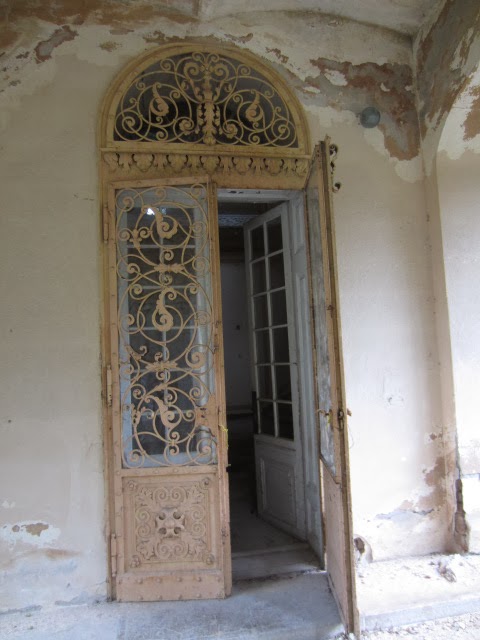
When I was looking for a place to buy in Budapest, a friend came to stay with me, and I made her join me as I went from address to address, trying to find what I wanted. Eventually I abandoned the project while she was with me, because her heart wasn't in it. Each time, I'd find something I regarded as a gem, I'd turn to her and see her unhappy expression.
She couldn't understand what the hell I was doing. All these tumbledown places looked squalid and careworn and grubby to her. To be polite she used the same phrase over and over again in response to my enthusiasm. 'It could be lovely', she would say, without any conviction. 'It could be lovely, I suppose.'
She was right, of course, although she didn't know it. Most of the places we saw were totally CBL, as we came to call it - the whole point of the project was to find something in precisely that state of possibility. For some reason, what particularly appealed to me was the thought of restoring something miserably delapidated to something like its former glory.
After my friend left, I eventually found exactly the thing I wanted. It had a hole in the ceiling, where the snow had been so heavy that the roof had crashed in, and a number of other similar bruises and blemishes, but they were all fixable, and now it's lovely - and the proportions of the rooms are enough to ensure you can never feel sad (16 foot ceilings, each room 30 square metres, no sense of being pressed into a box in that place).
Unfortunately, I only have a small amount of money and even less time, so I can't do anything about all the many, many neglected old buildings all over the various Eastern European countries that were once more or less reluctant members of the Soviet bloc. Perhaps though there are other people who don't know such places exist but just need me to tell them they are there, waiting for someone to recognise their could-be-loveliness.
I hope that's the case, because a friend has just told me that a house I visited a year or two ago in Western Romania is for sale, with all its land, its very own church, a wondrous greenhouse and the family graveyard, for a mere one hundred and fifty thousand Euros.It is in a landscape of such peace and beauty it would be impossible to be anything other than calm and happy there. As an added bonus, if you're a fan of Patrick Leigh Fermor, he visited the house when he was staying with friends nearby - he mentions it in Between the Woods and the Water.
Look at these pictures and tell me you couldn't imagine turning the place back into an enchanted Grand Meaulnes kind of place (get in touch with me if you really are interested, and I'll put you in touch with my friend, who knows how to go about putting in an offer):
Showing posts with label Patrick Leigh Fermor. Show all posts
Tuesday, 25 February 2014
Sunday, 23 February 2014
Well What Is It
The title of this post comes from the Duchess of Devonshire - not that I'm namedropping; I've never met her, (and, speaking of namedropping, this week I heard Giles Brandreth on Just a Minute on BBC Radio 4 say, 'Even the Dalai Llama has said to me that I've got to stop namedropping', which I thought was funny).
The Duchess of Devonshire used the phrase, 'Well, what is it?' in a letter to Patrick Leigh Fermor about bureaucratese, (you can read the passage here - in fact I recommend you do, because she is a very funny woman). I've borrowed it because I want to write about the NT Live film of Coriolanus, which was performed at the Donmar Warehouse in London.
Is it a film or is it a play? I don't know, so I've posted what I want to say about it on my blog about the films I see as well as the one about the plays I see. It's a film of a play so - no, I'm not going to get into one of those White Knight-Haddock's Eyes digressions.
The Duchess of Devonshire used the phrase, 'Well, what is it?' in a letter to Patrick Leigh Fermor about bureaucratese, (you can read the passage here - in fact I recommend you do, because she is a very funny woman). I've borrowed it because I want to write about the NT Live film of Coriolanus, which was performed at the Donmar Warehouse in London.
Is it a film or is it a play? I don't know, so I've posted what I want to say about it on my blog about the films I see as well as the one about the plays I see. It's a film of a play so - no, I'm not going to get into one of those White Knight-Haddock's Eyes digressions.
Tuesday, 12 March 2013
Health Warning
Before I get accused of encouraging a wave of gluttony across the many nations of the world, I should point out that eating can make you fat. To illustrate the point, let us have a look at what Patrick Leigh Fermor saw when he went to the Hofbrauhaus in Munich in the winter of 1933/34 (from the book A Time of Gifts):
"The trunks of these feasting burghers were as wide as casks. The spread of their buttocks over the oak benches was not far short of a yard.and they branched at the loins into thighs as big as the torsos of ten-year-olds and arms on the same scale strained like bolsters at the confining serge. Chin and chest formed a single column, and each close-packed nape was creased with its three deceptive smiles. Every bristle had been cropped and shaven from their knobbly scalps. Except when five o'clock veiled them with shadow, surfaces as polished as ostriches' eggs reflected the lamplight. The frizzy hair of their wives was wrenched up from scarlet necks and pinned under slides and then hatted with green Bavarian trilbys and round one pair of elaphantine shoulders a little fox stole was clasped. The youngest of this group, resembling a matinee idol under some cruel spell, was the bulkiest. Under tumbling blonde curls his china blue eyes protruded from cheeks that might have been blown up with a bicycle pump, and cherry lips laid bare the sort of teeth that make children squeal. There was nothing bleary or stunned about their eyes. The setting may have reduced their size, but it keyed their glances to a sharper focus. Hands like bundles of sausages flew nimbly, packing in fork load on fork load of ham, salami, Frankfurt, krenwurst and blutwurst and stone tankards were lifted for long swallows of liquid which sprang out again instantaneously on cheek and brow. They might have been competing with stop watches, and their voices, only partly gagged by the cheekfuls of good things they were grinding down, grew louder while their unmodulated laughter jarred the air in frequent claps. Pumpernickel and aniseed roles and bretzels breached all the slack moments but supplies always came through before a true lull threatened. Huge oval dishes, laden with schweinebraten, potatoes, sauerkraut, red cabbage and dumplings were laid in front of each diner. They were followed by colossal joints of meat – unclassifiable helpings which, when they were picked clean, shone on the scoured chargers like calves' pelvises or the bones of elephants. Waitresses with the build of weight lifters and all-in wrestlers whirled this provender along and features dripped and glittered like faces at an ogre's banquet but all too soon the table was an empty boneyard once more, sound faltered, a look of bereavement clouded those small eyes and there was a brief hint of sorrow in the air."
Monday, 12 November 2012
Books and Reading
I've just finished the new biography of Patrick Leigh Fermor by Artemis Cooper. One of the things that
Friday, 9 November 2012
Wednesday, 19 September 2012
Wednesday, 4 July 2012
Thank You Letters
We went the other day to a monastery in Romania where Patrick Leigh Fermor spent a night or two:
In a little corridor to the side of the main church there was a display of the paintings people have donated over the years to say thank you for prayers answered. This one dates from 1934, the date Leigh Fermor was at the monastery:
There are others that are older as well as some of a similar vintage and many more that are quite recent. They are touchingly naive. The recurring themes are bad driving and agricultural accidents:
This one has a strange sense of Janet and John about it:
I think this is my favourite:
In a little corridor to the side of the main church there was a display of the paintings people have donated over the years to say thank you for prayers answered. This one dates from 1934, the date Leigh Fermor was at the monastery:
There are others that are older as well as some of a similar vintage and many more that are quite recent. They are touchingly naive. The recurring themes are bad driving and agricultural accidents:
This one has a strange sense of Janet and John about it:
Subscribe to:
Posts (Atom)