Showing posts with label craftsmanship. Show all posts

Sunday, 14 July 2024

A Tale of Two Butterdishes

More than a decade ago we bought a handpainted terracotta butter dish at a market in Hungary. A few years after that something fell from a high shelf onto the dish part of it, shattering it. 

I went back to the market where we'd bought the dish, to see if I could find a pretty new one. There was nothing anywhere near as nice for sale. I pieced the broken bits of the dish together and saw that there was the name of the maker on the bottom. I looked online and discovered the maker had gone mad and decided to make things that looked as if they were part of a Disney franchise. 

I glued the dish together and we went on using it, even though it looked almost as bad as the many things in my grandmother's house that at some point had been broken and then not only glued but stapled together with exposed rivets. At least our mended butter dish didn't have visible rivets - but it was (is) still a bit of a mess, except when photographed from flattering angles.


Yesterday I decided to go to a folkloric shop I often pass, to see if I could find a replacement for our butter dish. I did - sort of. 

It is a butter dish made by the same company that made the original one. They have reverted to their earlier designs. 

This new butter dish cost a fantastic amount and, while I will use it, I will also go on using the old one until it has completely disintegrated. This is because, even in its broken state, it is so much nicer than its modern cousin. 

And the reason it is so much nicer is because someone took greater care in making the original butter dish. Someone decided not to cut corners. 

For instance, this is the handle of the lid on the old one:

And this is the handle of the lid on the new one:

At some point, someone thought: "Why bother with that ten minutes extra, painting the lines on the handle. Just leave it. It's not worth it."


The same decision was made when it came to the rest of the decoration. Several lines and quite a bit of painstaking dotted decoration have been eliminated. The new dish cost a great deal more than the old one and yet half has much effort went into it. 

For years, I've thought this article by James Meek was the best exposition of the way in which greed has made things worse in daily life and become the thing that creates change but no positive progress. But now I wonder if our two butter dishes demonstrate the story better. 

Although perhaps they are a symptom of something that may be even more dangerous for a civilisation: the waning of craftsmanship - and tangible evidence that fewer and fewer people take pleasure in taking pains.


Sunday, 13 September 2020

The Care of the Ancients

No, this is not a sermon on old people's homes and virus management, but a slight mangling of language to suggest that the people who came before us took greater care than we do in many areas of life, not least when planning what is now called "the built environment" but was then called buildings - or possibly architecture, if you wanted to be grand.

All sorts of good things flowed from their extra care in their choice of building styles - a lifting of spirits, a feeling that you, a little person on the street, and your feelings, were being taken into account and that there was a desire to please you, to brighten your life and that of your community.

Cost then was not the only consideration when planning a new school or office or hospital, whereas now my impression is that the creativity of an architect must exercise itself entirely within the parameters of cost - any ingenuity must be the result of brilliance plus cost considerations and, if brilliance is expensive, cost considerations always win out.

There is also the problem that we have not thought it important to keep the tradition of skilled craftsmanship alive. For some reason, the idea crept in at some stage that a degree in media studies gave you the right to regard yourself as wiser than a lifetime of quiet taking of pains to create beautiful objects. I have always been baffled by this.

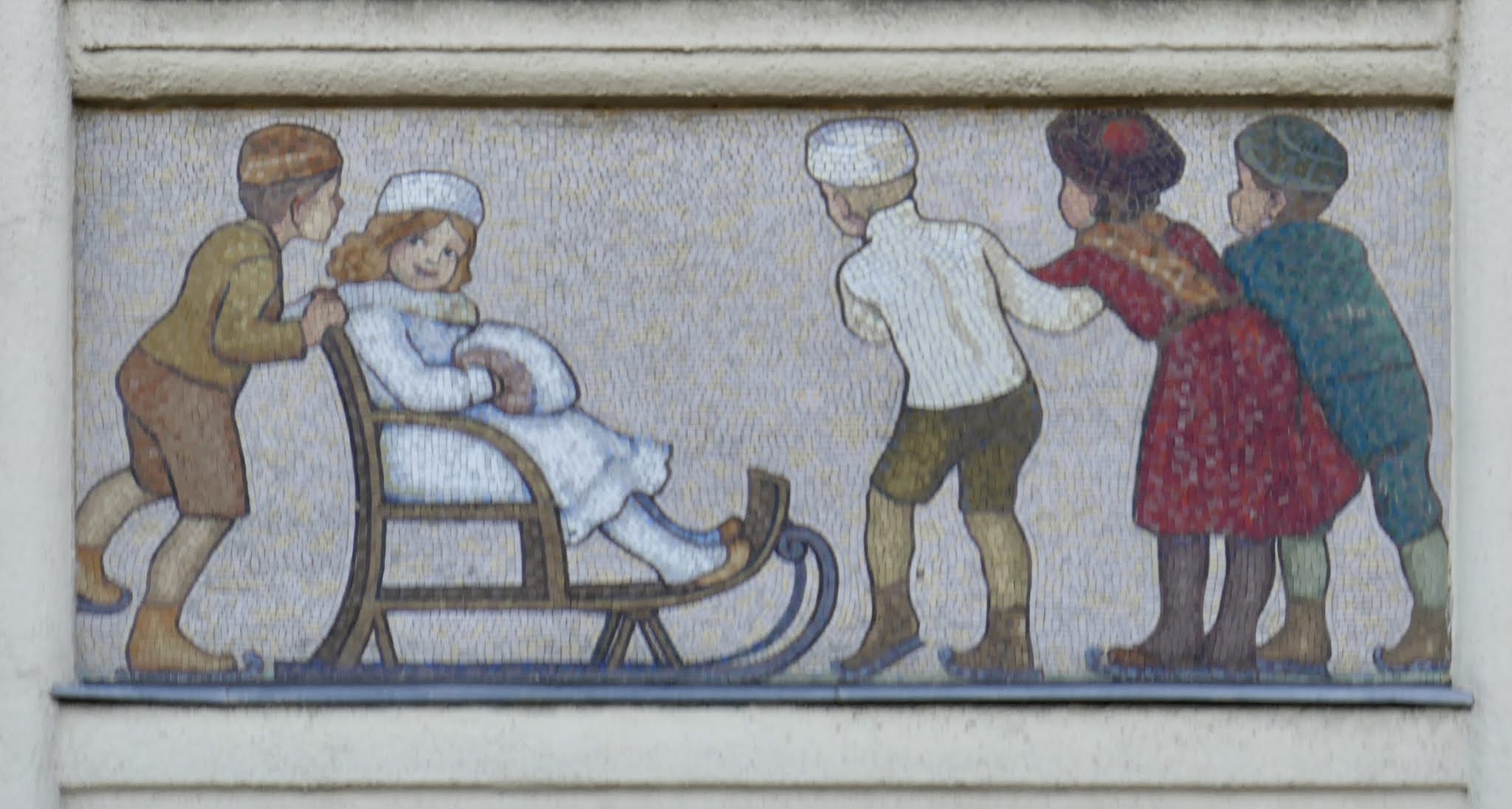
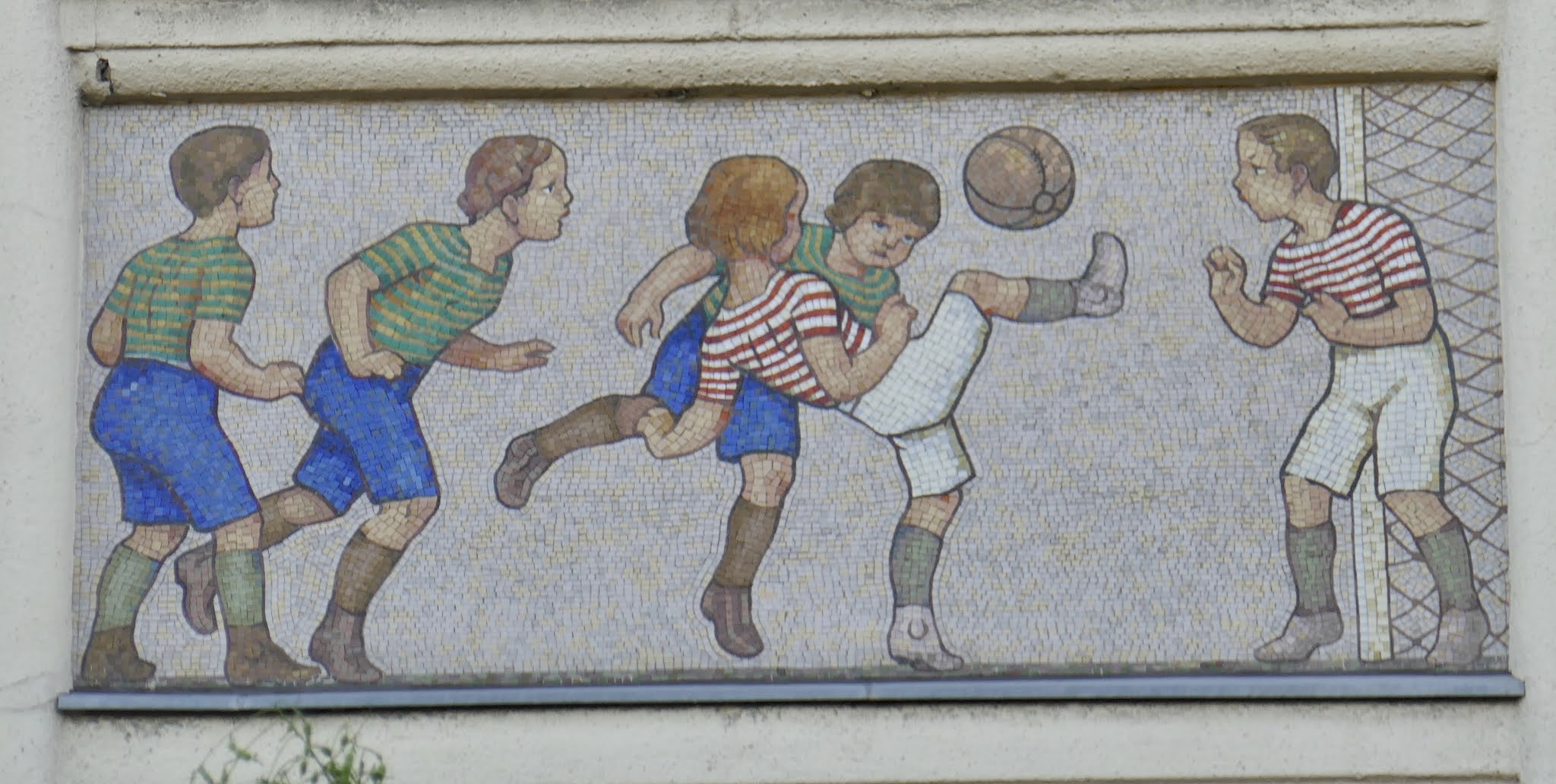
What prompted this line of thought was discovering a lovely school building on the corner of Lehel street and Dózsa György street in the thirteenth district of Budapest. Its architest was Ernö Balázs (Note No. 1) and the designer of the enchanting mosaic friezes that decorate it was Károly Kernstoch. The school started to be built in 1909 but, due to strikes, it was not opened until February 1911. It became a hospital in the first world war and got fairly battered in subsequent conflicts, but it is now fulfilling its original purpose, with a particular emphasis on singing, music and physical training. I can't believe that it doesn't have some positive effect on children to be provided with a building that has been decorated with such care:


Note No. 1 - he was also the architect of this and this and this.