Friday, 25 September 2020

All Tip and No Iceberg

 In 2013 I listened to a couple of talks given by Boris Johnson at the Melbourne Writers' Festival and came to the conclusion that he was very entertaining but lacked any substance - and, having pocketed a fee to talk about a topic he then didn't talk about, not a man of huge integrity, to boot.

Since then he has become Prime Minister of the United Kingdom and then fallen ill with the latest form of coronavirus, and recovered (as the majority of its victims do, we now know). Whether because of his basic lack of substance or as a result of his illness, he is no longer even entertaining. In fact, I am beginning to find his appearances excruciating - a politician rarely aims to evoke feelings of embarrassment and pity in the public he is addressing, but those are the emotions Boris Johnson now evokes in me.*  

I used to feel like this for the poor souls on the receiving end when Paul Keating was in the Australian parliament, skewering his opponents. Intriguingly, I realise that many of Keating's comments are applicable to Johnson today. For example, watching Johnson's performances in Question Time against the utterly uncharismatic shapeshifter, Keir Starmer, Keating's comment on an attack by John Hewson, (shadow treasurer at the time), comes instantly to mind:

"It was like being flogged with a warm lettuce."

Keating also observed of another opponent, "He's got the political morals of an alley cat", which is something many people have implied about the UK Prime Minister for a long time, (and the statement is also often made about him with the adjective "political" removed). 

Then there are these examples in the Keating speech in which he compared various of his opponents to different varieties of fireworks - at this point they strike me as uncomfortably applicable to the Johnson of today:

1. "I don't know if any of you remember the flower pot, but that was the one that always promised a dazzling performance. You'd light it up and it had multicolours, and it did a show for you, but often when you lit it up it went ffffft, you know, a bit of a spark ... there was always a bit of a show, and then there'd be a bit more, and a bit more, then, finally it fell away to nothing."

2.  "The Catherine Wheel - we used to nail them to the fence and they'd take off, spreadeagle the kids, burn the dog, run up a tree and then fizzle out going round in circles."

Some of Keating's comments on Andrew Peacock, (who was often leader of the opposition but never Prime Minister, and rumoured to be immensely vain), seem to fit Johnson equally well at present:

"All feathers and no meat", "a gutless spiv", "a soufflé" who makes speeches "with all the sincerity of a Mississippi gambler", "a squalid opportunist", a man whose party "ought to put him down like a faithful old dog because he is no use to it and of no use to the nation." 

In the end though Keating's verdict on Peter Costello, (Australia's long time Treasurer and a man who often tried feebly to be Keating, verbally, on the floor of the parliament but was always a pale imitation) most accurately clarifies the disappointing figure that Johnson as supposedly Conservative Prime Minister has turned out to be:

"All tip and no iceberg."

-———————————————

* (Johnson also is beginning to make me feel angry, as he has turned into the most frightful authoritarian nanny - vis yesterday, when announcing increased police numbers, he did not say that they would be used to help citizens who at the moment are ignored due to lack of resources when they experience theft; no, according to Johnson the new officers will be used to "enforce our rules to fight coronavirus and ensure people observe social distancing.")

Thursday, 24 September 2020

On the Other Hand

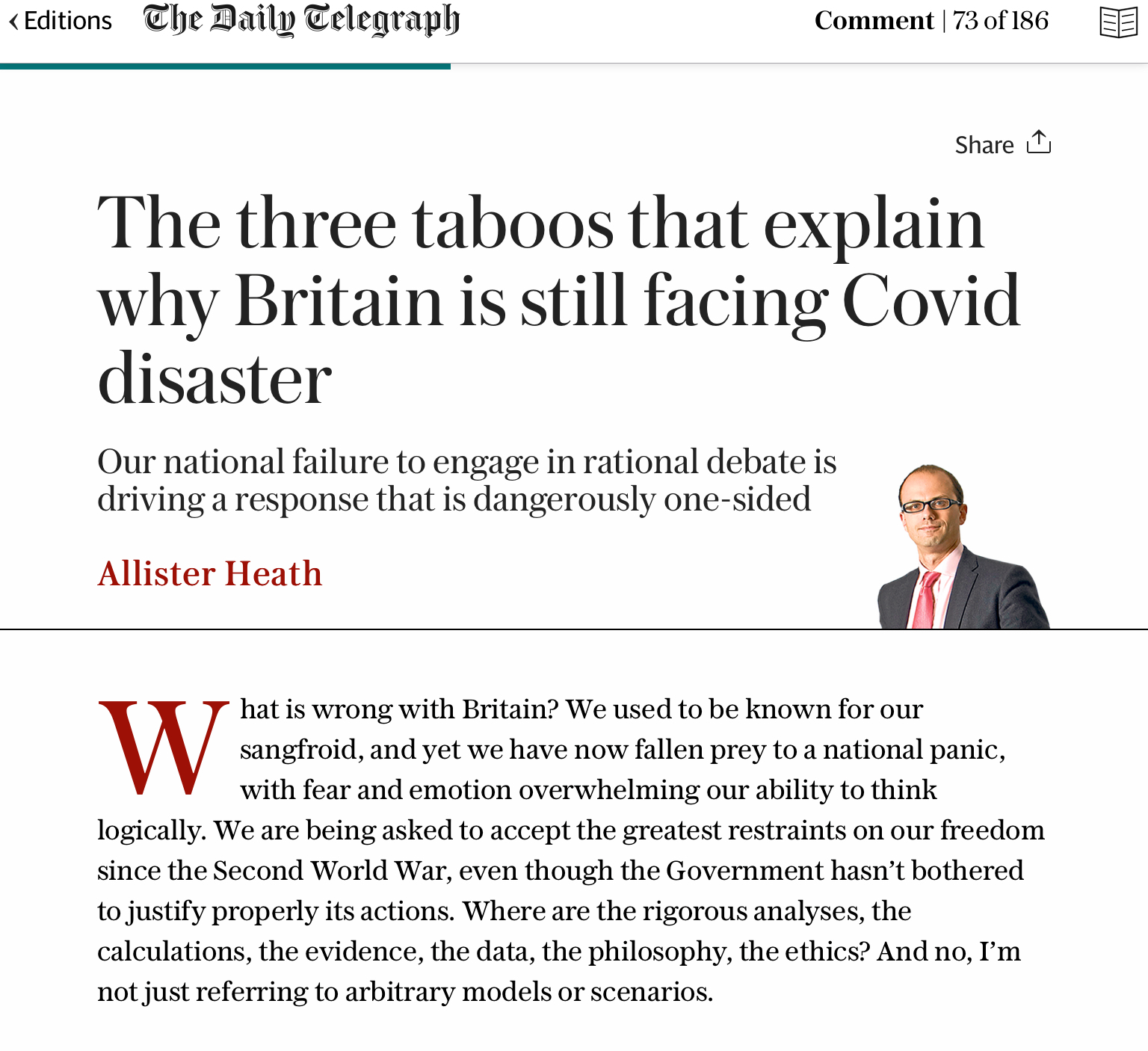
 Having been appalled by the Glenda Slagg quality of a contemporary columnist at the Times yesterday, today I am in awe of Allister Heath at the Telegraph whose column describing the flaws in UK coronavirus policy - (much of which is relevant to policy being followed in other countries as well today) - is so good I'm including it below. For those who haven't time, I've put my two favourite bits at the start:


beginning.


Wednesday, 23 September 2020

The Brightest and the Best

 I have been for ages under the impression that if I were young now and tried to get any of the fairly ordinary employment I managed to obtain in my own youth I wouldn't stand a chance. Only the brightest and the best can make it now - and they are far more numerous than they were in my day; it was only their scarcity that allowed me to stand a chance very occasionally back then. Today only the truly brilliant, the uber witty, the dazzlingly sparkling can make it. The mediocre need not bother even to apply.

But then I open the Times newspaper and come upon a columnist called Hilary Rose, spouting breathtakingly uninteresting piffle and I wonder:


Getting a column was always fiercely competitive and the best columnists were wonderfully well paid. You turned to their page with excitement, knowing you would be enlightened and entertained. Could it be that, while things have become very competitive, all the rules of the competition have changed?

Monday, 21 September 2020

Selfies in Words

For a long time, I've been vaguely aware of the proposition that a human being who is sad has to make their way through seven stages of grief. I don't know what those stages are but, as the realisation dawns that a decision like where I spend Christmas and who with is not going to be made by me but by a collection of very poor quality politicians and their equally second rate bureaucrats, (fuelled by a good dose of blind panic), I am definitely feeling more miserable than I've felt for a long time. I don't know where exactly I am on the road of seven but what worries me is that, while I have felt the most terrible sadness whenever anyone I have loved has died, that sadness has always been felt against a backdrop of basic optimism, whereas now cheerful optimism is draining away, along with hope.

To fight against a mood that might be thinking about turning into despair, I grasp at anything I see that seems faintly amusing. One of those things is the silly ways some people describe themselves on their Twitter profiles. Some people choose to present themselves rather seriously, including me, but others go for a degree of absurdity, and it is these generous souls that I like best. In case anyone else needs cheering up, I will from now on collect the ones among these that I find particularly funny and from time to time I will put them here, for those who want a moment's amusement.

I will start with a single but rather brilliant account tag. I can't even remember who it belongs to, but it is short and simple and it makes me laugh: 

"I'm slimmer than I look". 

Sunday, 20 September 2020

Don't Touch It, Don't Look At It

There is a woman who is married to a man who did something in David Cameron's government. To amuse herself, she kept a diary of all the social gatherings she and the husband enjoyed with the various politicians and hangers on of the time. Or possibly she did it to enrich herself, since she has now published the diaries.

Whatever her original motives, excerpts from the diaries are popping up in British newspapers and probably will soon reach papers in Australia, America and other parts of the world.

Having made the mistake of reading a few paragraphs of the excerpts, I feel it is my duty to tell anyone as easily nauseated as I am to try to avoid doing the same. Personally, I think any paper containing such excerpts ought to have been sold with a free sick bag as an insert.

If you find though that, for whatever reason, you cannot entirely avoid these diaries, please, I beg you, take heed of this piece of advice: if, while reading a bit of the book or even a review of it, you catch sight a few lines ahead of the word "pheromones", stop at once, go no further. There are things once read that can't be forgotten, no matter how much you wish they could be, and that passage is one of them. Using a useful but very little known rating system, the Jim Dixon Nause Index, that passage scores 999,000, at the very least.

To put my advice in a single sentence, I must turn to one of the lodestones of English literature, Stanley and Rhoda by Patricia Wells:


The title of perhaps the best Stanley and Rhoda tale, particularly its second half, tells you what I want to tell you better than I ever could:


Saturday, 19 September 2020

Clogging On

 After reading this letter in the Telegraph, I now realise that clogs (see last post) do have a significance - they are part of an ethical warrior's equipment:


Thursday, 17 September 2020

More Moaning

On a minor level, what has annoyed me this week has been something that has annoyed me often in the past - namely, the New Yorker house style when dealing with profiles of people. Their edict seems to be that they must always inform the reader about people's white belts and bootcut blue jeans and tailored, pale salmon, silk shirts and softly waving, slightly sunbleached hair. 

While I can appreciate that whoever first thought of it imagined that this would be a good way of bringing a subject to life, it has now become a really annoying verbal tic. 

This week as usual I noticed the device in an article I was reading and as usual I came to a screaming halt. I can't remember who the article was about but when his wife, (or partner?) entered stage left she was described as "a graceful blonde woman in clogs".

While the woman's graceful blondness might give me a clue to the subject of the profile's discernment and alert me to the possibility that he likes women who possess those traits (it might even be intended to imply that he is a typical bloody man, the kind who would never equip himself with any other female appendage than a blond and graceful one), why tell me about the clogs? No man has any say over his wife's footwear, unless he's a brute and beats her into wearing black patent leather high heels with ostrich feather pompoms. 

So what are the clogs there for? Are we being told that he isn't a brute, that, because he doesn't insist she wears other more glamorous shoes but is tolerant of her foibles, he must be a really good guy? Or are we being told that his taste isn't that great because, graceful and blond as she is, she wears clogs? Or that he chose her for the clogs, that he is even more limited in his choice of females than most men, insisting not only on grace and blondness, but also a fondness for the wearing of clogs?  It is so hard to deduce this, since we can't be sure whether he knew she wore clogs when he first got to know her, or whether she concealed her clog wearing from him until it was too late. Or perhaps we are being encouraged to see his tolerance of a clog wearer as a sign of weakness - surely a more discerning man would have divorced her as soon as he heard the things clonking along the corridor on her feet?

Or perhaps is it just another sign of the New Yorker being tedious.

I suppose I should just stop reading the magazine. It is certainly not of my politics, (and the very fact that I know what its politics are is a sign of how far it has fallen). All the same sometimes still it has a wonderful piece of fiction or a really fascinating account of something I didn't even know existed, and so I go on.

And anyway I have much bigger fish to fry in the moaning stakes, namely my rising frustration at the realisation that individual responsibility is being thrown out of the window because of coronavirus.

I should, by the way, make it clear that I am not part of the lobby that says the virus is not dangerous. I understand that it is extremely catching and that, if one is over 60 or a bit tubby or suffering from the famous 'underlying conditions',  there is a reasonable chance that, if caught, in a minority of cases it can result in a very nasty illness and also in death. I don't argue with the idea that it is a very unpleasant thing.

What I do argue with is government passing rules dictating my behaviour and making blanket rules to cover a range of citizens who are facing very different risks. The argument is that, if they don't do this, the young will all get together and catch it off each other, and then infect the old, and everyone will die like flies. As a result of potential fecklessness, we must all be looked after by authority. 

No. I can manage. I will assess each situation and decide whether I am prepared to take the risk it involves. And everyone else I know can do that too - and they want to. In most cases, in fact, we are probably more cautious than is strictly necessary - but by our own choice. 

We are adults, we can make up our own minds. Let us do that. Inform us, and then inform us some more, and then maybe a bit more again - but don't decide for us. 

A sense of individual responsibility is key to a properly functioning nation. Most of us are already making informed decisions about all sorts of things. No one suggests that we cannot balance the risks and make our own decisions about taking to the roads in our cars, in the full knowledge that there is always the chance that someone careless may hit us head on. Similarly, it is up to us to decide whether to drink ourselves silly, regardless of the consequences for our livers. I raise these two particular activities because the number of people who die from either liver disease or traffic accidents is almost exactly the same as the number of people who die from coronavirus, yet no one has closed down the economy and restricted our freedoms to prevent drinking or driving. 

Sadly, Australia and England, my two home countries, have gone bonkers very fast. The rules that have been brought in in each country are extraordinarily restrictive and destructive in lots of different ways - and it is far from clear that they are actually beneficial. Worst of all, what has suddenly become apparent is that there is a large section of the population in each country - possibly the majority? - who like regulations and who enjoy bossing each other about and dobbing each other in. When will it all end, I wonder, and, if it ever does, will we ever get back to true freedom?