One of my favourite things about being Catholic is the obligation to go to Mass. When at home, the obligation ensures I spend at least one part of every week engaged in prayer and worship, surrounded by fellow Christians. After a week of increasing gracelessness, my intention to be a better, kinder, more patient, less selfish person is strengthened and renewed. Although it may not be enough - and its effect certainly does not last long enough on me - each new Mass recalls me to the most important things.
Additionally, when travelling, the obligation to go to Mass provides a chance to join an unfamiliar congregation and to visit a church not just to admire its fine stonework or elegant altar but to experience it in the role for which it was built. A whole new dimension is added to what you learn about the places you find yourself in. The services you attend give you a glimpse into the lives of communities who, like you, accept the obligation to gather each Sunday to pray and worship Christ.
Sometimes - especially in Ireland, in my experience - the services are performed with more speed than I care for. Sometimes the congregation seems rather less pleased by the arrival of a stranger in its midst than Christ might have approved of. Usually though, you encounter kindness and receive the impression that among the attendees there exist genuine bonds of affection. To my great surprise, given the times we live in, I do not recall a single church where low attendance at Mass has been a feature.
I kick myself now for not having made posts on this blog before now to describe the different churches I’ve attended in various places. Each has been memorable in its own way, usually for positive reasons. Among my favourites have been: the Mass I went to in Menton, which wasn’t remarkable, apart from being my first Mass on my own, away from a parish where I knew people; a Mass in Australia in a tiny church where the priest, a former shearer, mixed a knowledge of rural matters and living on the land with great erudition, all expressed in a wonderfully strong Queensland drawl; the Mass I attended on the Isle of Skye, on a freezing rainy day in what was supposed to be high summer, in the middle of which a very young Frenchman staggered in, soaked, exhausted and burdened by a huge backpack, having been over-optimistic about the weather, while underestimating the time it would take to walk from Kyle of Lochaish to Skye, (yet still intent on fulfilling his religious obligation); and the Mass in the Yorkshire Dales, which the Church of England allowed to be held on their premises (originally built as a Catholic Church) even though the large attendance at the Catholic service and the very meagre turnout for the Church of England one that preceded it was possibly a bit dispiriting for the poor Church of England vicar.
Anyway, better late than never: here is my first post on my own Mass tourism. It concerns the Mass I attended on 21 July, 2024, in the village of Smokvica on the island of Korcula.
According to that great and admittedly not always accurate source, "the Internet":
"Smokvica is one of four (or five) older settlements on the island, where people have lived continuously since prehistoric times. It lies on the widest and most varied part of the island. It dominates over the native field and overlooks the open sea towards Lastovo. In ancient times, excellent interlocal communications were developed there, including those that went to other islands (Mljet, Lastovo). There are also the best fields on the island. Smokvica and Čara, because they are rich but small villages, were a frequent target of pirate devastation. Pirates could get rich loot without much risk. Therefore, Smokvica, like other island settlements, had its own guard and crew."

The church is called the Church of the Purification of the Virgin Mary, and it stands above a valley, (in which, I would guess from looking at them, those "best fields on the island" lie), on a dry hillside, the kind of terrain that made me think of poor Dr Michael Mosley and the place where he met his death. The church is supposedly fairly new - built in the early 20th century - but I find this puzzling as it looks and feels older. My husband is convinced it is actually a renovated version of a church from the 17th century but no source I can find absolutely confirms that, even though it makes sense. Generally, the view regarding the origins of the Church of the Purification of the Virgin Mary at Smokvica is that there were other churches nearby for hundreds of years, but not on the same site. This is the official account of the building:
"The parish church in Smokvica, the Church of the Purification of Mary (Apparition of the Lord in the Temple) is one of the largest in the diocese. It is located in the middle of the settlement and seems like a guardian mother. The construction of the church began in 1902, and the church was consecrated on October 10, 1920. It was built north of the older church of the same title, which has been "since time immemorial" and has been upgraded, extended and renovated on several occasions, especially in 1666. The new church was built with state aid and own bonds because it had plenty of land. During construction, it was covered with eternit panels, and the belfry remained unfinished. The bell tower was later completed with the help of the state in 1936, and the church got a new roof only during the renovation in 1996."
Whenever the church was first built, today it is a lovely place with a spacious, light interior that no one has spoiled in any way with fiddly modern additions.
I very much liked the wooden statues of saints:
Saint Joseph and the child Jesus
Saint Jerome, and the lion, peeping out beneath his robes (yes, he was the one who removed a thorn from a lion's paw)
Saint Rocco, I presume, as he is the patron saint of sore legs and always shows his leg in a way that, if you don't know why, I admit does seem faintly absurd - but once you do know seems endearing. He is also patron saint of dogs, falsely accused people and bachelors, and is possibly more usually called St Roch. I am very fond of him, for no particular reason.
Saint Andrew, possibly, I cannot quite make up the inscription at the bottom, but that name is mentioned, (but then Matthew and Thomas may be as well - it is difficult to tell)
I don't think I need to add a caption.
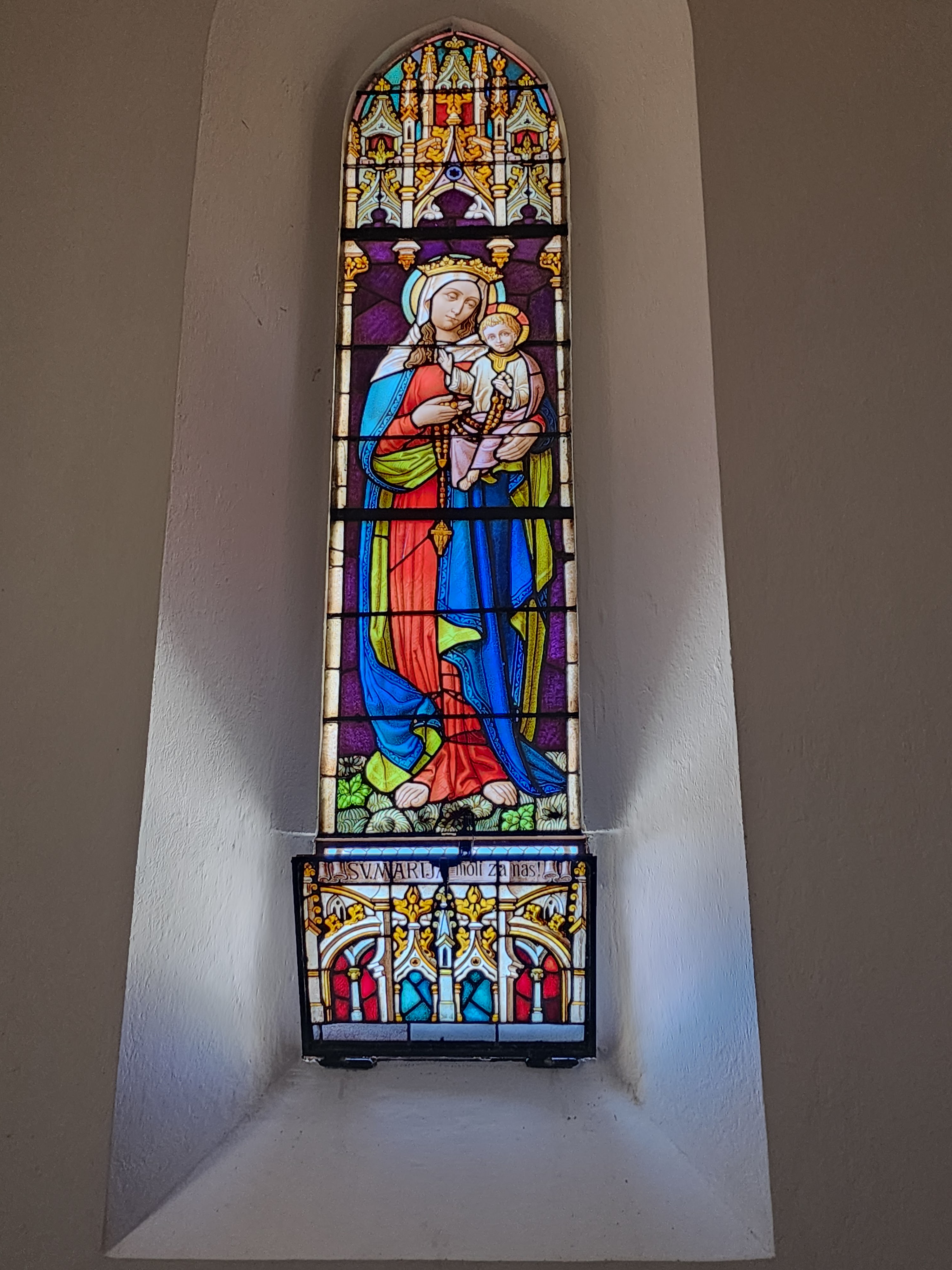
Stained glass is never easy to photograph, but there were some pretty windows portraying female saints:
The central altar had a wonderful untouched simplicity to it, unlike so many churches where new lecterns and baptismal fonts and other execrable whatnots, created in the second part of the 20th century and sent to try our patience, have been inserted. The only function of such new introductions (mercifully absent in Smokvica), other than reminding us of the wisdom of St Therese of Lisieux -
- is to bear witness to our society's current dispiriting inability to create beauty (see note and pictures below for an especially striking example of the kind of thing I mean):
The painting behind the altar I thought at first depicted the presentation of Jesus in the temple, but when I realised the name of the church I realised it was actually a painting of the presentation of the Blessed Virgin:
There is a lovely chandelier made of fine worked metal hanging halfway down the central aisle before the altar:
There are also two attractive side chapels, although I seem to have misplaced my photograph of one of them:
The service itself was enchanting, although possibly not quite as sumptuous as the one described
here. There were six local children, three girls and three boys, acting as altar servers. One of the girls read out the prayers. Two of the boys came round with velvet and gold threaded mesh collection bags on long wood-and-brass poles that reminded me of the oars used when going punting. The boys took the job immensely seriously in an adorable way and were assiduous in sticking their oar in, (to repurpose the phrase), wherever it was even faintly possible to do so. The priest was in his sixties and we tried to understand what he was saying but realised that whatever Serbo-Croat we once knew, we now know very little.
Two things were outstanding. One was the choir - strong voices, melodies with that undertow of melancholy that you hear in folk music at this end of Europe - (to hear a bit of the Smokvica choir, follow this
link.) The other was a small boy in the pew in front of us, the youngest in his family and one of the most hilarious children I have ever seen. He made me think of a classmate my husband sometimes talks about called John Spratley, who was among the naughtiest boys in the school, mainly because he dedicated his existence to making other people laugh.
Even when sent out of by the teacher John Spratley, my husband remembers, continued his activities in the entertainment department. For instance, one afternoon when they were in a classroom that had a row of what I think are called clerestory windows - windows set high up in a wall - looking out onto the corridor where Spratley had been sent, Spratley managed to find a branch from a tree with leaves at the end of it. He marched up and down outside the classroom, bobbing the leaves up so that they were visible and then making them disappear, twitching them as if they were some kind of excited creature, making them run and then suddenly stop, vanish and appear again, and generally keeping everyone amused.
The child in the pew in front of us danced, made faces, larked about, pretended his grandmother's walking stick was a gun and generally was a ray of delight for the rest of us and utterly maddening for his mother. I wouldn't have missed him for the world.
-----------------------------------------------------------------------------------------------------------------------------
Promised note about ugly church additions - the worst I have seen can be found in the Augustinerkirche in Vienna, which needed nothing added to it and already had a very beautiful altar:
Nevertheless the church authorities in Vienna decided to spend good money on a highly distracting and visually horrible new altar, lectern and candleholder:
PS - I found the second side chapel, with.a bit of added choir to boot: