Saturday, 28 December 2024

Things I Am Puzzled By - an Occasional Series

 I am increasingly puzzled by the message I'm receiving from many different organs of authority - government, media, corporations - that I should try to minimise activity that uses electricity or other sources of heat, light or locomotive power (because using those things is likely to affect our planet’s climate) and the countervailing pressure I feel I am under to use: bank cards (reliant on electricity) rather than cash to pay for things; electronic devices to interact with government and almost all organisations (more reliance on electricity) rather than talking to a person face-to-face; and AI (enormous consumer of both electricity and water) to “chat” with, for example, my bank, rather than going in and speaking to someone across a counter.


How is minimising the use of power and water compatible with the move towards making us do everything via a screen? 

Friday, 27 December 2024

Recent Reading - The Vanity Fair Diaries by Tina Brown

Until recently I haven't been much of a Kindle reader, but when travelling I have realised an e-reader is a way to indulge my greedy desire to have a vast choice of reading matter without paying extra for luggage or having to deal with heavy cases as I advance in years. And thus, while travelling recently I bought, in a fit of parsimonious jetlag, The Vanity Fair Diaries by Tina Brown for 99p. 

It was, on the face of it, an odd choice, as I don't read Vanity Fair and my vague impression of Tina Brown was the disgustingly English one that she might be a bit 'pushy' - the 'pushy' label is such a brilliant curb to hold back people who might dream of success. Where does it come from, I wonder? Why, if people have drive, is it considered rather sickening in many English circles for them to openly pursue their ambitions? 

I don't know, but one thing is certain - somehow, Tina Brown, although not from the New World, seems to have been oblivious to the notion that she should restrain her work ethic and behave with unpushy decorum. As a result, while still in her thirties she soared across the firmament of magazine publishing, a blazing comet of courage and positivity. While all the way through her diaries I kept wondering whether the goal of producing a glossy magazine was worthy of the ingenuity and constant work she lavished on the task, I nevertheless found the book absolutely riveting. Brown's diaries give a fascinating insight into a particular era and also into what the journey she took as a young English woman in a very competitive field of enterprise in one of the most competitive cities on earth, (New York), was like.

When the book begins, Tina is feeling restless. She is still only in her twenties, but she has already been editing Tatler for some time and she is eager for a greater challenge. When offered the editorship of a failing magazine called Vanity Fair, she grabs the opportunity and hurtles off to live in New York, despite the fact the prospect of the move frightens her quite a lot, particularly as she is leaving her husband behind in London.

What follows is a several stranded story. There is the tale of how she very brilliantly manages to turn Vanity Fair into an enormous financial success, which, at least in her telling, is in large part due to her intense attention to detail, her alertness to the zeitgeist and her ability to spot really good writers and manage them well - plus her obsession with cover photographs, which you slowly realise as the book goes on are among the most important factors influencing magazine sales. 

As well as this purely strategic business story, there is the equally intriguing account of how Brown learns to make her way in the higher echelons of New York society (as well as, to a lesser extent, in Hollywood circles), gaining confidence and achieving an increasing understanding of the way the people she moves amongst think. In this context, her comments about America, most especially New York, versus Great Britain are fascinating. On the one hand, she feels that "the work ethic and energy" in New York "hold you up with invisible hands and make you buoyant when you get out of bed"; on the other, she recognises "how terrifyingly tough NYC is, what an hourly battering it is to stay on top". In America, she says, ''everyone comes at you with such velocity". One reason I found these observations especially interesting is that I think they help one to understand the phenomenon that is Donald Trump. Even though he is no longer young, there is an energy to him that is purely American - and there is also a refreshing energy in the rising generation he has gathered around him. It is an energy that I think people in the old world lack, perhaps inevitably.

Above and beyond these two strands, the business one and the portrait of America, the diaries tell the story of a woman who tries to "have it all". Brown describes with considerable honesty the difficulties of loving your work and your children and trying to keep hold of both without damaging either. She more or less pulls it off, but the struggle involves enormous strain. My heart went out to her as I read. For all our notions of progress, we have not even begun to resolve the dilemma of how brilliant, driven women can have careers and provide the love and attention they feel their children need. Even using the adjective "driven" to describe Brown seems to me to risk casting her in a negative light. Instinctively, many people find ambition in women, particularly women with children, unattractive, even if they don't admit they do. While this visceral reaction might have evolutionary advantages, it makes life difficult for those who are born driven - and it also makes things difficult in the world we now live in, where, to have any chance of owning a place to live, both members of a couple need to work full-time.

In the interstices of the book's three main stories are all sorts of vignettes - Marlon Brando stringing along Brown's husband, (who wants a book out of him), with hours of time in a swimming pool and sauna late in the night, during which Brando recites speech after speech from Antony and Cleopatra entirely from memory; Mick Jagger being hilarious on his motivation for having so many girlfriends; a marvellous scene where Tina and the Kissingers lie on the Kissingers' huge orthopaedic bed watching the start of the Iraq war unfold on television; the revelation that Brown finds Joan Didion rather dull company; glimpses of Robert Hughes while he is writing that work of genius, The Fatal Shore; brushes with Anna Wintour; and on and on.

Strangely, although Brown can see the absurdity of individual situations such as that she describes with the Kissingers, she displays no trace of a larger sense of the silliness of human life. And I realised that this was a huge advantage. To never stop and think, "Is an idiotic magazine really worth draining myself for?" was essential if she was to be successful. If you are unable to take success seriously, you will get nowhere. To be a big shot you need to have faith not only in yourself but in your goal. You can never let yourself glimpse the possibility that what you are scrambling toward may not be worth it - and, luckily for her, that appears not to have been an idea that ever entered Tina Brown's mind. 

By the end of the book I admired Brown for her hard work, her drive and her genuine brilliance in the role she chose for herself. However, there is one thing I have been wondering since I finished reading her Vanity Fair diaries and that is: how is Brown today? Most of us moving into our sixties are aware of having little time left in which to achieve the goals we've always had in the back of our minds - or possibly we've come to the realisation that we won't achieve them. What is it like to have met all your targets in your forties? What do you do with the rest of your life?

Perhaps Brown will release some more diaries and then I will be able to find out.

Saturday, 23 November 2024

The Colours of Mushrooms

I like this. I don't know why. Putting it here means I can find it again easily, look at it some more & maybe eventually be able to explain why it appeals to me. Probably something to do with how it demonstrates the wonderful diversity of the world and the appeal of looking at things from an unusual perspective.

Of course, I could watch a David Attenbrough programme to be reminded of the first bit. But that would mean putting up with David Attenbrough. I may be alone in this but I don't enjoy listening to him or watching him as he travels around the world. Especially now that, having got to an age where he finds travel too exhausting, he has decided that everyone else should be told that travel is a sin.


Tuesday, 29 October 2024

On an Istanbul Ferry


I have never been to Turkey before & I was surprised by this announcement on a ferry across the Golden Horn:

"Dear passengers we would like to remind you that smoking is prohibited indoors and outdoors, in accordance with the will of Allah."

We were on our way to Chore church, which Andrew Graham-Dixon talks about very interestingly 6 minutes into the 8th video in this playlist.

Perhaps when I have time I will do a post about our outing. Chore is a wonderful place. It is now a mosque, which means in one of its rooms a fine mosaic of the Virgin and Child presides over shoeless men & no women all day long:

Actually, as I probably won't in the immediate future get around to a further post on the church, I will add a few of my photographs of its beautiful interior:


So beautiful. 


Sunday, 27 October 2024

Word of the Month

The word I have noticed I have been using more frequently than usual this month is "dispiriting". 

The continuing phenomenon of marches against Israel in Britain (especially those where police arrest anyone who holds up signs pointing out that Hamas are terrorists) is dispiriting. Leaving aside other aspects of this lunacy, if the protestors are upset about violence and civilian death, as they claim, where were they during the wars in Syria and Yemen? Can it really be pure anti-semitism that brings these crowds of vicious idiots onto the streets?

The hacking attack that has left Internet Archive's library of books inaccessible for some time now is dispiriting in the way all vandalism is.

Searching for a watch strap and discovering none of the ones I used to buy come with brass buckles any more - only buckles made of a silver grey alloy are now made - is dispiriting as I take it as a small indicator that quality is no longer easily available or much cared about. Even things considered to be of very high quality - expensive brand-name goods - do not have the quality of individual craftsmanship. Where is the joy of buying a mass produced handbag labelled Mulberry, compared to the pleasure I had when I was 21 of finding in a tiny street in Venice a bag that was beautifully made and designed by a craftsman in his little workshop? It was an object unlike anything anyone else had bought. It was also expensive but I never regretted buying it. It gave me huge pleasure as an object - and also because of the memory of saving for it, searching for it and finally discovering it. 

The Royal British Legion's decision to stick a sexual politics flag onto their poppy symbol is dispiriting because it suggests that yet another institution has lost its way:

One of the many things we remember with awe and admiration when buying a poppy is the way in which people united and worked together, regardless of their many differences, to fight for what they believed was good. Now the Royal British Legion has decided to introduce division in the name of inclusion. As Roger Scruton pointed out:

"It is not enough to allow homosexual relations between consenting adults: a campaign of 'education' must be introduced into schools and colleges to inculcate the idea that homosexuality is a normal 'option."

Schools and colleges and the Royal British Legion, it seems.

While on the subject of LGBTIQ blah, did you know that the judge who jailed a tubby elderly man for shouting some ugly stuff at a demonstration but let off people who had committed far worse crimes is Master of the Inner Temple LGBTQ+society? I find it dispiriting that the Inner Temple needs such a society and, given that society exists, I hope an Inner Temple Heterosexual Society is also thriving, just for balance.

The jailed elderly man killed himself after a few weeks in jail, by the way. It was predicted that he would have a very hard time in there with AAsiangangs who would victimise him for his anti-immigration views. May he rest in peace along with Britain's freedom(1)

Deeply dispiriting. Especially as the things I have mentioned here do not amount to a comprehensive list of the things I find dispiriting in the world just now.


(1) Regardless of anyone's views on abortion, receiving a large fine for standing silently in a street is an assault on freedom


Saturday, 19 October 2024

Random Thoughts - 19 October 2024

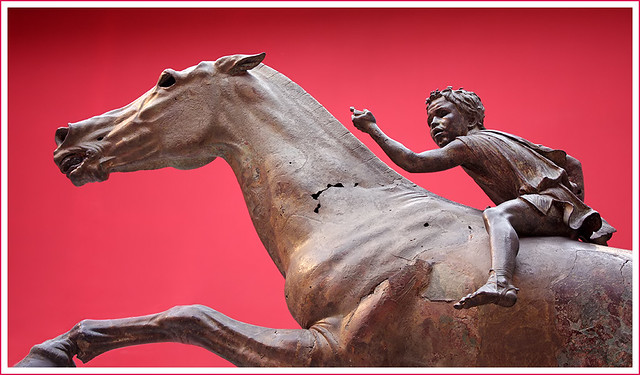
Firstly, until this morning I never knew about this entrancing sculpture The Jockey of Artemision, made in approx 140 BC and part of the collection of the National Archaeological Museum, Athens.

Secondly, what if Keir Starmer had accepted free tickets to see Cosi fan Tutte at Glyndebourne three times, rather than Taylor Swift? Would I be as shocked and disgusted? I fear I wouldn't. Incidentally, if you want an insight into Starmer, I found the episode of Giles Brandreth's Rosebud podcast series in which Brandreth interviewed Starmer very revealing. Not in a good way. 

I should point out that the Rosebud podcasts are entertaining, apart from the Starmer episode - and even that one is worth listening to, if you want to try to understand who Britain's new Prime Minister is. We particularly liked the episode involving Rob Brydon and the one devoted to John Cleese, who seems still to nurse a faint melancholy about never having been appointed a prefect. 

After listening to the Cleese episode, since we were in roughly the right part of England to do so, my husband insisted on making a detour to look at John Cleese's childhood house in Weston-super-Mare. I wouldn't bother, if you were thinking of following suit. I can send you one of the pictures my husband took and you will probably then recognise that it is not a worthwhile use of time.

Speaking of Weston-super-Mare, we ended up there again, several times, shortly after that first Cleese-inspired visit. One of our children was doing some work down by the sea and so we did some grand-parenting while she was busy. 

What is it about British seaside towns? Why do so many of them feel like sets for films about the collapse of civilisation or the world after almost everyone has left to live on Mars? 

There is a great deal of faded splendour in Weston-super-Mare, huge old buildings probably mostly Edwardian, all built with apparent confidence and energy and optimism and now unkempt, often with a superstore or carpark plonked right next to them. Somehow the attempts at grace expressed in the details of the older buildings seem almost laughable, as well as poignant, when viewed beside something made with an almost aggressive lack of regard for aesthetics.

There is a huge sandy beach at Weston-super-Mare, which ought to be attractive to visitors, surely. There are even still donkey rides available on it - when I saw that, I felt I'd gone back in time not just to my childhood but to before the war, as I don't remember donkey rides in my childhood, except in books. There is a fine municipal fountain, but only enormous seagulls frequent it. Perhaps the seagulls eat anyone who comes near, hence their size.

What has happened? Why has so much of coastal Britain - oh all right, so much of Britain generally -' descended into scruffiness? It's more than just poverty; it feels as if there's an almost universal lack of faith that things can be better. And who decided buildings should never aspire to anything beyond function?

I should point out that, once you ignore the groups of drunk men urging you to bring your grandchild over to pat their bull mastiffs who definitely won't bite, and the overweight heavily pierced young people marching about wearing various styles of cheap clothing and coloured hair intended to make them look individual but mostly managing to make them look unoriginal, you can have a nice time. We found a new cafe started up only the week before by some brave and optimistic souls, and a nice little restaurant that is part of a chain but manages to seem individual. I can't remember the name of the chain but each of its outlets is furnished with lots of old wooden tables and chairs and leather sofas, almost certainly bought in country auctions, with the walls absolutely covered with a blizzard of paintings, presumably bought in bulk from the same kinds of places. 

The cumulative effect is rather charming, even though almost all the paintings are really bad - mostly still lives and portraits, with the odd landscape mixed in. Furthermore, sometimes, among all the cheerful tat, one painting shines out at you, obviously better than the rest. In Weston-super-Mare, for example, there was a portrait that seemed to me almost good - and, as it was signed, I was able to look up the artist. His name was Victor Dolphyn and he was Belgian. On the Internet I found that this still life of his sold not too long ago. If I'd had the money and known about the auction, I would have been very happy to buy it for the 800 euros it seems to have gone for:


Sunday, 29 September 2024

Literary Meals - a Continuing Series: Point Counterpoint by Aldous Huxley

The opening chapters of Aldous Huxley's Point Counter Point take place at a splendid party. It is Huxley's curtain-up, where he can display on one stage almost his full cast of characters.

Unfortunately for them, however, one pair of characters (including Philip Quarles, arguably the novel's central character and almost certainly Huxley's alter ego) are not at the party, nor even in England when we first meet them, but somewhere in India, being entertained by a politician whose food sounds quite foul:

"Four or five untidy servants came out of the house and changed the plates. A dish of dubious rissoles made its appearance...They drank sweet champagne that was nearly as warm as tea. The rissoles were succeeded by sweetmeats - large, pale balls (much fingered, one felt sure, long and lovingly rolled between the palms) of some equivocal substance, at once slimy and gritty and tasting hauntingly through their sweetness of mutton fat."

I re-read Point Counterpoint during lockdown and was rather dismissive of it on this blog at the time. Picking it up again now, as well as rediscovering that disgusting meal, I see that it is full of brilliant insight and much prescience. 

I realise I like the character of Rampion, based on DH Lawrence, as he is made to say all sorts of amusing and not unintelligent things:

On Cubism, Rampion says:

"Nothing like modern art for sterilising the life out of things. Carbolic acid isn't it."

On scientists, Rampion says: 

"What the scientists are trying to get at is non-human truth"

On the world, Rampion says: 

"The world's an asylum of perverts."

Unfairly but not unamusingly, I'm ashamed to admit, on St Francis, Rampion says: 

"Your little stink-pot of a St Francis...a silly, vain little man trying to blow himself up into a Jesus and only succeeding in killing whatever sense or decency there was in him, only succeeding in turning himself into the nasty smelly fragments of a real human being. Going about getting thrills of excitement out of licking lepers. Ugh! ... Not curing the lepers, mind you. Just licking them For his own amusement. Not theirs. It's revolting!"

On his belief that the majority of humanity never really live fully, Rampion says: 

"Make the effort to be human!" (That's the short version)

Augustus John is also brought to life quite vividly, including his superstitious beliefs, outlined here while he is waiting for a doctor's diagnosis:

"One should never formulate one's knowledge of coming evil; for then fate would have, so to speak a model on which to shape events. There was always a kind of impossible chance that, if one didn't put one's foreboding of evil into words, the evil wouldn't happen."

The scenes between the Augustus John character and his grandchild are truly touching.

Middleton Murry, another celebrity of the time, now largely forgotten other than for being Katherine Mansfield's lover, appears in the novel as Burlap and one has the impression that Huxley disliked Middleton Murry very very much. Here he is being vicious about him and his self-centredness:

"For every Jesuit novice Loyola prescribed a course of solitary meditation on the passion of Christ; a few days of this exercise, accompanied by fasting, were generally enough to produce in the novice's mind a vivid, mystical and personal realisation of the Saviour's real existence and sufferings. Burlap employed the same process; but, instead of thinking about Jesus, or even about Susan, he thought of himself, his own agonies, his own loneliness, his own remorses. And duly, at the end of some days of incessant spiritual masturbation, he had been rewarded by a mystical realisation of his own unique and incomparable piteousness."

Here he encourages the reader to feel extremely queasy about Burlap's feelings for his girlfriend which, Huxley explains are :

"those of a child for its mother (a rather incestuous child, it is true, but how tactfully and delicately the little Oedipus!); his love was at once babysish and maternal; his passion was a kind of passive snuggling."

Ugh.

Most damning of all is Huxley's remark about the writing efforts of Middleton Murry's alter ego:

"Burlaps books were so heartfelt that they looked as though they had come from the stomach, after an emetic."

Huxley I realise now tries to mitigate the slight lifelessness that a novel of ideas can have - or apologise for it - by having his alter ego, Philip Quarles write in a notebook, which we then read as part of the novel:

"The great defect of the novel of ideas", Quarles tells his notebook - and thus, us - "is that it's a made-up affair. Necessarily; for people who can reel off neatly formulated notions aren't quite real; they're slightly monstrous. Living with monsters becomes rather tiresome in the long run."

Quarles also interestingly observes that:

"It's incomparably easier to know a lot, say, about the history of art and to have profound ideas about metaphysics and sociology than to know personally and intuitively a lot about one's fellows and to have satisfactory relations with one's friends and lovers, one's wife and children. Living's much more difficult than Sanskrit or chemistry or economics...It's much easier to be an intellectual child or lunatic or beast than a harmonious adult man. That's why (among other reasons) there's such a demand for higher education. The rush to books and universities is like the rush to the public house. People want to drown their realisation of the difficulties of living properly in this grotesque contemporary world."

and reflects with great clarity on the attraction of pageant, after seeing a Fascist march:

"How does one explain the fascination of the military spectacle?... A squad is merely ten men and emotionally neutral The heart only begins to beat at the sight of a company. The evolutions of a battalion are intoxicating. And a brigade is already an army with banners - which is the equivalent, as we know from the Song of Songs, of being in love. The thrill is proportional to the numbers. Given the fact that one is only two yards high, two feet wide, and solitary, a cathedral is necessarily more impressive than a cottage and a mile of marching men is grander than a dozen loafers at a street corner. But that's not all. A regiment's more impressive than a crowd. The army with banners is equivalent to love only when it's perfectly drilled. Stones in the form of a building are finer than stones in a heap. Drill and uniforms impose an architecture on the crowd. An army's beautiful. But that's not all; it panders to lower instincts than the aesthetic. The spectacle of human beings reduced to automatism satisfies the lust for power. Looking at mechanised slaves, one fancies oneself a master...The trumpets were prodigious - like the overture to the Last Judgement. (why should upper partials be so soul-shaking?) And when the trumpet overture was done, the thousand voices burst out with that almost supernatural sound which choral singing always has."

One character's thoughts about his first experience of sex with an actual female, seem alarmingly contemporary, given the almost universal availability of very graphic pornography via the internet and its reported warping of youthful expectation:

"Such an apocalypse, the first real woman - and at the same time, such a revolting disappointment! So flat, in a way, after the super-heated fancy and the pornographic book."

There are also some bits that are just quite funny, such as this bit of a letter from a really frightful character called Lucy, describing what is either an early piece of conceptual art or a very odd fetish:

"Suffering from a cold and intense boredom, only momentarily relieved by your letter. Paris is really terribly dreary. I have a good mind to fly away somewhere else, only I don't know where. Eileen came to see me today. She wants to leave Tim, because he will insist on her lying naked in bed whie he sets fire to newspapers over her and lets the hot ashes fall on her body. Poor Tim! It seems unkind to deprive him of his simple pleasures. But Eileen's so nervous of being grilled."

The same Lucy expounds on modernity, saying:

"Living modernly's living quickly. You can't cart a wagon-load of ideals and romanticisms about with you these days. When you travel by airplane, you must leave your heavy baggage behind. The good old-fashioned soul was all right when people lived slowly. But it's too ponderous nowadays. There's no room for it in the aeroplane...The thing is to know what you want and to be ready to pay for it."

That seems very close to how contemporary citizens are encouraged to view the world, even though it was composed back in the early part of the twentieth century. 

Meanwhile the extremely weird character called Spandrell's declaration about trees makes me laugh: 

"What I hate about trees in the summer is their beastly fat complacency. Bulging - that's what they are; like bloated great profiteers. Bulging with insolence, passive insolence."

Spandrell also makes the following intriguing and increasingly chilling statements:

"The great public has a chronic and cannibalistic appetite for personalities."

"From someone who does not appeal to one even devotion, even the flattery of admiration, are unbearable."

"There is in debauchery something so intrinsically dull, something so absolutely and hopelessly dismal...Actions which at first seem thrilling in their intrinsic wickedness become after a certain number of repetitions morally neutral. A little disgusting, perhaps, for the practice of most vices is followed by depressing physiological reactions; but no longer wicked, because so ordinary. It is difficult for a routine to seem wicked."

Philip Quarles's father doing the crossword also amused me, slightly prefiguring the central character in One Foot in the Grave in an episode when at home, at a loose end, he starts roaming through the medical dictionary:

"A crossword problem had brought Mr Quarles to the seventeenth volume of the Encyclopaedia Britannica. Idle curiosity detained him.  The Lord Chamberlain, he learned, carries a white staff and wears a golden or jewelled key. The word lottery has no very definite signification; but Nero gave such prizes as a house or a slave, while Heliogabalus inroduced an element of absurdity - one ticket for a golden vase, another for six flies. Pickney B S Pinchback was the acting Republican governor of Louisiana in 1873. To define the lyre, it is necessary clearly to separate it from the allied harp and guitar. In one of the northern ravines of Madeira some masses of a coarsely crystalline Essexite are exposed to view...." etc

There is also a speech by Philip Quarles's mother that I think is supposed to make us despise her, but unfortunately I think is pretty spot on:

"The enormous stupidity of the young people of this generation is thye never think of life except in terms of happiness. 'How shall I have a good time?' That's the question they ask. Or they complain: 'Why am I not having a better time?' But this is a world where good times, in their sense of the word, perhaps in any sense, simply cannot be had continuously, and by everybody. And even when they get their good times, it's inevitably a dispapointment - for imagination is always brighter than reality. And after it's been had for a little, it becomes a bore. Everybody strains after happiness and the result is that nobody's happy. It's because they're on the wrong road. The question they ought to be asking themselves isn't: Why aren't we happy, and how shall we have a good time? It's: How can we please God, and why aren't we better."

John Updike in his preface to More Matter, a collection of his essays and criticism, wrote that "just as the impossibly ideal map would be the same size as the territory mapped, the ideal review would quote the book in its entirety, without comment." I take this as a cue to add a few random quotations from Point Counterpoint that I admired for their clarity, perception or some other quality that made them worth passing on. 

1. A description of a butler:

"Butler Simmons: was middle-aged and had that statesman-like dignity of demeanour which the necessity of holding the tongue and keeping the temper, of never speaking one's real mind and preserving appearances tends always to produce in diplomats, royal personages, high government officials, and butlers."

2. A mind opening gloss of things that Sir Isaac Newton and Aristotle said, which I find useful since I know in my heart of hearts that I am never going to read either: 

"The moving instant which, according to Sir Isaac Newton, separates the infinite past from the infinite future advance inexorably through the dimension of time. Or, if Aristotle was right, a little more of the possible was every instant made real; the present stood still and drew into itself the future, as a man might suck forever at an unending piece of macaroni."

The analogy in the final sentence of that paragraph is also wonderfully irreverent.

3. This observation from one of the book's characters:

"Nights are like human beings - never interesting until they're grown up. Round about midnight they reach puberty. At a little after one they come of age. Their prime is from two to half past. An hour later they're growing rather desperate, like those man-eating women and waning middle-aged men who hop around twice as violently as they ever did in the hope of persuading theselves that they're not old. After four they're in full decay. And their death is horrible. Really horrible at sunrise, when the bottles are empty and people look like corpses and desire's exhausted itself into disgust."

4. This realisation when a character sees his lover bent to a match flame to light her cigarette and notices that the expression on her face is identical to that when she is leaning toward him for his kisses:

"There are many thoughts and feelings, but only a few gestures; and the mask has only half a dozen grimaces to express a thousand meanings."

5. Another character's realisation:

"There are some people who no sooner enjoy but they despise what they have enjoyed

6. A sad truth:

"A bad book is as much of a labour to write as a good one."

7. A passage describing a book Philip Quarles is reading about the human brain throws up the startling possibility that Huxley may have inspired Finnegan's Wake - although on reflection perhaps, having already read the very first instalments of Joyce's book, Huxley is actually here poking fun:

Quarles comes "upon the case of the Irish gentleman who had suffered from paraphasia...The physician had asked the patient to read aloud a paragraph from the statutes of Trinity College, Dublin. "It shall be in the power of the College to examine or not examine every Licentiate, previous to his admission to a fellowship, as they shall think fit." What the patient actually read was: "An the bee-what in the tee-mother of the trothodoodoo, to majoram or that emidrate, eni eni krastrei, mestreit to ketra totombreidei, to ra from treido as that kekritest."...

"The final word about life", Philip Quarles writes in his notebook, determining to use the phrase beginning "An the bee'what" on the title page of his next book.

Finally, the book is not merely an icy set of ideas. There is tragedy in it, including the tragedy of Quarles's wife who loves a man who is almost certainly not capable of giving love in return:

"Still being in love with him, she persisted in her efforts to lure him into direct contact and, though the process was rather discouraging - like singing to deaf-mutes or declaiming poetry to an empty hall - she went on giving him her intimacies of thought and feeling."

I won't go further on the twists and turns of the plot and tragedy, except to say there are elements that are almost unbearably sad.