Friday, 26 August 2022

A Life Less Triggered

Thinking of going to a play in London, I noticed this on the website of the theatre I was considering. 

I wonder what the box office tells people who contact them for more information. 

I also wonder what they'd say to me if I rang & mentioned that the things they worry I might take fright at are the components of the story of my life.

And I consider mine a fairly ordinary life.


Saturday, 6 August 2022

A Taste of Money

Viktor Orban had a meeting with Donald Trump the other day. I don't have the kind of mind that can get terribly interested in why the meeting took place or what was discussed, but I do find the photograph that resulted fascinating. 


The first thing I wanted to know when I saw the photograph was where it was taken. It turns out it was taken in this place, a golf club owned by Donald Trump, (entry fee deposit USD350,000). The main clubhouse may aspire to look older but it was only built in 1939. The other buildings clustered around the swimming pool, (supposedly cottages belonging to members of the Trump family) have the hollow look of the buildings you see in outlet shopping centres 


But what a strange room that meeting room is. The decorative style is some kind of vague apeing of a stately home - but the ceiling is exceptionally low, and, worse still, it is dotted with vents. 

No matter, someone seems to have decided, we'll bung up a shop-bought chandelier and no one will notice a thing. And who cares if chandeliers usually dangle from metres of chain. As any fule kno, even if the cord's only two inches long, a chandelier adds class.

Hunting scenes do too, obviously. Even if neither you nor anyone in your family has ever got on a horse, it definitely lifts the tone to have some horsey pictures scattered about the walls. If you distract guests with horses, they'll never notice that you couldn't be bothered to get out the crystal jugs and instead simply dumped plastic bottles all along the table in a very inelegant way. 

And black - yeah, black's classy also. Go ahead, paint those alcoves black. Then they'll go with the fireplace and no one will wonder what on earth they are there for. What's that you say - they could have books on them? Yeah, no, whatever - I mean obviously you don't want books. Books are for losers. Just paint the damn things black and stick up some flags and voila, it's just like Downton Abbey. You say grace and favour, I say, how classy is British racing green?

Before Trump owned it, the place belonged to John DeLorean. Whether it was Trump or DeLorean who made the decorative choices we see displayed in the picture with Orban I do not know.

Tuesday, 5 July 2022

Recent Reading - My Phantoms by Gwendoline Riley


The relationship of a mother and a daughter can be one of the closest and most loving of all bonds, but when it goes wrong it seems often to be among the most toxic relationships of all. If a girl feels unloved by her mother or in competition with her or simply ignored by her, if a mother makes her daughter feel she is failing as a female or if she tries to reverse the roles, asking the daughter to become her protector and carer, things can go deeply wrong.


My Phantoms by Gwendoline Riley is the account of a daughter's relationship with a mother who she cannot really stand. There isn't a plot, just puzzlement as the first person narrator, Bridget, relates her unchanging frustration in the face of her mother's failure to be happy and records her attempts to deal with the older woman, whose name is Hen. 

Hen tries to find happiness through joining clubs but finds herself disappointed. "I just looked round the table and thought, 'No'", she tells her daughter about one such attempt. She marries twice and although both marriages end in failure, continues to invest most of her hope in the idea that a man will rescue her - "Someone like Castle," she says, (Castle is a character in a TV show she likes), "Someone to, you know, have badinage with." She tries travelling and thinks perhaps she has found someone. Bridget asks him to dinner and her mother, on the evening in question, waits with the impatient excitement of a small child. Bridget watches her as she waits at the window. "Strange little silhouette. Awful animal attention", she observes. 

Hen seems content when her daughter pretends her own social life is boring, as if her daughter's happiness, rather than making her mother happy, would only reinforce her own failure.  Hen has one friend, a gay man called Griff, who she doesn't like very much. All the same, she thinks she wants more friends. "I'm not sure what she would have done with friends", her daughter comments about this aspiration, "I suppose it had just lodged in her mind that one should have them; that it was 'what people did.'

If Bridget's account of her mother is truthful, Hen bases her ideas of how her life should be on fiction, making huge decisions such as choosing a place to live on the illusion that she will be given the key to a new world, one she has glimpsed on the television screen. Just as she hopes she will meet a "Castle", so she chooses her flat in Manchester because she imagines a life that, as Bridget exclaims when Hen describes it to her, is "like a Friends fantasy." 

There is a yearning Bridget senses in Hen that makes her feel, when talking to her mother, that she isn't really being listened to - or at least that there is a barrier to communication, a mutual incomprehension between them, as if "what I said was being scrabbled through for some currency quite other than meaning or information: rather for the glitter of that old magic coin, the token she could hold tightly and exchange for entry, for a real welcome, into her imagined other place". 

For years, Bridget avoids letting her mother meet her boyfriend. When her mother asks her about this, Bridget tells the reader, "We both knew she placed no value on the quality or substance of any encounter" Is this fair? Does Hen know any such thing? This is the difficulty with first person narrative - the reader's perspective is limited to that of the narrator. Who is Bridget? Is she reliable? Is she fair?

Possibly Hen is one of those unfortunate people who, without evoking out-and-out hatred in anyone, does evoke fairly universal irritation. Perhaps she belongs to the sad tribe of people who are mildly annoying, slightly needy and rather dull.  But, if so, why does Bridget feel so little genuine pity for her, why is she relentless in the face of pathos? When her mother tells her she is miserable, Bridget delivers a lecture that is certainly rational but seems to me cruel in its honesty, correct but brutal:

"'Are you listening, Mum?'" she asks, adding, "'Can I tell you what I think? You need to think about what you want. And why what you get seems to leave you so empty. This comes up a lot with you, this note of disappointed expectation. I think you feel like a bargain has been broken when you say you do what you're supposed to do. You understand that a deal was never struck, don't you?' 

'And you ought to think about why you need to be distracted so much. With loud TV and outings, and daft crushes. I understand that they are the stuff of life, that they are ways to get through life. But they seem to leave you so empty.'"

Perhaps the real problem for Bridget is that she blames her mother for not protecting her or her sister Michelle from their father, who is the one truly vivid character in the book. He is a horrible man, a bully, cruel, unpleasant, thoughtless  and deliberately nasty to his children, but when he appears in the book, suddenly everything is alight and alive. 

Bridget explains that when she and her sister are with him: 

"What Michelle and I - and whichever other of his relatives was about - had to do was be there and be subject to him; we had to not be doing anything else. I'd call that a fit-up job, wouldn't you? And hence that dreadful fixed feeling: that for all that was apparently required of you, you could just as well have been a mannequin. Except, of course, you couldn't.  A living witness was required for the attitudes of this self-pollinating entity. A living listener was required - and you were it - even as the 'living' element was summarily disregarded. Nobody ever said anything back. Not once. There were no quibbles, no queries." 

When he tries to embarrass them or crush them, Bridget says that she and her sister "did what our instinct told us to do in such moments, which was to sort of fade out of the moment," adding, "His company was something to be weathered, that was all."

Although Bridget alleges that her mother "did not give real advice, ever, about anything", Hen does in fact give Bridget and Michelle one very solid piece of advice. She advises them never to provoke their father. This seems wise, but if Bridget somewhere deep within herself believes her mother ought not to have allowed her children near the man, then perhaps it seems inadequate - or worse - to her. She also alleges that her mother found some excitement in the situation with the children's father and during her marriage almost certainly enjoyed deliberately provoking the man. Since the marriage ended when Bridget was two, she cannot be basing this on anything but bitterness.

But why is her bitterness directed at her mother, rather than her father? Is it a positive, an indication that she still cares about her relationship with her mother, while she has long since given up on her dad? I don't know but I do suspect the father is key to everything in the narrator's relationship both with her mother and also with her sister (inasmuch as she has one with Michelle - there is no explanation of why but the communication between the two women appears to be almost non-existent and it is Michelle who bears the brunt of responsibility for their mother, although Bridget doesn't appear to appreciate or acknowledge this.)

Bridget is a curiously muted character, without obvious aspirations, content with a small life, sheltering quietly in a small flat with her boyfriend - an analyst who, when he does finally meet Hen, declares "She's clearly frightened of engaging" - together with their rescue cat. When the boyfriend makes his diagnosis of Bridget's mother, I couldn't help thinking, " Is that not also true of Bridget?" Did the trick she learned in childhood, the ability to "fade out of the moment" become a permanent self-protective state?

And if so, if Bridget, Michelle and Hen all got into this fading habit, are they then the phantoms of the title? Or is the problem more complex? Is Bridget, in fact, very like her father, capable of being nasty in the same way he was? Certainly, toward the end of the book when she sits with her ill mother, she seems to enjoy deliberately provoking Hen, just as her father enjoyed provoking others. "'Are you bored with my company?' I said, brightly [to Hen]. Luring her on." 

I don't know whether Gwendoline Riley artfully sets these questions, knowing the answers, or whether the book is mainly an effort on her part to disentangle the threads of her own experience, in the hope of making sense of what happened and understanding the ghosts that haunt her, most especially the ghost of her mother. Either way, what the book conveys brilliantly is how complex and mysterious family bonds can be. And when Bridget asks herself, following her last encounter with her mother "why was I thinking about getting anything out of her?" I would answer, "Because she forgot to give you a mother's all embracing, unconditional love."


Tuesday, 21 June 2022

Toothsome

I know that 'toothsome' doesn't mean 'about or related to teeth', but I've never used the word and always wanted to so I thought I'd follow Humpty Dumpty's cavalier approach to language and ignore what the word actually means and let it pretend to be relevant to a tooth-related post.

The post itself arises from an item in today's Telegraph newspaper by Joe Barnes, the Telegraph's Brussels Correspondent. The item concerns a gold tooth that belonged to Patrice Lumumba. The tooth has been in the safekeeping of the Belgian police since 1961. Momentously, yesterday the tooth was given back to Lumumba's family in what was described as "a small, private ceremony". 

It is that phrase that stood out for me in the article. As soon as read it, I wished Barnes had provided more details. Ideally, I wished he had been allowed to expand our understanding with some photographs of the event. 

These are some of the questions that arose in mind that I suppose I will now never get answers to:

1. Was the tooth presented on a velvet pillow or discreetly in a small cardboard box? 

2. Were the King and Queen of the Belgians involved? 

3. Were drinks served? 

4. Were speeches made?

Until I got to the end of the article, I also wondered how thrilled Lumumba's family members might be to receive this unusual object. But Barnes does end by telling us that Juliana, Lumumba's daughter, said the return of the tooth was long overdue. Congo's Prime Minister went further, explaining that "the restitution of the relic was essential for his country's national memory".

All of which made me turn to my copy of Letters from a Nut and specifically the inquiry from Mr Ted L Nancy, who suffered a similar loss while staying at the Brown Palace Hotel in Denver in 1995: 

"560 North Moorpark Rd. 

#236 Thousand Oaks, CA 91360 

LOST & FOUND DEPT. 

BROWN PALACE HOTEL 

321 17th Street Denver, CO 80202 

Sep 14, 1995 

Dear Lost & Found Dept.: 

When visiting your hotel the afternoon of last Saturday, I bit down onto some crackers. Later on, after I woke up, I realized I had lost a tooth. Did anyone find a tooth in your hotel? I'll describe it. It is a small hard whitish object. The size of a piece of corn. It has a rippled top; speck of silver embedded in the top. If anyone has found this tooth I would like to come and pick it up. I do not want somebody else's tooth. I have had that happen before. PLEASE DO NOT MAIL IT! I do not want to lose it again. I believe my tooth could be somewhere in the sundries shop, probably by the front, or it could be in the lobby on the floor somewhere in the back. I don't know where I lost it but I do know it was not in my head when I left your hotel last Saturday. 

Thanks for getting back to me on this. 

Respectfully, 

Ted L. Nancy 


17 October 1995 

Mr. Ted L. Nancy 

560 North Moorpark Road 

#236 Thousand Oaks, CA 91360 

Dear Sir: 

In response to your letter of 17 September, we proceeded at once to check the areas mentioned. Also, we have checked our Lost and Found records, and have monitored items turned in since then. We have failed to find your missing tooth. 

Such a loss is regrettable. No doubt, it is an inconvenience to you. Although I do not believe it likely that the tooth will be returned to us this long after the loss, let me assure you that we will keep record of your letter, and will let you know if the tooth is returned. If I can help you in any other way, please let me know. 

Director of Loss Prevention 

Since 1892 • 321 Seventeenth Street • 

Denver, Colorado 80202 • 

(303) 297-31 1 1 • Managed by Quorum Hotels & Resorts"

Thursday, 16 June 2022

For All His Faults I Love Him Still

Simon Hoggart was for a long time parliamentary sketchwriter at the Guardian. He briefly got himself into a muddle over a woman who David Blunkett simultaneously got himself into a muddle over. Possibly Blunkett could plead his inability to see as an extenuating circumstance but really the two of them were just middle-aged men being made fools of by Eros. Not a lonely predicament, poor dears.

The more important thing about Hoggart is that he was brilliantly funny. I miss his wit, and am slowly going through everything he wrote that is available at the Guardian website. His pieces are pretty much the only things I read there. Here is the one that I have just got to and, although it is over 20 years old, I must have laughed six or seven times while reading it. Hail Hoggart, I say.

Sadly, when I reached the end of the article, I was greeted with a message from today's Guardian management, congratulating me for "being one of our top readers globally" (apparently I have read 95 articles on their website in the last 12 months, so, if I am one of their top readers globally, I doubt they are going to last very much longer, frankly). They go on to thank me "for turning to the Guardian on so many occasions" and they talk about how "fiercely independent" they are committed to remaining. 

What they want of course is money. And I want to explain to them that I would definitely give them money, if they continued to sponsor the quality of writing that Hoggart produced so regularly and, more importantly, if they remained committed to humour. As it is I am not prepared to pay them to read things that were produced and paid for over 20 years ago, however much those things do continue to make me laugh. 

Wednesday, 25 May 2022

Another Tree Lover

For me the old spa towns of Europe feel a little like portals back into the time just before the First World War broke out - if only I could work out how to use them, it might be possible to return to early July 1914 and perhaps connect to an alternative strand of time in which the disastrous conflict that occurred in our own part of the multiverse never happened at all. While Baden-Baden is not quite as evocative as Karlsbad or Marienbad in this respect, it certainly has a melancholic air of having been slightly forgotten, after being at the centre of much attention. 

In its hey-day Baden Baden was much loved by Dostoevsky and Tolstoy and Turgenev. There is even a bust of the latter:


The bust was given to Baden Baden by the cultural ministry of the Russian federation in 2000. By rights I suppose we ought to have made an attempt to pull it down or cover it in eggs or paint, since the Russian federation has now proved itself a very bad thing and the current practice is to tear down all statues of persons in any way associated with bad things.

But we didn't, shame on us. And there is no point in me writing about Turgenev for my statue blog, since he is not an obscure figure who needs me to tell anyone who he is. The one thing you may not know about him though is that he loved Baden Baden and wrote to Flaubert in a fit of enthusiasm, suggesting he visit as soon as he possibly could, because the Baden Baden trees were so nice.

The Baden Baden trees are still magnificent. 

But, to get to the point of this blogpost, not far from Turgenev stands a much older monument to a person who was once of great prominence but is now, I suspect, a great deal less well known than Mr T. Here it is:


If you wish to find out more about who the monument is dedicated to, you can by clicking here.


Wednesday, 18 May 2022

England's Green

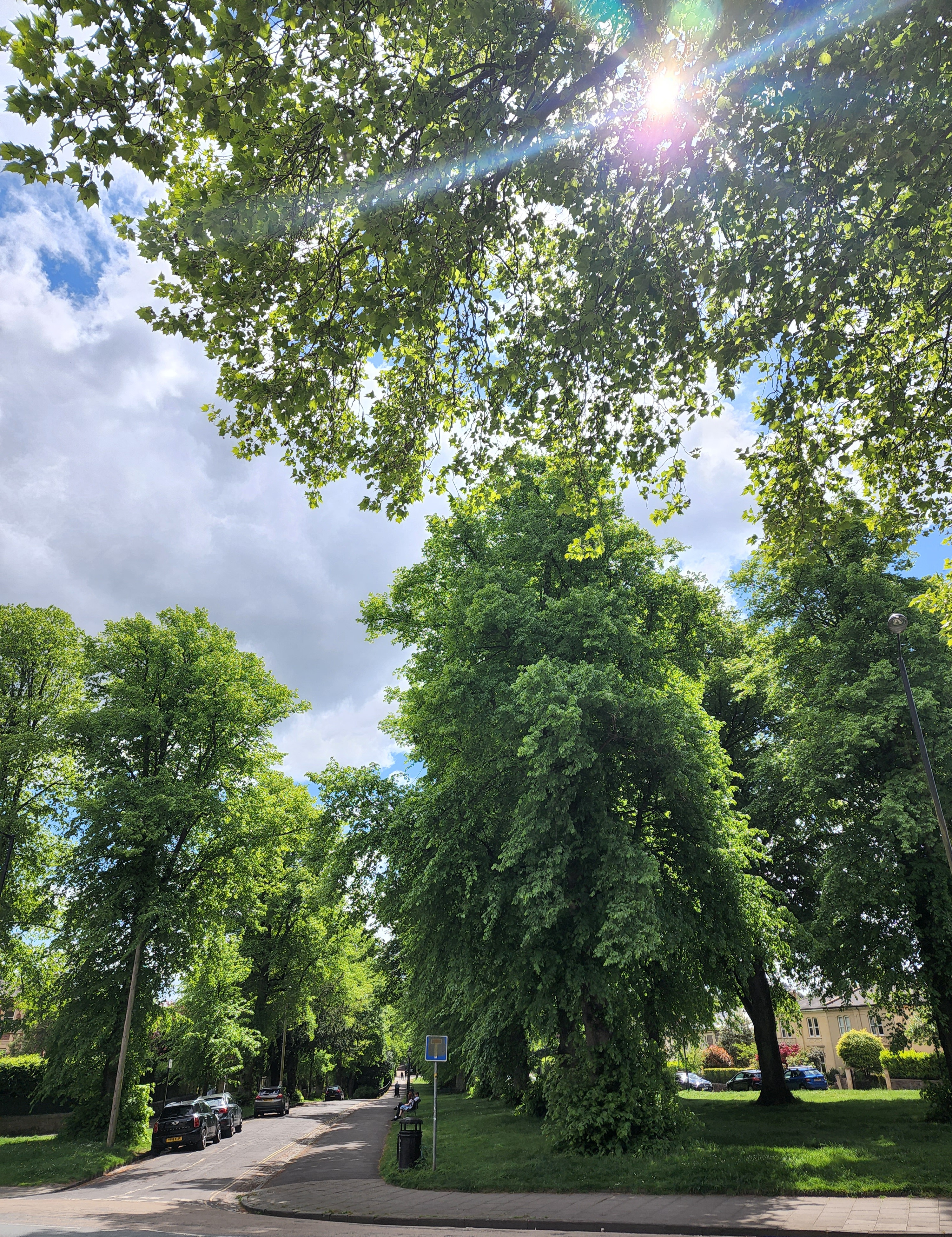
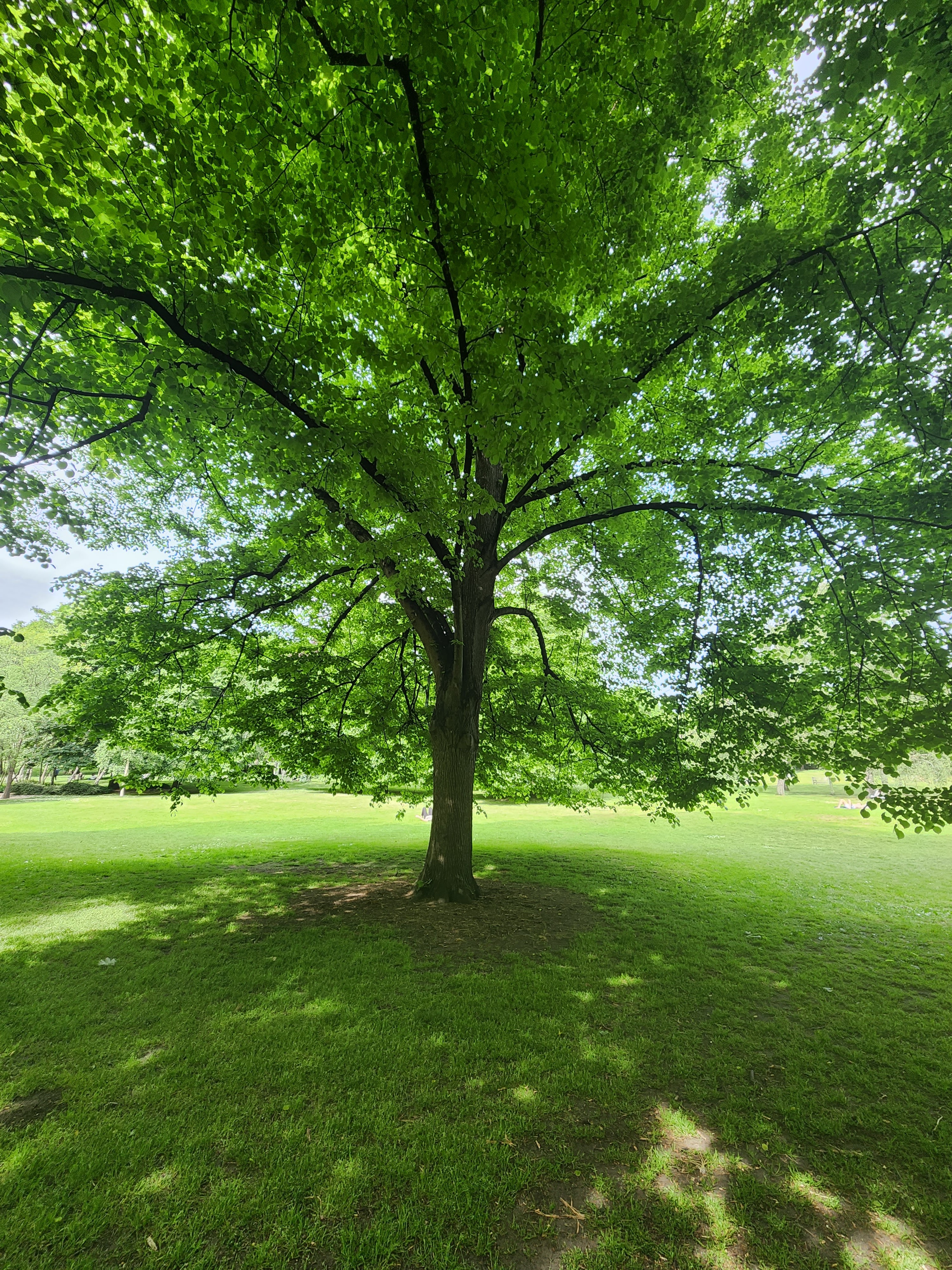
Until a few weeks ago, I hadn't spent time in England in the spring for decades. Now I am, staying mostly in Bristol, and I find that every day I am astonished, delighted, entranced, enraptured, insert further gushing adjectives, by England's trees.  It is their foliage mainly that captures me, the sheer lushness of their leafy greenness, bursting out wherever I look:


and of course I am thrilled by flowering hawthorn:


and awestruck by the magnificence of copper beeches:
This one stands at the entrance to St Andrew's Park, Bristol.
This one is on a street corner in Clifton. Here is a little clip of it being gently swayed by a breeze:


Today, I took the train from Bristol, up to London, and then back again, and I spent almost the whole of the two journeys gazing out the window, admiring trees. While in London I did yet more tree worshipping during my walk from Westminster Cathedral back to Paddington Station via Hyde Park (for those who don't know, there is a bit of Hyde Park up near Bayswater Road that the park authorities deliberately leave untended; it feels like a wild meadow when you walk through it and is one of the nicest places I know of in London, especially at this time of year).

On my travels today and over the weeks since I've been here, I've wished for the ability to express how I feel about the beauty of England's trees. This afternoon, on the train journey back to Bristol, when the train went through a long tunnel, I turned to the book I'd brought with me, and I found that way back in 1845 John Clare had articulated a great deal of what I would have liked to, and he had done it extraordinarily well:

All Nature Has a Feeling by John Clare

All nature has a feeling: woods, fields, brooks
Are life eternal: and in silence they
Speak happiness beyond the reach of books;
There's nothing mortal in them; their decay
Is the green life of change; to pass away
And come again in blooms revivified.
Its birth was heaven, eternal is its stay,
And with the sun and moon shall still abide
Beneath their day and night and heaven wide.