I read the other day that the word "robot" came into English from the Czech for "work", which really anyone with half a brain who's studied a Slavic language ought to have guessed years ago. That group does not include me, I'm sorry to say and, given that I have studied a Slavic language, there is only one conclusion to be drawn, I guess.
Instead of drawing that conclusion, however, I prefer to believe that my brain, all half of it, has been preoccupied with more important things. Rather than worrying about the provenance of the word "robot", I've been busy with worrying about the automatisation - or robotification, if you like - of just about every form of employment once undertaken by those of us who are not geniuses.
I admit to a certain level of hypocrisy in this matter. The truth is I have been known to find myself worrying about the loss of unskilled jobs because of automation, while simultaneously enjoying the simple autonomy of using the automated cash registers now available at so many supermarkets. Mind you, my worries about the future of unskilled employment at these moments are usually interrupted by exclamations from the automated machine I'm using. These generally lead to idle speculation about whether a chick lit novel called Unexpected Item in the Bagging Area about a woman who gets pregnant without meaning to would be a success.
But I digress. While replacing people with things is clearly going to have some pretty horrendous consequences in the job market, the thing about the process that bothers me most is the way in which it is whittling away the opportunities for idle chat between strangers. As Kurt Vonnegut pointed out beautifully, the most pleasant moments in life are often to be found in the inconsequential interchanges we have while faffing about doing apparently unexciting chores.
I was reminded of this just yesterday while staring out of my front window, (an activity I am quite fond of, especially when the alternative is persuading myself to write a chick lit novel called Unexpected Item in the Bagging Area about a woman who becomes pregnant without meaning to [no, I'm not serious and yes, do by all means take the idea if it appeals to you]). On the opposite side of the street there was a man cutting his hedge. To my amazement, this man was using a pair of hand-held clippers.
Amazement might seem a strong reaction to this sight, but, until now I'd understood that where gardening and Belgium intersect automation is the name of the game. Even though every house on our street has hedge plants and other scraps of gardeny type stuff, I have never once before - in almost a year of living here - seen anyone deploying a garden tool that doesn't have a motor. The gardening world of Brussels appeared until yesterday to consist exclusively of men driving around town with trailers full of noisy machines. In return for hefty payments, they would hurtle toward your dwelling, eager to deploy their chainsaws and leaf blowers and buzzcutters and handheld missile launchers and - well, perhaps not the latter, providing you pay your bills on time. As a result, the noise on the street is not deafening but it is often maddening.
But back to the point. There I was, at the window, staring in open surprise at this extraordinary being, a man who didn't seem to care about saving himself labour, who didn't invest his masculinity in horsepower and loud sound, a man who preferred a slow, elegant approach, a man who valued the importance of artistry in his work. As I watched, I saw him clip for a bit; brush away what he'd clipped; lower his shears and stand back to get an idea of the effect he'd created; and then return to the task, refining what he'd done before. He seemed to be enjoying himself. He appeared to be taking pride in the process and in the result.
And even better still was what happened next. Along came one of the neighbours, returning home from a walk with her tubby labradors. She waved as she approached the man and then stopped and engaged him in conversation. He clipped and talked, she watched and responded, he stood back and looked at the hedge, while answering something she'd asked him, she pointed out a bit he'd missed and agreed with his reply. He worked and they chatted - they did both things at the same time!
This was so civilised and pleasant. In the presence of the normal gardeners, the woman with the fat labradors would have been scuttling from the gate to the front door, desperate to escape the unpleasant buzzing. There would have been no opportunity for conversation, no friendliness, no chance for one of the fat labradors to find a scrap of something that might be edible there in the gutter, no pointless easygoing interlude where for a moment both people had a sense of being connected.
What I saw there, between my neighbour and the pre-mechanised gardener was a small green leaf of community emerging.
But the men with the automated shears and leaf blowers will be back soon, ready to nip it in the bud.
Tuesday, 25 August 2015

Thursday, 13 August 2015
Battered Penguins - The Go-Away Bird & Other Stories by Muriel Spark

There are twelve stories in this collection, which was first published in 1958. The first, Black Madonna, introduces Raymond and Lou Parker, a Catholic couple who at first seem unbothered - possibly even quite pleased - by their childlessness. They have a three-room council flat that they like; they are able to buy a motor car, unlike their neighbours who have children; they "read two books apiece a week"; and, in Lou's case at least, they have managed to leave behind and largely forget a fairly squalid early life.
At the time of the story, a Black Madonna, carved from oak, is given to the church the Parkers belong to, by a "recent convert." Although some of the congregation find it ugly, the priest explains, with as much pretension as Lou and Raymond reserve for the conduct of their existences, that it must not be draped or dressed, as this will "spoil the line".
Shortly after the appearance of the Black Madonna, two young Jamaican men arrive at the motor works where Raymond has a job. Lou and Raymond befriend them, with self-consciously determined liberal lack of prejudice. At about the same time, Lou begins to test the Black Madonna to see if her rumoured power to answer prayers is real. After a few small requests, the couple decide "to put in for a baby to the Black Madonna". The result brings to mind the old adage about being careful what you wish for.
Perhaps this story is meant to be read as if told from the point of view of God, whose eyes, Lou's poverty-stricken sister points out when they visit her, "are not shut". Leaving aside the question of whether the dull flatness that results when Spark keeps within this authorial voice is interesting or not, the truth is that Spark is not actually able to maintain a non-judgemental all-seeing Godly tone throughout. Unfortunately, she cannot resist poking fun at the couple, with heavily ironic asides such as this one:
"For no one could call Lou a snob and everyone knew she was sensible".
The unevenness of Spark's tone also jars when she suddenly decides to offer the odd humanising detail about her protagonists. For example, when Lou visits her sister, Spark drops her insistence on describing nothing but the external aspects of Lou and her behaviour and suddenly allows us into the most hidden parts of her mind:
"Lou looked at the chipped paint, the dirty windows, and torn grey-white curtains and was reminded with startling clarity of her hopeless childhood in Liverpool".
For the rest of the narrative Lou and her husband are presented as mere cut-outs. As a result, the story's climax is unaffecting, unbelievable and the whole thing seems contrived by the author for no reason other than to poke fun at aspirational middle class people with delusions about themselves. The same is true of You Should Have Seen the Mess, a later story in the collection. It is told in the first person by a character who judges everything and everyone by how hygienically they lead their lives. In this story, Spark thinks she is ventriloquising a particular type accurately, but I am not convinced she pulls it off. The characterisation is too one-dimensional and, in both stories, the targets are so harmless I can't quite understand why Spark felt it worth the effort to attack them.
The second story in the book, The Pawnbroker's Wife, is gripping by comparison with its predecessor. In it, Spark creates an impression of sinister malice at work. The element of the supernatural in The Pawnbroker's Wife is also evident in The Twins and in The Portobello Road. Although Miss Pinkerton's Apocalypse isn't really very good - except for the fact that it provides the book's funniest line, viz. "It is not radioactive; it is Spode" - that story also falls into the semi-supernatural category. Come Along, Marjorie and The Seraph and the Zambesi share the mysterious quality of The Pawnbroker's Wife but, sadly, they are less obscurely frightening. Of all this group, The Portobello Road stands out for its very clever plot twist.
Daisy Overend targets a different kind of hypocrite from Lou and Raymond and works better than their story. Perhaps this is because it is told in the first person by an obviously hostile narrator. The reader isn't distracted by wondering whether he or she is supposed to dislike the main character - the narrator makes it absolutely obvious that, as far as she is concerned, the reader is meant to dislike the main character a great deal. On the other hand, this makes the piece seem fairly trivial. One is left with the impression that Spark was using this piece of writing to spite an old adversary. The final effect is that one has been witness to a piece of delighted but obscure revenge that probably gave its writer great pleasure to create but contains little to nourish the reader's mind.
The Go-Away Bird is the longest story in the collection. In it, Spark has a great deal of fun highlighting the flaws of the English. Via Daphne, her main character's, naivety as a new arrival in the country, she reveals skilfully how much most people's notion of "England" is stubborn myth.
While the central events of the story take place in "England", they are framed by episodes in Africa that prove the truth of a remark made quite early on by a drunk. This character is probably the only decent person Daphne encounters during her life.
"I grant you we have the natives under control", he tells Daphne, "I grant you we have the leopards under control ...We are getting control over malaria. But we haven't got the savage in ourselves under control".
I suspect Spark felt that statement applied not just to humanity in colonial Africa, but humanity in general. Although she usually writes icily, apparently without sympathy, it may not be because she dislikes her individual characters, but because she dislikes humanity itself. The world of her stories is a world peopled with characters who are preoccupied with the personal and fleeting, who ignore - either deliberately or because they are too limited to recognise it - the infinite.
The exception that proves the rule is A Sad Tale's Best for Winter, which is my favourite story in the collection. It concerns Selwyn Macgregor who lives by a graveyard and entertains "a lively faith in the Resurrection". He contemplates the graveyard, he drinks a lot, he runs out of money at a certain point every month, vanishes into his house, presumably does not drink until he gets more money and certainly does not communicate with any living soul during that time. When his next lot of money arrives, he opens his doors again and repeats the above process. He refuses to change his ways when he is asked to. He remains cheerful but stubbornly enigmatic. And, while I won't tell you how the story ends, that doesn't mean anything exciting happens.
One reason I love the story is that it contains this wonderful passage:
"There wouldn't be much point in going into many details about Aunt Macgregor, what she looked like in her navy blue and how her eyes, nose, and mouth were disposed among the broken veins of her fine severe old face, because her features went, as Selwyn said, under the earth where corruption is, and her navy blue went to the nurse",
In addition, I find the thing wonderfully enigmatic. Spark does not make her position clear, as she does in Black Madonna and You Should Have Seen the Mess. Her narratorial voice is much less intrusive, less caustic than in the other stories in the book. As a result, perhaps, the story echoes about puzzlingly for days afterwards in one's thoughts.
Overall The Go-Away Bird and Other Stories is an intriguing curate's egg. Like Scott Fitzgerald, Spark sometimes wrote rather bad pieces. Like him, she also wrote plenty of things that were exceptionally good. This book contains no genuine duds - in fact, I suspect that even the ones I have criticised may emerge as far better than I realise, once I've let them settle in my memory for a while. My favourites in the collection are those that contain an obvious element of the supernatural, but, for readers who like things that don't immediately give up their secrets, each story has its own particular strangeness and is worthy of at least one read through.
I should also point out the cover drawing by Terence Greer, which I like very much
Tuesday, 11 August 2015
Someone to Love
I watched a film made by Agnes Varda the other day. It is called Le Petit Amour in French and Kung Fu Fighter in English. This is the film 's opening sequence which, for some reason, I can watch over and over again.
Once you've watched the entire film from which this little segment comes, you can see that in the clip's few seconds the entire story of the film is actually summed up:
Once you've watched the entire film from which this little segment comes, you can see that in the clip's few seconds the entire story of the film is actually summed up:
Sunday, 9 August 2015
An Eighth Week of Wonders
This week I wondered how this could possibly happen - the blind-eye-turning, the appalling depravity practised against a small child, the lack of compassion and understanding shown towards the shattered remains of a human being that resulted:

On a more cheerful note, I wondered if many people were aware of the tweeter who calls himself Mick Twister (@twitmericks). He (or she?) comes up with limericks in response to current events.
I came across the account when I read this limerick, which was composed after the problems at the Channel Tunnel entrance at Calais hit the news:
"Calais is starting to crack,
With folks fleeing ruin and wrack.
You'd think, once they're over
With one look at Dover,
They'd turn and all try to get back"
He churns them out at quite a rate and generally they are clever and funny.
And for a wonder, this is not bad
Meanwhile, I'm going to make a virtue of having no lift by learning how to do this when I come down the stairs.
Saturday, 8 August 2015
Taking the Mikes
Yesterday, or the day before, I wrote about how most of the tourists I've seen this summer seem preoccupied by taking pictures of themselves. This morning, I remembered an essay by Hungarian writer George Mikes, which covered the same kind of territory.
Decades ago, (around 1986, I think) Mikes wrote an essay called How to Avoid Travelling, in which he described how people who went abroad fell prey to the same kinds of photographic obsessions that I've been noticing. At the time he was writing, Mikes seems to have believed the phenomenon was limited to Americans - it has certainly spread to a wider group of nationalities since then.
Here is an excerpt from How to Avoid Travelling. If you want more in the same vein, you can find it in a Penguin book called How to be a Brit, which has many other funny sections, (I'm particularly fond of the chapter called, In Praise of Television):
"'Travel' is the name of a modern disease which became rampant in the mid-fifties and is still spreading. The disease - its scientific name is travelitis furiosus - is carried by a germ called prosperity. Its symptoms are easily recognisable. The patient grows restless in the early spring and starts rushing about from one travel agent to another collecting useless information about places he does not intend to visit, studying handouts, etc; then he, or usually she, will do a round of tailors, milliners, summer sales, sports shops, and spend three and a half times as much as he or she can afford; finally, in August, the patient will board a plane, train, coach or car and proceed to foreign parts, along with thousands of fellow-sufferers, not because he is interested in or attracted by the place he is bound for, nor because he can afford to go, but simply because he cannot afford not to. The disease is highly infectious. Nowadays you catch foreign travel rather as you caught influenza in the twenties, only more so.
The result is that in the summer months (and in the last few years also during the winter season) everybody is on the move. In Positano you hear no Italian but only German (for England is not the only victim of the disease); in some French parts you cannot get along unless you speak American; and the official language of the Costa Brava is English. I should not be surprised to see a notice in Blanes or Tossa de Mar stating: Aqui Se Habla Espanol - Spanish spoken here.
What is the aim of all this travelling? Each nationality has its own different one. The Americans want to take photographs of themselves in (a) Trafalgar Square with the pigeons, (b) in St Mark's Square, Venice, with the pigeons and (c) in front of the Arc de Triomphe, in Paris, without pigeons. The idea is simply to collect documentary proof that they have been there. The German travels to check up on his guide-books: when he sees that the Ponte di Rialto is really at its proper venue, that the Leaning Tower is in its appointed place in Pisa and is leaning at the promised angle - he ticks these things off in his guide book and returns home with the gratifying feeling that he has not been swindled. But why do the English travel?
First, because their neighbour does and they have caught the bug from him. Secondly, they used to be taught that travel broadens the mind and, although they have by now discovered the sad truth that, whatever travel may do to the mind, Swiss or German food certainly broadens other parts of the body, the old notion still lingers on. But lastly - and perhaps mainly - they travel to avoid foreigners. Here, in our cosmopolitan England, one is always exposed to the danger of meeting all sorts of peculiar aliens. Not so on one's journeys in Europe, if one manages things intelligently. .... [And yet] The main aim of the Englishman abroad is to meet people; I mean, of course, nice English people from next door or from the next street.
Normally one avoids one's neighbour ('It is best to keep yourself to yourself' - 'We leave others alone and want to be left alone' etc., etc.). If you meet your next door neighbour in the High Street or at your front door, you pretend not to see him, or, at best, nod coolly; but, if you meet him in Capri or Granada, you embrace him fondly and stand him a drink or two; and you may even discover that he is quite a nice chap after all and both of you might just as well have stayed at home in Chipping Norton."
And, just in case anyone is still contemplating the pre-hol purchase of a selfie stick, here is a cautionary tale:

Thursday, 6 August 2015
Screenbased Travel
I thought of calling this post "Thanks for the memories", or "No need for the Memories", or "Hey that's me in the corner", or "Just looking (at ourselves)".
But I didn't in the end, because, while the post is partly about how hardly anyone who goes travelling these days actually observes the places they're travelling through or creates detailed memories - inside their own heads rather than digitally - of what they see around them, what it's primarily about is how travellers go to places now and not only do not look at those places with any kind of attention but basically, having made the effort to get to those places, spend almost their entire time there looking at their screens.
This was not always the case - well obviously not; we didn't always have screens, but even when we did have, in the form of cameras, there was still a large majority of people who didn't look at everything around them purely through a viewfinder. Once travel seems to have been undertaken in a spirit of inquiry. You can sense this when, (if?), you read old Baedeker guides.
In their time, these books were tremendously popular. They contain no illustrations but just page after page of extremely detailed information about anything and everything that a traveller might see in any particular place.
There must have been an appetite for what they provided, for Baedeker was a very successful company. Judging by the contents of their guides, once upon a time, if you went to a new city, you went in a state of enormous curiosity. When you got there, you wandered around, noticing things, wondering about them and then consulting your guide to find out more.
From what I've observed recently, this is not the spirit in which most people travel today. People are on the move in ever larger numbers but, in 2015, the people you see pouring out of planes and trains and buses and descending upon Bruges or Budapest or Brussels's Grande Place don't seem very interested in the details of their new surroundings.
What they mostly seem interested in is arranging themselves in front of the places they've come to and then taking pictures of themselves - pictures that, presumably, they then take home to look at later. Thus, the places become backdrops in pictures that will be studied closely at some point in the future. It's a warped form of delayed gratification, I suppose.
All this makes me wonder whether travelling at present, (if that phrase - "at present" - is not, in fact, the most inappropriate one to use in this particular context), happens when you're doing it or only when you get home and have the opportunity to review the pictures you took when you were on the move - or better still when you have the opportunity to show the pictures to someone else.
Are all these snaps merely affirmation that something happened? Is this what we've come to? Do we need to repeatedly record our images to prove that our lives occur? If the things we do aren't recorded in images that can be looked at by others - or, at the very least, by our future selves - did we actually do them? To paraphrase the old question about whether a table exists when we are not there to see it, have we got to the point where our lives are not real unless they can be looked at by others? Are we all performing for a notional hidden audience? If so, who is in this audience and why do we care what they think?


Ocasionally someone might glance briefly over their shoulder to see the actual view in real time, before letting the camera click

But mostly looking at the view can wait until they get home:


This couple took some extra insurance pictures, which didn't include either of them, presumably in case one leaves the other and no longer wants to include them in their memories.

There is a kind of balletic or praying kind of contortionism called for sometimes.
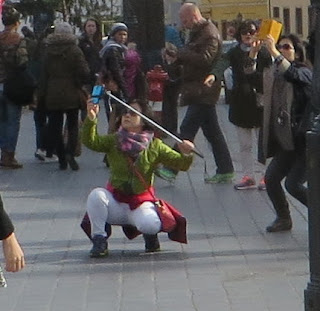


 There is often synchronised clicking


 My favourite self-recording tourist so far this summer would have to be this funny little person who went to Brugges and persuaded someone to take her in the main square doing heroic poses:


 She then spent the rest of her time in the city looking at the results, (and probably posting them to her followers?)


But maybe nothing is real if it isn't in a picture on our devices - or at the very least recorded in a blog post.

(This is interesting, as is this, [possibly the only amusing thing emerging from Russia in recent times]. Also, I have read reports of people falling over cliffs or out of windows in their intense concentration on the task at hand - namely, taking selfies - so perhaps there will be a Darwinian fadeout for the habit.)
But I didn't in the end, because, while the post is partly about how hardly anyone who goes travelling these days actually observes the places they're travelling through or creates detailed memories - inside their own heads rather than digitally - of what they see around them, what it's primarily about is how travellers go to places now and not only do not look at those places with any kind of attention but basically, having made the effort to get to those places, spend almost their entire time there looking at their screens.
This was not always the case - well obviously not; we didn't always have screens, but even when we did have, in the form of cameras, there was still a large majority of people who didn't look at everything around them purely through a viewfinder. Once travel seems to have been undertaken in a spirit of inquiry. You can sense this when, (if?), you read old Baedeker guides.
In their time, these books were tremendously popular. They contain no illustrations but just page after page of extremely detailed information about anything and everything that a traveller might see in any particular place.
There must have been an appetite for what they provided, for Baedeker was a very successful company. Judging by the contents of their guides, once upon a time, if you went to a new city, you went in a state of enormous curiosity. When you got there, you wandered around, noticing things, wondering about them and then consulting your guide to find out more.
From what I've observed recently, this is not the spirit in which most people travel today. People are on the move in ever larger numbers but, in 2015, the people you see pouring out of planes and trains and buses and descending upon Bruges or Budapest or Brussels's Grande Place don't seem very interested in the details of their new surroundings.
What they mostly seem interested in is arranging themselves in front of the places they've come to and then taking pictures of themselves - pictures that, presumably, they then take home to look at later. Thus, the places become backdrops in pictures that will be studied closely at some point in the future. It's a warped form of delayed gratification, I suppose.
All this makes me wonder whether travelling at present, (if that phrase - "at present" - is not, in fact, the most inappropriate one to use in this particular context), happens when you're doing it or only when you get home and have the opportunity to review the pictures you took when you were on the move - or better still when you have the opportunity to show the pictures to someone else.
Are all these snaps merely affirmation that something happened? Is this what we've come to? Do we need to repeatedly record our images to prove that our lives occur? If the things we do aren't recorded in images that can be looked at by others - or, at the very least, by our future selves - did we actually do them? To paraphrase the old question about whether a table exists when we are not there to see it, have we got to the point where our lives are not real unless they can be looked at by others? Are we all performing for a notional hidden audience? If so, who is in this audience and why do we care what they think?


 |
| It seems to me that, for many people, the only times they are paying attention when travelling is when they are staring into a screen to have their picture taken or when they are staring into a screen studying the result |
 |
| The only people facing the landmark in this picture - the Matthias church, with the Fishermen's Bastion beyond it - are those taking pictures |


Ocasionally someone might glance briefly over their shoulder to see the actual view in real time, before letting the camera click

But mostly looking at the view can wait until they get home:


This couple took some extra insurance pictures, which didn't include either of them, presumably in case one leaves the other and no longer wants to include them in their memories.

There is a kind of balletic or praying kind of contortionism called for sometimes.


 |
| Is anyone in this picture not taking a picture? |
There is ensuring you cover every single angle:


But maybe nothing is real if it isn't in a picture on our devices - or at the very least recorded in a blog post.

(This is interesting, as is this, [possibly the only amusing thing emerging from Russia in recent times]. Also, I have read reports of people falling over cliffs or out of windows in their intense concentration on the task at hand - namely, taking selfies - so perhaps there will be a Darwinian fadeout for the habit.)
Subscribe to:
Posts (Atom)