Sunday, 11 February 2024

Reading 2024: Money from Holme by Michael Innes

Some people do the Wordle puzzle to keep their minds agile. The writer known as both J.I.M Stewart and Michael Innes seems to have written novels with the same end in mind. He was astonishingly prolific. 

Money from Holme is set in the art world of London. It is only 171 pages long. Those pages contain a cleverly plotted tale about an unprepossessing man who thinks he can take advantage of an artist but ends up in a farce. As the story treats the politics of a fictitious African country as risible - 

"First, there was a Fascist revulsion. Then there was a Communist revulsion. And after that there was the revulsion of the Moderate Democrats. That was the worst"

- it probably wouldn't be allowed to be published now. Additionally, much fun is had with the muddled English of a London gallery owner of probably Central European origin, which is a racism of sorts, I suppose, if you're in the market for taking offence at racism. 

The novel is frivolous and amusing and contains a reference to those "rotten chaps in Whitehall" and so I enjoyed it. It is definitely not a must-read for the improvement of one's soul but it may give some people an hour or two of mild pleasure. 

Wednesday, 7 February 2024

Words and Phrases, an Occasional Series

My husband tells me that he has discovered the most dominant element of my personality - namely, I don't like change. As he has had the dubious privilege of spending his life with me pretty much continuously since the day of Brezhnev's death - also known as the day we first met - I think he probably has as good a perspective on the topic as anyone. This dislike of change - if I accept it exists (and actually I do) - may explain why I get het up about new bits of language that suddenly appear and begin infesting every journalistic piece I read.

Which brings me to today's gripe - a new (at least to me) coinage that makes me feel queasy each time I see it:

"meet cute".

It's round the wrong way, it makes no sense, it is maddening. Maybe only because it's new? I don't know. I just think it's disgusting.

Tuesday, 6 February 2024

All the Fun of the Fair

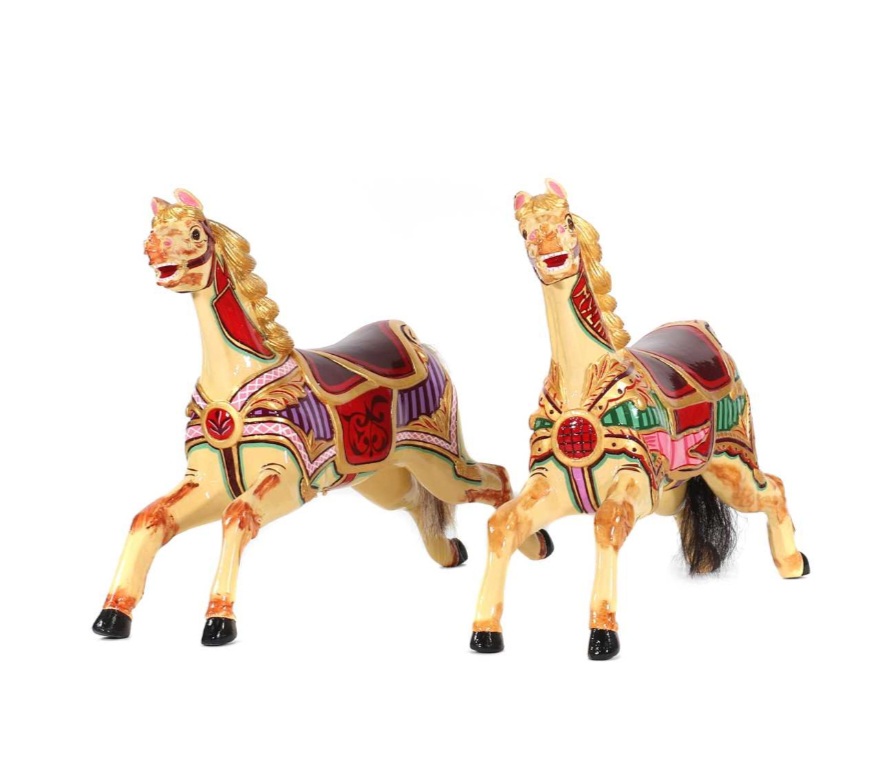
I have a huge talent for time wasting and one of my favourite methods of doing so is looking at auction catalogues. In that context I browsed through this one yesterday and was struck by the exuberance of the objects. I can't think where I would put a fairground horse but I have the idea that glimpsing one around the place would always be cheering - even though I am fully aware that no actual horse ever has their legs in that position when galloping.


I love the use of the word "important" in auctioneers' catalogues - to whom? In which circles?

Monday, 5 February 2024

New Club

I just listened to this long interview between Louis Theroux and Nick Cave. I don't listen to contemporary music so I have little idea about Cave's work in that area. However, I am always stimulated by the interviews with Cave that I've read or listened to, and this one is no exception. Among the topics covered are: drug addiction - surprising insights there; Kylie Minogue - as radiant and oddly brave as I've always hoped she might be; and Cave's churchgoing.

This last is the thing that especially caught my attention. Cave admits that he goes to church very regularly, but he goes out of his way to emphasise that he is not a Christian, even though he also explains how very significant going to church is for him.

This dabbling on the edge of faith is becoming more and more common. The two other examples that spring to mind immediately are Louise Perry and Tom Holland. Jordan Peterson is hovering somewhere in the same "faith adjacent" area, I gather. Douglas Murray, as an ex choir scholar, is presumably steeped in the Christian faith and has said he cherishes Christianity, describing himself as a Christian atheist. Ayaan Hirshi Ali has even come out of the closet and declared herself Christian, but in a rather equivocating kind of way, so that I feel she also is still really a member of this new club of teeterers.

I suppose they are all embarassed to make any further leap, because to say you are a Christian is to provoke the not in-valid accusation that you are entirely irrational. How can you believe some bloke who lived 2,000 years ago was the embodiment of God? How can you even admit a God exists?

There is no proof. None of it is measurable scientifically. But for me at least, irrationality is not a criticism. The whole of existence is irrational and in the face of that I feel only humility (not a particularly encouraged trait at present). We understand nothing on the vast scale of existence, only a few bits of the mechanics. I am therefore content to ignore other people's scorn and pity and follow Saint Anselm's lead when he said:

"I do not seek to understand in order that I may believe, but I believe in order to understand. For this also I believe - that unless I believe I shall not understand."

------------------------

PS If I wanted to be cynical, I might ask how it happens to be so easy for one group of people - Muslim asylum seekers in Britain - to embrace Christianity when it is so hard for the majority of the British population. It is a puzzling phenomenon, (hem hem, as Nigel Molesworth would say).


Wednesday, 31 January 2024

Reading 2024: Yesterday's Spy by Len Deighton

Told in the first person, this is a plunge into a world peopled by men equipped with gold Dunhill lighters who bonded through sharing danger in the Second World War and whose main approach to coping with what they remember is to drink large amounts without ever getting properly drunk. 

It opens in White's, the very grandest of the St James's Street clubs. Someone I used to know joined White's and Brooks's and, realising that the latter was a nicer place by far, inquired at White's how he could resign his membership. His question was met with utter perplexity: "Sir, no one has ever requested such a thing before."

Anyway, that is pretty much the last glimpse we get of English high society - and puzzlingly the character who is supposedly a member of White's is more Arab than English anyway. 

Speaking of things Arab, the plot turns out to be surprisingly contemporary - with both Russians and Arabs implicated in a dangerous plot against the west. As regards the latter of the two aggressors, one character observes that everyone knows what the novel's villain "is up to: he's an Arab." "And you?" comes the response. "I'm a Jew, simple as that", is the reply. The same character later observes "Helping the Israelis might be the West's only chance to survive". I suspect this may still be true today, although I recognise this is contested ground and have no intention of engaging in any arguments on the subject.

It is eventually discovered that the dirty work to get the planned attack on the west off the ground has been performed in secret in France by people "from all the Arab states, brought in as waiters and labourers, foundry workers and garbage men...the French immigration can't stop them." Immigration authorities worldwide seems to have caught the virus of impotence since then. Perhaps it originated with the French - who knows.

Anyway, lo and behold, what a shock, our narrator narrowly foils the dastardly plot, after some rather John Steed/Avengers plot twists. All eventually ends reasonably well - as well as it can in a disenchanted post-war world. 

The whole thing took only a few hours to read and is therefore a proper airport book - in the sense that if you got stuck, as sadly does happen too often, for hours in an airport, it would entertain you for several hours. 

Incidentally, one aspect of the novel that I hadn't expected, and that enhances its escapist atmosphere, is Deighton's fondness for describing men's clothing. One character has "a beautifully cut chalk-stripe suit", another wears "chalk-stripe worsted" and "hand-made shoes", a third, bizarrely, sports "a short fur coat and a black kerchief knotted cowboy-style, right against the throat", while a fourth, a rather tough German policeman, is seen straightening "the shoulder strap of his impeccable white trench coat". I seem to remember that a dark grey pure silk trench coat also makes an appearance. 

Not many hand-made shoes or chalk-stripe worsteds were in evidence at Luton airport last time I was there. Perhaps things have improved since. If not, Deighton would provide not only diversion but a sartorial refuge while stuck waiting for a cheap flight.


Saturday, 20 January 2024

Reading 2024: The Afterlife and Other Stories by John Updike

I wonder if John Updike would be published, were he starting out now. On the basis of one short story and a bit of one of his novels, this reader believes he's worth ditching from the canon on the charge of misogyny - and there are plenty of others who have appeared over the last decade or so as witnesses for the prosecution in that regard.

Finding women so attractive that you keep being unfaithful to other women - as Updike seems to have done a lot in his early adulthood ("I was a passionate creature in those years, with surges of desire shaking my bones" one of his elderly characters in this collection observes, looking back at his younger self) - is, I suppose, a kind of misogyny, although not a straightforward one. Whatever kind it is or isn't, I don't think it makes any difference to whether Updike's writing is bad or good - but I don't read fiction in order to think, "Hurray, this writer thinks exactly like me".

What I read Updike for is his wonderfully meticulous descriptions, the notice he takes and the care he then goes to in order to create for his readers a small world, a few characters. If all the photographs of the nineteen fifties and nineteen sixties are digitised and then vanish due to digital wastage or a permanent outage of electricity, we will still be able to find, in Updike's evocations of the America he lived in, perfect snapshots of that part of our past.

The Afterlife and Other Stories is a collection that seems to have been written when Updike was beginning to feel "the ineluctable logic of decay tightening its grip on his body", so that "the headlines in the paper ... seemed directed at somebody else, like the new movies and television specials and pennant races and beer commercials - somebody younger and more easily excited, somebody for whom the world still had weight". The stories mainly concern middle class people in the middle of their lives. Some are still married, some newly divorced, some alone, some in uncomfortable second marriages. Most of the protagonists are increasingly aware that death is approaching. 

A recurring theme is a complicated relationship with a mother who remains a difficult, yet intimately connected, figure, a woman who irritates but can share with the protagonist, "the vanished texture of the world she had brought him to life within, a world of glamorous drugstores, with marble counter tops, and movie houses that were exotic islands of air-conditioning, with paper icicles dripping from the marquee," or who, if she has already died, has left her son "the sole custodian of hundreds of small mental pictures...of a specialised semiotics, a thousand tiny nuanced understandings of her, a once commonplace language of which he was now the surviving speaker." 

The stories tell of the awkwardness of visiting neighbourhood friends who have reinvented themselves elsewhere, of the uncomfortable intimacy of ill-matched couples holidaying far from home without children or other people, of a mother's obsession with a farmhouse, of the rise and fall of a community recorder orchestra and various other things. Mostly they are mesmerising in the clarity of their description and the attention Updike pays to the protagonists and their mysteriously shifting moods. Interspersed through the book are some lighter pieces, most notably one about a Scottish caddy, which beguiled me, even though when I began it I fretted, because I wanted more of the usual quiet insight I'd come to expect.

I am reading a lot of Updike at the moment. In another book, he talks of his jet-lagged insomnia during a trip to Finland. In this collection, in a story called Falling Asleep Up North, he provides one of the most accurate descriptions of insomnia I've ever come across. Reading it as an insomniac, I was grateful to discover that I am not isolated in my, until now rather lonely, inability to sleep:

"Falling asleep has never struck me as a very natural thing to do. There is a surreal trickiness to traversing that in-between area, when the grip of consciousness is slipping but has not quite let go and curious mutated thoughts pass as normal cogitation unless snapped into clear light by a creaking door, one's bed partner twitching, or the prematurely jubilant realisation I'm falling asleep.  The little fumbling larvae of nonsense that precede dreams' uninhibited butterflies are disastrously exposed to a light they cannot survive and one must begin again, relaxing the mind into unravelling. Consciousness of the process balks it; the brain, watching itself, will not close its thousand eyes. Circling in the cell of wakefulness, it panics at the poverty of its domain - these worn-out obsessions, these threadbare word-games, these pointless grievances, these picayune plans for tomorrow, which yet loom, hours from execution, as unbearably momentous."

For me, reading Updike is like being with a companion who describes what he sees and feels with such care and precision that I am able to pay more attention to my own surroundings and to see more sharply and perhaps with greater wisdom what being a human is. His work is reassuring and also inspiring - his close observation of life and his subsequent ability to turn what he has observed into sentences full of bright, clearcut images deserves nothing but praise.


Friday, 19 January 2024

Virtue Signalling

In the district of Budapest variously called the party district, the Jewish quarter and district VII,  this mural appeared in 2022. 
It was commissioned by the United Nations (your taxes at work) and shows a refugee, a dove at her left shoulder, two children in tow.


What I find nauseating about it is how insulting it is to the actual refugee from whom it takes its inspiration:
Why does the woman in the mural not look like an actual woman under great duress, but instead resemble a catwalk model? Is the implication that refugees must not only be desperate but also fulfil the requirements of the fashion and beauty world's adjudicators?

More importantly, why is the UNHCR wasting money on this kind of thing? If you donated to them, would you expect them to use your cash for propaganda?
 

PS How interesting - I just walked past and saw that the explanatory plaque which showed the original photograph on which the mural was based has now been taken down.