I had up until now thought that writing prizes were rather a bad thing, encouraging the 'this is best, this is my favourite' mentality familiar to any parent of a child between the ages of four and fourteen (drives to school were peppered with questions of the 'which is your favourite film, mum', and 'which song do you like best of all the songs in the world' variety, questions to which I could never find a single answer).
Anyway, today I've changed my mind. The reason I have is that Lydia Davis has been announced as the winner of the Man Booker International prize and until she was announced as the winner I had never heard of her. Now I have, and thanks to the e-book, that other phenomenon about which so many people are ambivalent, (and about which I want to write when I have more time one day), I've been able to start reading and enjoying her right away (an example of her work is this perfect articulation of the dilemma faced by thirty-something women, called The Double Negative: "At a certain point in her life, she realises it is not so much that she wants to have a child as that she does not want not to have a child, or not to have had a child.".
If there were no Man Booker International prize, I'd never have known that Lydia Davis existed. I now do know she exists and I'm glad I do. Ergo literary prizes are wonderful.
(Mind you, I still don't understand how the banal piece of predictable, shallow nonsense that is The Hand That First Held Mine could possibly have deserved the Costa prize)
Showing posts with label Books. Show all posts
Showing posts with label Books. Show all posts
Friday, 24 May 2013

Friday, 17 May 2013
The Little Book of Calm
Some time ago I mentioned some of the horse books that I grew up with. One that I did not include then but which was once very important to me was The Manual of Horsemanship, a text I prized as a child:
 The Manual of Horsemanship is probably the first piece of surrealist literature I ever read; that is, it is a work of total fantasy, written from a point of view of profound seriousness. It is a piece of fiction from beginning to end, a collaboration between the author and the reader in which they both pretend that it might be possible to turn the essentially chaotic business of dealing with a large living animal into an orderly affair, provided precise rules are followed.
It begins by taking the living, spirited being it is dealing with and turning it into a diagram:

(Once everything is labelled, one feels much more in control, even if a combination of fetlock joint, pastern, coronet and wall of foot does combine with an impulse from whatever it is that lies beneath the poll to kick you in the ribs.)
Having drawn and quartered, if not hung, the enemy, so to speak, the book proceeds without any further mucking around to describe the operation of getting on and getting off a pony, ("Because it is the recognised official Manual of the Pony Club it is not considered necessary to substitute the word 'horse' for 'pony' in all sections where either word is equally applicable", by the way), and all the interim procedures.
It continues, alternating between statements that might seem almost as appropriate in a book of Zen Buddhist technique ("Every aid requires the complete harmony of body, legs and hands", "If this system is carefully adhered to, the rider will find these exercises falling into his lap, as a ripe plum does from a tree", "If the rider takes a great deal of trouble in the initial stages of training, he will reap great benefits as time goes on. It is wishful thinking to imagine this high standard of training can be achieved in a short time. It is not possible") and instructions that a) beg the question of the point of the whole exercise - "The greatest difficulty in equitation is to keep the horse absolutely straight" - and b) presuppose a world very unlike the one in which most of us live, a world where you are part of a discerning elite ("knowledgeable horsemen and women will not use bad or coloured saddlery, neither will they neglect the care of their own saddlery") and have access to "your own veterinary surgeon" and your own "well-conducted hunting stable".
There are enigmatic diagrams that seem to explain everything and nothing, (mostly the latter):

(These two remind me of the kind of thing you sometimes see in American literary criticism - The Narrative Patterns in Jane Austen's Oeuvre: Characters and the Maze):


and diagrams which make the difficult look easy:
 There are instructions for doing things that could never be done while holding a book in one hand (this comment actually applies to almost the entire text):
 Best of all the reader is presented with a whole programme for living:
 Every eventuality is covered and, provided rigid discipline is observed, all will be well. I find this impossible fantasy very soothing. My children had Hogwarts; I had a dream of stable (in all senses of the word) routine.

It begins by taking the living, spirited being it is dealing with and turning it into a diagram:

Having drawn and quartered, if not hung, the enemy, so to speak, the book proceeds without any further mucking around to describe the operation of getting on and getting off a pony, ("Because it is the recognised official Manual of the Pony Club it is not considered necessary to substitute the word 'horse' for 'pony' in all sections where either word is equally applicable", by the way), and all the interim procedures.
It continues, alternating between statements that might seem almost as appropriate in a book of Zen Buddhist technique ("Every aid requires the complete harmony of body, legs and hands", "If this system is carefully adhered to, the rider will find these exercises falling into his lap, as a ripe plum does from a tree", "If the rider takes a great deal of trouble in the initial stages of training, he will reap great benefits as time goes on. It is wishful thinking to imagine this high standard of training can be achieved in a short time. It is not possible") and instructions that a) beg the question of the point of the whole exercise - "The greatest difficulty in equitation is to keep the horse absolutely straight" - and b) presuppose a world very unlike the one in which most of us live, a world where you are part of a discerning elite ("knowledgeable horsemen and women will not use bad or coloured saddlery, neither will they neglect the care of their own saddlery") and have access to "your own veterinary surgeon" and your own "well-conducted hunting stable".
There are enigmatic diagrams that seem to explain everything and nothing, (mostly the latter):

(These two remind me of the kind of thing you sometimes see in American literary criticism - The Narrative Patterns in Jane Austen's Oeuvre: Characters and the Maze):


and diagrams which make the difficult look easy:


Monday, 13 May 2013
The Sad Neglected: Books Unfairly Overlooked - The Long Prospect by Elizabeth Harrower

I suppose it is wrong to call this a sad neglected book, since my copy is part of the admirable Text Classic series of reissues. On the other hand, I did get it in the remaindered bookshop and I have never heard anyone talk about it or its author. Which is evidence of just how nuts the book world is right now.
I loved this book. I loved it particularly because I'd just come from trying to love a book called The Secret Keeper by Kate Morton, who, I'd discovered, is Australia's most successful author, if success is counted by sales (and for a writer really what else matters - if people don't pick up your book, you might as well not have written it, after all, [speaking of which, you might like to take a look at this]).
Anyway people are gobbling Morton up, so I got excited and thought I might enjoy her work too.
But I was wrong. Sadly, my only reaction to Morton's work was disappointment. Horrible, mind-numbing disappointment. The prose was dull, there was no insight or attempt to plunge into human psychology. No character had enough depth to be even faintly interesting. There was no feel of authenticity to the novel, on any level, just page after page of drivel about 'one of those heavenly summer days when the sky is blue and the breeze is warm and you just know there is something exciting waiting round the corner' and situations where 'each woman knew in her heart that it was the last time the one would ever see the other' and an unremitting stream of cliches, with characters being 'bundled unceremoniously' and waking 'at the crack of dawn' and finding a puncture 'plain as day', which doesn't bother them, because 'they were young and in love'.
And then there's the dialogue, which banal doesn't really do justice to:
"'I am feeling poorly.'
'Don't want pudding?'
Laurel shook her head, halfway to the door, 'Early night for me, I'm afraid, terrible to be ill tomorrow.'
'Can I get you something else? Paracetamol? Cup of tea?'
'No', said Laurel, 'No, thanks, except, Rose...'
'Yes?'
'The play?'
'...You are a funny thing', said Rose with a lopsided smile" -
(and what the hell is a lopsided smile anyway - you have no idea how long I've stood in front of the mirror trying to work it out).
Strangely enough The Secret Keeper and The Long Prospect do have faint parallels, which possibly made the contrast between them seem more striking and the injustice to Harrower more obvious. Both books are about the same thing - an adolescent girl who is put under a lot of strain by those who should be protecting her. However, whereas Laurel, the adolescent of Morton's novel is demonstrated to be in emotional turmoil thus:
"Laurel meanwhile took to nail-biting in earnest"
Emily, the protagonist of The Long Prospect, is portrayed with intelligence, wit, understanding and depth.
Harrower doesn't bother with some lousy plot about cake knives (why should I care who it was plunged into or why, when I can't even begin to believe that the plunger or the plunged-into exist, except as little black smudges of words on the pages of Morton's novel?) She swaps the narrative propulsion of wondering whodunnit (inasmuch as anyone does wonder) for wisdom and insight. Her story is a brilliantly observed parable, highlighting the way that children are essentially prisoners of the families into which they are born, trapped by the narrow horizons of those who have the responsibility to raise them.
Emily is a child who 'longed to be in a climate of effort where people strove, where mathematical precision would eventually arrive at the answer to all questions, and where warmth and kindness and love were everywhere, but mainly over her', but who goes to a school where she is surrounded by a class who 'noted through eyes in the top of its hydra-head a way of sitting or of speaking that might be branded different from the norm. The imitation of any such discovery ... occupied its lunch hour' and is surrounded at home by people who would 'even laugh at Shakespeare'.
She lives with Lilian, her grandmother, about whom the best that can be said is that a'certain quantity of alcohol brought out in her a kind of mellow fruitiness that was the nearest she ever came to any kind of charm'.
Paula, Emily's mother and Lilian's daughter, lives in Sydney but visits occasionally and, apart from the rather odd circumstances of her marriage - her husband lives in a country town, where he works, but they are not planning to divorce - is a strict conventionalist. Thus, when Emily becomes very fond of Max, Lilian's lodger and the first person to pay proper attention to her, Paula is quick to accept Lilian's intimations that the relationship is odd. She has in any case already made up her mind about Max:
"She could see that under that nice-seeming manner, he thought, and wanted to talk and stir things up. It quite made her shake when people were like that. Only drunks were like that - but he wasn't a drunk. The only thing left for him to be was peculiar..."
Max, of course, is not peculiar; he is simply nice enough to recognise that the people who are supposed to look after Emily, do not in fact look'after her in any respect ...it was as if, being young, her connexion with the human race was very simply discounted.'
No matter. Emily is wrenched away from him. Thereafter, she works 'with fanatical thoroughness' at school, she becomes at home 'unobtrusive as a shadow', but 'under the listless surface was a hot gushing, weak but uncontrollable animal that lifted its arms and exhausted her with meaningless tears - when she broke an old saucer for instance; at any sudden noise or small accident.'
In the final pages of the novel, Emily appears to reach some new level of understanding. Our last glimpse of her, 'sapped, hollow, belatedly obedient', is, I hope not of a defeated creature but of one who knows that she has to serve time before she can escape.
Harrower's description of the careless blundering of much human life is horribly accurate, while her ability to convey Emily's emotions and character is wonderful. She also has a gift for finding the perfect descriptive phrase for objects. After reading this book, I will never look at a 1950s beehive hairstyle again without recalling Harrower's depiction of one character touching 'the wickerwork of her lacquered hair', while from now on whenever I see a palm I will think of her remark that they look like 'overgrown pineapples'.
The story of Emily and Max, in this age of moral outrage and panic about paedophilia, touches some familiar, if unsettling, chords. The vivid portrayal of Emily in particular is a great achievement, and I find myself longing to know that she ends up faring well in her later life. I suppose the Paulas and the Lilians of the world are the ones who read Kate Morton. For the Emilys and Maxes, I'm glad that Harrower is there to fill the gaps.
Sunday, 5 May 2013
Updike Moments
Going through old papers this evening, I came across some quotes I wrote down while reading John Updike's book of short stories called The Music School.
I don't know why I didn't use them in the post I wrote about the collection. I suppose it's impossible to quote all the great bits of Updike, but since I've got them, I thought I'd add them to the blog. I especially like the first and last:
"the unqualified righteousness with which our own acts, however admittedly miscalculated, invest themselves."
"I imagine warmth leaning against my door, and open the door to let it in; sunlight falls flat at my feet like a penitent."
"His voice was faint and far, like wind caught in a bottle."
Ploughing, "like a slow brush repainting the parched pallor of the winter-faded land with the wet dark colour of loam."
I don't know why I didn't use them in the post I wrote about the collection. I suppose it's impossible to quote all the great bits of Updike, but since I've got them, I thought I'd add them to the blog. I especially like the first and last:
"the unqualified righteousness with which our own acts, however admittedly miscalculated, invest themselves."
"I imagine warmth leaning against my door, and open the door to let it in; sunlight falls flat at my feet like a penitent."
"His voice was faint and far, like wind caught in a bottle."
Ploughing, "like a slow brush repainting the parched pallor of the winter-faded land with the wet dark colour of loam."
Thursday, 28 March 2013
Battered Penguins - Hemlock and After by Angus Wilson

The novel opens on the day that Bernard Sands, the book's central character, receives, 'Treasury's final confirmation of official financial backing' for 'the purchase and maintenance of Vardon Hall as a centre to provide leisure and support for' younger writers. For Bernard, a 'Grand Old Man of Letters' who has recently acknowledged his own homosexuality, this is the latest in a long line of successes. He is delighted, but as time passes his delight is diminished by a 'growing apprehension of evil that had begun this summer to disrupt his comprehension of the world.'
Bernard's apprehension of evil is hardly surprising given the monsters who surround him. There is horrible Mrs Wrigley, whose portrayal is so vivid I found it hard to convince myself, when I'd finished reading, that the lingering odour I thought I could detect existed only in my imagination :
"Despite the hot June evening, Mrs Wrigley's first action on getting back to the cottage was to light the paraffin stove. The smoke filled the stuffy airless little room. Mrs Wrigley's protuberant frog's eyes smarted and watered behind her thick steel-rimmed glasses. The smell of the paraffin spread to blend with the rank odour of stale sweat, the clinging scent from the half-empty tin of sardines on the table and the sickening, periodic whiffs mingled from bad meat and dog mess somewhere near the sink. These Mrs Wrigley did not notice. She took off her worn old red leather hat - disintegrating relic of the craftwork of some proud gentlewoman - revealing a close cropped mannish head of grey hair. She did not remove the old mackintosh which she wore over her bulky, shapeless form, although she was sweating with the long climb up the hill from the village. She put the kettle on the rusty gas stove which had been bought from some of Ron's winnings at the dogs only a year ago. While she waited for the kettle to boil she prodded with her boot at an old collie dog with sores that lay in a basket under the table. Then pouring the boiling water into a teapot full of dead tea leaves, she drew the sardine tin towards her and liberally sprinkled the contents with vinegar.'
There is Hubert Rose who is engaged in a 'frenzied search to regain those wondrous secret childhood games beside which all the pleasures of the adult world were dust and ashes in his mouth', and who tries to justify his attempt to procure a small girl for himself with the argument that she 'was born into a world with nothing to offer her [and] is going to part with something she'll be giving away to Tom, Dick, and Harry in a couple of years, at an age when an ignorant society prefers to think she's bathed in childhood innocence instead of slum smut.'
Worst of all, there is dreadful Mrs Curry, 'an elephant figure of Mabel Lucie Attwell chubbiness', who resembles a 'huge, obscene parrot' and has a fondness for 'comfiness' and 'pretty little tiny things', furnishing her cottage with pictures of 'a bluebell wood, misty and shimmering, in which two tiny naked children sported' and 'a field of dancing daffodills into which a little girl had strayed without her clothes', about which she would observe, 'quite suddenly, "Poor little thing, she's lost her frillies"' or '"Naughty little things, they want a smack a bot, don't they?"' Her utterances, we are told, are always open to two interpretations, either pleasant or 'of such extreme obscenity that the mind reeled before it.' It is she who recognises Hubert Rose for what he is and sets about procuring what he desires.
In Mrs Curry's activities, Andrew O'Hagan pointed out recently in the London Review of Books, there are echoes of the Jimmy Savile affair. Strangely, there is an even closer parallel in the description of one character's fetishisation of her clothing, which mirrors the odd way in which Savile himself treated his dead mother's dresses:
"Celia Craddock preserved most of her old evening dresses ... going to her bedroom ... she would look at them, touch, stroke them and eventually would find herself seated on the floor, surrounded by the billowing pools of rich material."
Fortunately, in the midst of the ghastliness that takes up so much of the novel, there are moments of humour, some surprisingly Barbara Pym-like:
'"I can always get you turkey eggs when you want 'em," she heard Bill say. It was difficult to imagine when she would want them ...'
some more grim than Pym:
'She had been reminded ... of a long session with an analyst - that Bavarian, Dr Wengl, who had made you draw pictures - in which they had got stuck at her father's deathbed. Dr Wengl had insisted on her visualising the scene ... but they had got nowhere; all she could recall vividly was the intricate square of iron work at the bedhead.'
others possibly appealing only to an Antipodean English person, who recognises a peculiarly English kind of pleasure:
'It was more than comforting to find the famous vine so small and fruitless, the delphiniums so inferior and the shrubbery no more than a tangled mass of dusty St John's Wort. There was general conviction among the visitors that they could have done better at home. They settled down to an afternoon of satisfied disappointment'
or to those who have been to Leicester Square:
'The evening seemed cooler. Almost anywhere but Leicester Square would have reflected its summer beauty.'
Even more fortunately, amid the seemingly unrelenting corruption of the novel's characters, one figure of integrity emerges - Ella, the apparently insane wife of Bernard Sands, whose 'foggy picture of life' is pierced by 'letters and words [which] began to weave themselves - Minors, Lincoln, loins and then again minors, minors'. Once her 'armour of neurosis' is penetrated in this way, Ella rises to the challenge and sets out to frustrate Mrs Curry in her endeavours.
In case we have not picked up the message that in this mad world only the mad can be sane, Wilson underlines it by ensuring that, of all the characters, only Ella can see Mrs Curry as she actually is. Elsewhere the woman is described as 'a gigantic moored airship' of 'soft cushiony flesh'. She is given an almost supernatural, eternal quality when she is portrayed pondering her prey and asking herself, 'What, will the line stretch on to crack o'doom? All the love-starved and the needy, and all on bended knee'.
Through Ella's eyes, however, she shrinks back to normal size and becomes unthreatening, impotent and ordinary:
'She blinked at the huge figure before her in undisguised interest, taking in every detail of the broken veins around the nose and on the cheeks beneath the layer of powder, the old-fashioned shoes with pointed toes, the flesh forced into bulges around the corsets, 'Evil power' indeed, she thought with scorn ... Why! she was just someone's cook dressed up, certainly dishonest and probably a secret drinker.'
Ella is unafraid of Mrs Curry and is able to halt her progress temporarily. However, as Bernard recognises, Mrs Curry has 'a fertile imagination for evil'. She has not been defeated forever but only for the moment. The struggle against what she represents is neverending.
Despite this, Wilson permits a touch of optimism - or at least a reminder of a grandeur in existence beyond 'the rack of self-advancement and self-pity' on which people spend their lives in Bernard's social world - to creep into his book at its close. On the final page, he shows us Ella turning from the room she is in to look at the view beyond the window:
'It was really easier to concentrate on the clouds moving above and below like great golden snowdrifts'
she decides, and with that enigmatic sentence, hinting at distant splendour, the novel ends.
Sunday, 10 March 2013
Cake Time
Following on from yesterday's delicious lunch description from Jane Gardam, here is tea, as promised:
"For tea ... we had small thick triangles of rye bread and butter, small thin triangles of white bread and butter. scones with butter and home-made strawberry jam in a glass dish with the strawberries hanging whole in the jelly, suspended like rubies. We had Sally Lunn and Sad Mary and sponge cake with jam in the middle and icing on top - plain white. We had fresh lemon-curd tarts and raspberry tarts, each the size of a fifty-pence piece and light as flakes. We had an English Swiss roll, not sticky and with bitter chocolate filling, not sickly black cherries. And - bother the boy, it had taken five hours - we had an old English Lenten Simnel cake soaking with soft marchpane, soft as honey, light as air ... 'You are of course mad,' said my husband, 'but at least there is now one Swiss in the world who won't forget that the English respect food.'"
"For tea ... we had small thick triangles of rye bread and butter, small thin triangles of white bread and butter. scones with butter and home-made strawberry jam in a glass dish with the strawberries hanging whole in the jelly, suspended like rubies. We had Sally Lunn and Sad Mary and sponge cake with jam in the middle and icing on top - plain white. We had fresh lemon-curd tarts and raspberry tarts, each the size of a fifty-pence piece and light as flakes. We had an English Swiss roll, not sticky and with bitter chocolate filling, not sickly black cherries. And - bother the boy, it had taken five hours - we had an old English Lenten Simnel cake soaking with soft marchpane, soft as honey, light as air ... 'You are of course mad,' said my husband, 'but at least there is now one Swiss in the world who won't forget that the English respect food.'"
Another Reading Feast
Having spent many years bewildered by the lack of publicity received by the writer Jane Gardam, I rather rashly offered to do a 1p review of something by her for the Dabbler the other day. As a result, I'm rereading her collection of short stories, Going into a House Darkly and I've just come across a great food passage that I really ought to have included in this post, had I remembered it.
It is part of a story about a woman who is trying to prepare a very bright young Swiss boy for a Common Entrance exam, which includes an imaginative essay element. They boy appears to have no imagination and the English relatives with whom he lives cook nothing but baked beans - usually burnt. The teacher decides to invite him to lunch and give him really good food, in the hope that it may 'unlock one shred of his soul'.
This is what she gives him:
"We had ... little lemon soles, hot and curly and light and crisp, in breadcrumbs and with lemon juice. Then we had sirloin of Scotch beef, not en croute but just as juicy; and green vegetables and small carrots with parsley butter and chopped, uncooked onion. The potatoes ... I parboiled and then shoved far back in the top of the oven for seventeen minutes in hot olive oil ... [They] came out of the Aga like golden, crunchy, soft-centred flowers. Then we had redcurrant water ice, the redcurrants from Rusham Farm, and for the damson tart a jug of cream from Solley's Farm at Worth, thick and yellow. The cheeses were Cheddar - I'd spent a long time choosing the finest of five good ones - a local chevre and a perfect double Gloucester.
The pastry for the tart was the best I had ever made. I'd iced the knife as well as the water and the bowl. It was crisp but flaky. Almost transparent. The damsons sat darkly inside it basking in a congealing sticky lake of crimson juice and sprinkled with hard brown sugar. They looked comfortable as fat black ladies in a spa."
She also gives him tea, which I will save for tomorrow.
It is part of a story about a woman who is trying to prepare a very bright young Swiss boy for a Common Entrance exam, which includes an imaginative essay element. They boy appears to have no imagination and the English relatives with whom he lives cook nothing but baked beans - usually burnt. The teacher decides to invite him to lunch and give him really good food, in the hope that it may 'unlock one shred of his soul'.
This is what she gives him:
"We had ... little lemon soles, hot and curly and light and crisp, in breadcrumbs and with lemon juice. Then we had sirloin of Scotch beef, not en croute but just as juicy; and green vegetables and small carrots with parsley butter and chopped, uncooked onion. The potatoes ... I parboiled and then shoved far back in the top of the oven for seventeen minutes in hot olive oil ... [They] came out of the Aga like golden, crunchy, soft-centred flowers. Then we had redcurrant water ice, the redcurrants from Rusham Farm, and for the damson tart a jug of cream from Solley's Farm at Worth, thick and yellow. The cheeses were Cheddar - I'd spent a long time choosing the finest of five good ones - a local chevre and a perfect double Gloucester.
The pastry for the tart was the best I had ever made. I'd iced the knife as well as the water and the bowl. It was crisp but flaky. Almost transparent. The damsons sat darkly inside it basking in a congealing sticky lake of crimson juice and sprinkled with hard brown sugar. They looked comfortable as fat black ladies in a spa."
She also gives him tea, which I will save for tomorrow.
Monday, 4 March 2013
Ford Madox Ford Meets Oz Commercial TV
I do wonder what the author of Parade's End would think about his narrative being interrupted by the Lotto draw. I also wonder how interested the Channel Nine audience will be in the adventures of Christopher Tietjens:


Wednesday, 20 February 2013
Looking at History
Today I would like to salute a historian called RJ Unstead. Everything I know about history (admittedly not a great deal) I know only thanks to him. His were the works that introduced me to the subject and also the only ones that ever captured any of my attention. Even now, whenever I need to know anything about the past, I turn first to him. Thus, when the news broke recently about the discovery of Richard III's remains under a carpark and I thought, 'Now who was Richard III and when exactly did he live', it was Unstead I got down from the shelf.
Unstead wrote a series called Looking at History and I encountered all four volumes when I was at primary school. I was thrilled also to find the whole set, bound together, on the shelves of the late lamented Chelsea Bookshop, a narrow, dark place on the King's Road in Chelsea, run by two somewhat ill-tempered ladies, who seemed elderly to me at the time but were probably merely middle-aged in fact.
Most of the spare time that I did not spend in the children's section of the Chelsea Public Library, (not, as now, housed in the old town hall but diagonally across the road and around the corner from there), was spent in the Chelsea Bookshop until, in the mid sixties, it was swept away in the great change that rid the King's Road of all businesses not devoted to the sale of glittery dresses and other tat, (luckily, just about exactly at that same moment my interest switched from reading to glittery dresses; luckily for me, that is, although possibly not so great for the ill-tempered ladies).
Anyway, I saved up my pocket money and bought the complete Looking at History and I still have it:

I still love it as well. It explains right at the beginning that what it will provide is everything about Britain 'from Cavemen to the Present Day', (the 'Present Day' referred to was actually 1963, but who wants to hear about anything that's happened since then really - it's mostly depressing, after all).
While Britain is a bit of a stretch for what is really a book about England's history, what you get is an introduction to all the major events of English history, with the odd nod to the existence of Scotland and no mention at all of Ireland or Wales - or such brief ones that I missed them. Leaving aside that bias, (and I do realise that there will be those who just can't do that), the book is remarkably even-handed. For instance, when explaining about the Norman invasion, Unstead simply states this:

Later he does mention that 'the Saxons hated the Normans', but there is no taking sides about whether they were justified in doing so.
His approach is similar when he introduces Cromwell, (and younger readers please note - gay for Unstead merely meant blithe):


 He's certainly more balanced than this fellow:
What makes the book really interesting though is the way that events are really only a kind of skeleton that gives the thing structure. The bulk of the text is concerned not with battles or kings or parliament but with the details of daily life for ordinary people. It includes sections called 'Happenings' but they form only a small part of the whole. Around them, recurring sections detail all manner of other aspects of existence in the past.
With the help of numerous illustrations, mostly taken from scholarly works or from the collections of the British Museum, the Public Record Office, the Victoria and Albert Museum and many other smaller enterprises, Unstead's work brought the world of the past vividly to life for me - and it still does.
He focusses on the day-to-day things we all share, making it almost impossible for readers not to identify with their predecessors. For instance, he tells us about the food that was eaten at different stages of the nation's history:


 and the kinds of uniforms:
 and clothes:

 that people wore.
He shows us how people's houses were furnished:


 and how the streets looked:
 He tells us about how people got about:


and also about children's activities:

Excitingly (my cousin and I must clearly have been shaping up to be future tabloid readers, as we would turn to these with guilty salacity, if that's the word - and, if we were anything to go by, Steerforth need not worry about the harmful effects a rather grim old seafront slot machine might have had upon his younger son), he tells us about punishments:


He also tells us about entertainments:


and the insides of houses:
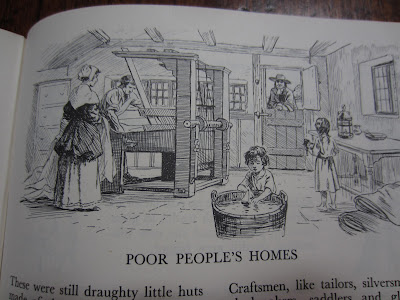


Despite things being dealt with very briefly - this was after all a text for early primary school - Unstead still managed tremendous clarity, as can be seen from this brief explanation of the wireless:

Reading the book now, I am surprised to find that it has not dated in terms of its attitudes. While it is clearly unforgivable that Unstead makes no mention of England's treatment of the Irish - or indeed any hint at all that not all members of the union might be equally happy (and, of course, he doesn't even contemplate for a moment the idea of dealing with this thing called world history which seems to be the latest fashion), I cannot see any sign of jingoism or racism or any of those things that we are sometimes led to believe were bred in the bone of our forebears and need to be eradicated from our consciousnesses now. Certainly the book is bafflingly short on reasons for the start of World War I:
 but then again I've never read anyone who has managed to show how the outbreak of that war did make any kind of proper rational sense.
In any case, despite its minor flaws, the work's great strength for me was that it captured my imagination in a way that barely any history book has done since (the one exception I can think of is JB Bury's History of Greece). It introduced me to the idea that history was about people who ate and drank and played and wore clothes, just as I did, thus instilling - in me at least - a kind of fellow feeling with the past.
It left indelible memories too, which isn't bad for something I was introduced to at the age of six. For instance, when I went to Lavenham three or four years ago and clapped eyes on the Wool Hall, it was almost like stepping through the back of a cupboard into Narnia, for I had been carrying around in my mind the image of that exact building, ever since I'd seen it in Looking at History several decades earlier:
 What is more, through an odd working of nostalgia - for the book, and the age I was, and the coziness of the classroom in which I first encountered it - I now find, coming back to England by plane, that I experience a kind of secondary nostalgia for the country itself, as I look down and see faint traces in pasture that, RJ Unstead taught me to recognise, correspond to the old feudal land divisions:


The book ends with a series of questions which suggest to me that it is very difficult to imagine any sort of change except the one you have already experienced. Thus, Unstead dwells on faster and faster transport but has no inkling of the developments in communication that are heading his way. He finishes thus:
"Perhaps the Age of Coal and Iron is already over and we have entered a new Age of Plastics and Atomic Power, in which men will no longer labour to put brick upon brick, or to dig for fuel in coalmines. We have certainly entered an age of speed and science, in which ways of life will change more swiftly than in the past.
Will life become easy and pleasant, or dangerous, yet dull? What do you think?"
Quite a good question, to which I do not have the answer.
What do you think?
Unstead wrote a series called Looking at History and I encountered all four volumes when I was at primary school. I was thrilled also to find the whole set, bound together, on the shelves of the late lamented Chelsea Bookshop, a narrow, dark place on the King's Road in Chelsea, run by two somewhat ill-tempered ladies, who seemed elderly to me at the time but were probably merely middle-aged in fact.
Most of the spare time that I did not spend in the children's section of the Chelsea Public Library, (not, as now, housed in the old town hall but diagonally across the road and around the corner from there), was spent in the Chelsea Bookshop until, in the mid sixties, it was swept away in the great change that rid the King's Road of all businesses not devoted to the sale of glittery dresses and other tat, (luckily, just about exactly at that same moment my interest switched from reading to glittery dresses; luckily for me, that is, although possibly not so great for the ill-tempered ladies).
Anyway, I saved up my pocket money and bought the complete Looking at History and I still have it:

I still love it as well. It explains right at the beginning that what it will provide is everything about Britain 'from Cavemen to the Present Day', (the 'Present Day' referred to was actually 1963, but who wants to hear about anything that's happened since then really - it's mostly depressing, after all).
While Britain is a bit of a stretch for what is really a book about England's history, what you get is an introduction to all the major events of English history, with the odd nod to the existence of Scotland and no mention at all of Ireland or Wales - or such brief ones that I missed them. Leaving aside that bias, (and I do realise that there will be those who just can't do that), the book is remarkably even-handed. For instance, when explaining about the Norman invasion, Unstead simply states this:

Later he does mention that 'the Saxons hated the Normans', but there is no taking sides about whether they were justified in doing so.
His approach is similar when he introduces Cromwell, (and younger readers please note - gay for Unstead merely meant blithe):


What makes the book really interesting though is the way that events are really only a kind of skeleton that gives the thing structure. The bulk of the text is concerned not with battles or kings or parliament but with the details of daily life for ordinary people. It includes sections called 'Happenings' but they form only a small part of the whole. Around them, recurring sections detail all manner of other aspects of existence in the past.
With the help of numerous illustrations, mostly taken from scholarly works or from the collections of the British Museum, the Public Record Office, the Victoria and Albert Museum and many other smaller enterprises, Unstead's work brought the world of the past vividly to life for me - and it still does.
He focusses on the day-to-day things we all share, making it almost impossible for readers not to identify with their predecessors. For instance, he tells us about the food that was eaten at different stages of the nation's history:


He shows us how people's houses were furnished:


and also about children's activities:

Excitingly (my cousin and I must clearly have been shaping up to be future tabloid readers, as we would turn to these with guilty salacity, if that's the word - and, if we were anything to go by, Steerforth need not worry about the harmful effects a rather grim old seafront slot machine might have had upon his younger son), he tells us about punishments:


He also tells us about entertainments:


and the insides of houses:
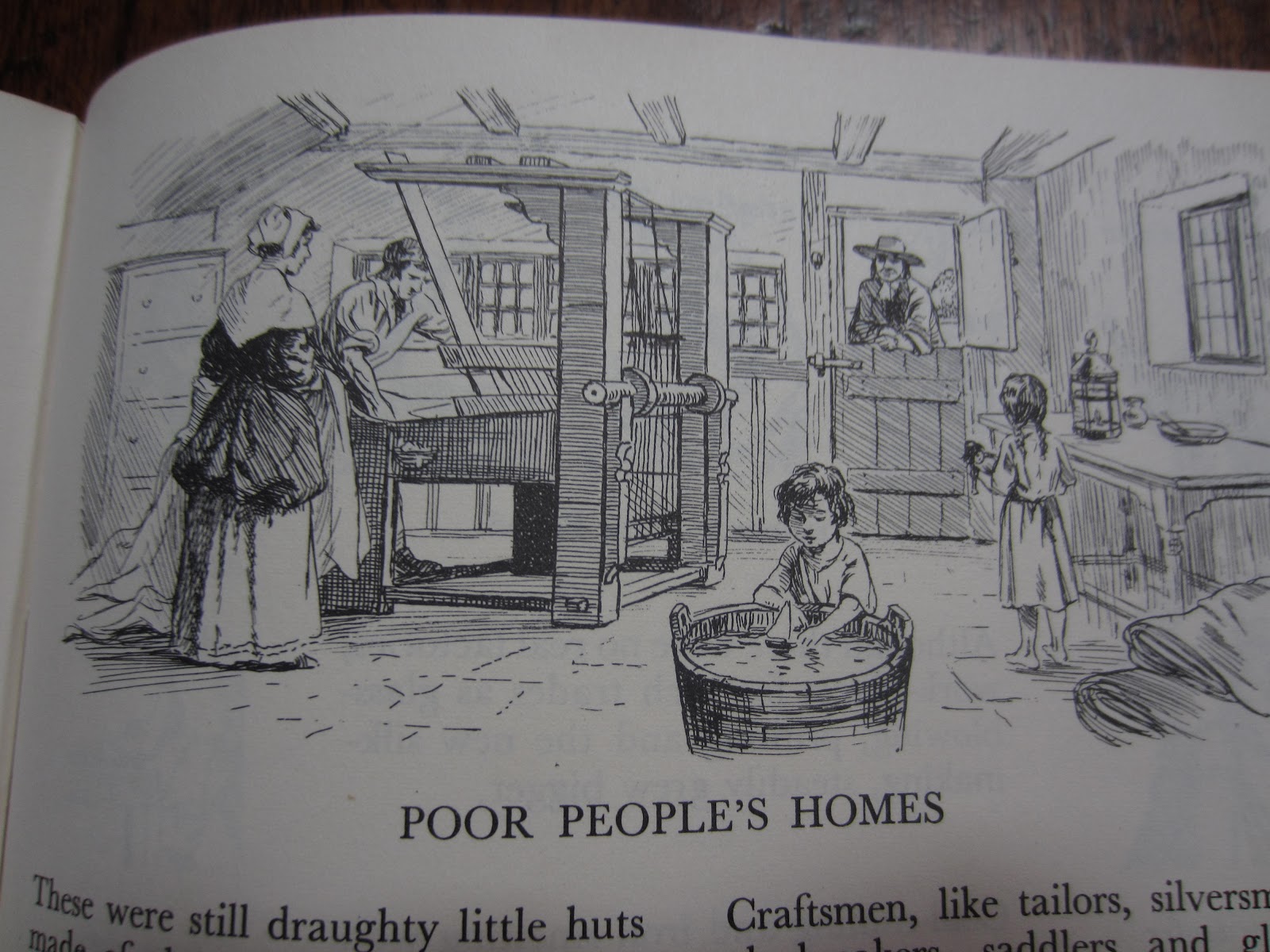


Despite things being dealt with very briefly - this was after all a text for early primary school - Unstead still managed tremendous clarity, as can be seen from this brief explanation of the wireless:

Reading the book now, I am surprised to find that it has not dated in terms of its attitudes. While it is clearly unforgivable that Unstead makes no mention of England's treatment of the Irish - or indeed any hint at all that not all members of the union might be equally happy (and, of course, he doesn't even contemplate for a moment the idea of dealing with this thing called world history which seems to be the latest fashion), I cannot see any sign of jingoism or racism or any of those things that we are sometimes led to believe were bred in the bone of our forebears and need to be eradicated from our consciousnesses now. Certainly the book is bafflingly short on reasons for the start of World War I:

In any case, despite its minor flaws, the work's great strength for me was that it captured my imagination in a way that barely any history book has done since (the one exception I can think of is JB Bury's History of Greece). It introduced me to the idea that history was about people who ate and drank and played and wore clothes, just as I did, thus instilling - in me at least - a kind of fellow feeling with the past.
It left indelible memories too, which isn't bad for something I was introduced to at the age of six. For instance, when I went to Lavenham three or four years ago and clapped eyes on the Wool Hall, it was almost like stepping through the back of a cupboard into Narnia, for I had been carrying around in my mind the image of that exact building, ever since I'd seen it in Looking at History several decades earlier:


The book ends with a series of questions which suggest to me that it is very difficult to imagine any sort of change except the one you have already experienced. Thus, Unstead dwells on faster and faster transport but has no inkling of the developments in communication that are heading his way. He finishes thus:
"Perhaps the Age of Coal and Iron is already over and we have entered a new Age of Plastics and Atomic Power, in which men will no longer labour to put brick upon brick, or to dig for fuel in coalmines. We have certainly entered an age of speed and science, in which ways of life will change more swiftly than in the past.
Will life become easy and pleasant, or dangerous, yet dull? What do you think?"
Quite a good question, to which I do not have the answer.
What do you think?
Sunday, 13 January 2013

Thursday, 3 January 2013
Gosh Where Did the Time Go
It's 2013 already and I'm back on the internet super highway, after beautiful coast days and sweaty turkey roasting days and madly
Tuesday, 11 December 2012
Tristram Shandy's Dad's Opinion
Inspired by this post at the incomparable Anecdotal Evidence blog, I have started reading Tristram Shandy
Monday, 26 November 2012
Nothing is Lost
If you look hard enough, everything is on the Internet - including Judi Dench in the play I mentioned
Thursday, 22 November 2012
Corsets and Sable Trim
If I can't find some food in a book, then a passage that is full of details about clothes is the next best thing. As
Tuesday, 20 November 2012
Marcel's Citrus Epiphany
Speaking of food in novels, when one of my daughters was still at school, they
Sunday, 18 November 2012
Monday, 12 November 2012
Books and Reading
I've just finished the new biography of Patrick Leigh Fermor by Artemis Cooper. One of the things that
Monday, 5 November 2012
Sunday, 21 October 2012

Saturday, 13 October 2012
Eating My Words
Some time ago I got all het up about television programmes being made from novels. I now
Subscribe to:
Posts (Atom)