Having speculated about heaven, I suppose one must also mention the other place, (although only while touching wood, of course).
I think my favourite vision of that unattractive region is the one Lord Redesdale, the father of the Duchess of Devonshire, came up with. He had a horror of anything sticky so, when his youngest daughter asked him what his definition of hell was, he answered, "Honey on my bowler hat."
I learnt this from an exceptionally funny article reposted from the Telegraph on the excellent Patrick Leigh Fermor blog here.
Showing posts with label Heaven. Show all posts
Showing posts with label Heaven. Show all posts
Saturday, 4 May 2013

Saturday, 20 April 2013
In Heaven
Further to my musings about possible heavenly attributes, I'd like to get a bit more specific about the food and drink aspects of heaven:
You have to start the day with double cream and something chocolate, plus a warm croissant and jam, followed by fried eggs and bread, hot, almost overcooked and crispy, the way my grandmother used to make them (but no washing up afterwards, of course, and no smell of frying embedding itself in the curtains). Anything less substantial to eat will leave you feeling very unwell as you start the day.
If you drive at night without drinking, it can seriously impair your skills - you need some gin or vodka before you leave the house, just in case you encounter a breathalyser unit, and on the way home you will need to have tucked away a glass or two of wine as well.
Among the foods needed to keep you thin and healthy, as well as chocolate, cheese and cream, you will have to eat sour snakes regularly, and maybe include from time to time that staple of my boarding school life, brown sugar mixed with butter and spread half an inch thick on toast
And on the question of whether or not you are educated only if you have been educated in science (something that won't figure in my version of heaven), I should point out that that wise writer Marilynne Robinson is quoted here talking about "a kind of parochialism that follows from a belief in science as a kind of magic, as if it existed apart from history and culture, rather than being, in objective truth and inevitability, their product."
You have to start the day with double cream and something chocolate, plus a warm croissant and jam, followed by fried eggs and bread, hot, almost overcooked and crispy, the way my grandmother used to make them (but no washing up afterwards, of course, and no smell of frying embedding itself in the curtains). Anything less substantial to eat will leave you feeling very unwell as you start the day.
If you drive at night without drinking, it can seriously impair your skills - you need some gin or vodka before you leave the house, just in case you encounter a breathalyser unit, and on the way home you will need to have tucked away a glass or two of wine as well.
Among the foods needed to keep you thin and healthy, as well as chocolate, cheese and cream, you will have to eat sour snakes regularly, and maybe include from time to time that staple of my boarding school life, brown sugar mixed with butter and spread half an inch thick on toast
And on the question of whether or not you are educated only if you have been educated in science (something that won't figure in my version of heaven), I should point out that that wise writer Marilynne Robinson is quoted here talking about "a kind of parochialism that follows from a belief in science as a kind of magic, as if it existed apart from history and culture, rather than being, in objective truth and inevitability, their product."
Thursday, 9 February 2012
White Noise
While I was ill the other day, (yes, I was, as a matter of fact: I felt quite dreadful, thanks for asking, and for quite a few days I had a REALLY high temperature and you know I actually don't think I got anywhere near enough sympathy, but that's another story [the story of my life, possibly, blub, blub, blub]), I spent quite a lot of time in an odd state where I wasn't quite asleep but I wasn't in any sense sensible, (not unusual, some might say).
Anyway, I could vaguely hear the radio mumbling to itself in another room for a lot of the time that I was lying in this insensible - or semi-sensible - state, and I found the sound rather comforting. I wasn't up to listening to anything coherent but I liked hearing a soothing kind of burbling noise.
That led me to thinking about radio stations that I might set up, if I were rich, to serve a similar calming kind of purpose for their listeners. I decided that I would quite like the following sounds to be available on the airwaves at all times, just in case I wanted to switch them on:
Cricket commentary (well, we have that pretty nearly full time already, come to think of it);
The sea - for connoisseurs there could be sections of the day devoted to different seas and oceans of the world and people could form groups to discuss which they enjoyed most and why, (or not - they might prefer to continue with book clubs as usual; it was merely a suggestion);
Insect noise - that kind of background static that you get on a hot day in Victoria;
The distant, impossible to quite make out conversations you hear on telephone wires sometimes, while you are waiting for a number to connect - very often these seem to be quite vehement arguments being conducted by Chinese people, from what little one can tell;
Shipping forecasts - Dogger, Cromarty, Finisterre et cetera;
The applause of audiences following really superb concerts by the Vienna Philharmonic, the Berlin Philharmonic or the Tasmanian Symphony Orchestra;
Football results, like the ones that seemed to run for hours on a Saturday afternoon on the television in my childhood: West Bromwich Albion nil; Westham Wanderers 2 et cetera et cetera, all in that slightly liturgical lilt, as if reading out a psalm;
Country auctioneers calling cattle sales;
Rain on a corrugated iron roof - again different times of the day could be allotted for different rain patterns and, possibly, for the true afficionadoes, for different qualities of corrugated iron;
School playgrounds - we used to live next door to a school and I enjoyed the way the day was punctuated with eruptions of shrieks and laughter and shouts. Mind you, just like a school day, the station should only broadcast such sounds at times that coincided with the school breaks themselves; the rest of the time listeners should be able to hear simply the noise of the streets around the school;
Country racecallers calling picnic races;
A full list of prices on the stock exchange for the day, with rolling updates, (just a continuing drone, in other words - not broadcast for the purposes of the information contained within the reports).
I look forward to many more equally tranquilising suggestions.
Anyway, I could vaguely hear the radio mumbling to itself in another room for a lot of the time that I was lying in this insensible - or semi-sensible - state, and I found the sound rather comforting. I wasn't up to listening to anything coherent but I liked hearing a soothing kind of burbling noise.
That led me to thinking about radio stations that I might set up, if I were rich, to serve a similar calming kind of purpose for their listeners. I decided that I would quite like the following sounds to be available on the airwaves at all times, just in case I wanted to switch them on:
Cricket commentary (well, we have that pretty nearly full time already, come to think of it);
The sea - for connoisseurs there could be sections of the day devoted to different seas and oceans of the world and people could form groups to discuss which they enjoyed most and why, (or not - they might prefer to continue with book clubs as usual; it was merely a suggestion);
Insect noise - that kind of background static that you get on a hot day in Victoria;
The distant, impossible to quite make out conversations you hear on telephone wires sometimes, while you are waiting for a number to connect - very often these seem to be quite vehement arguments being conducted by Chinese people, from what little one can tell;
Shipping forecasts - Dogger, Cromarty, Finisterre et cetera;
The applause of audiences following really superb concerts by the Vienna Philharmonic, the Berlin Philharmonic or the Tasmanian Symphony Orchestra;
Football results, like the ones that seemed to run for hours on a Saturday afternoon on the television in my childhood: West Bromwich Albion nil; Westham Wanderers 2 et cetera et cetera, all in that slightly liturgical lilt, as if reading out a psalm;
Country auctioneers calling cattle sales;
Rain on a corrugated iron roof - again different times of the day could be allotted for different rain patterns and, possibly, for the true afficionadoes, for different qualities of corrugated iron;
School playgrounds - we used to live next door to a school and I enjoyed the way the day was punctuated with eruptions of shrieks and laughter and shouts. Mind you, just like a school day, the station should only broadcast such sounds at times that coincided with the school breaks themselves; the rest of the time listeners should be able to hear simply the noise of the streets around the school;
Country racecallers calling picnic races;
A full list of prices on the stock exchange for the day, with rolling updates, (just a continuing drone, in other words - not broadcast for the purposes of the information contained within the reports).
I look forward to many more equally tranquilising suggestions.
Wednesday, 14 December 2011
Ely Loons
When I was very young, we spent a particularly happy summer in a cottage in Suffolk. I don't know if that part of England is generally sunny but, at least in my memory, for the weeks we were there it seemed to be always bright and warm. It also seemed to be wonderfully empty, its flat golden landscape quite undisturbed by traffic, unless you counted the Massey-Ferguson combine harvesters that moved steadily across the fields.
I divided most of my time between a) bicycling to the local village shop to buy boiled sweets and toffees, b) lying on my bed and reading while sucking the boiled sweets and toffees and c) developing a peculiarly intense relationship with the cottageowners' hamster, until he escaped my over-zealous attentions by disappearing down a burrow in the garden, (and was replaced by another rather more likeable and therefore less interesting specimen, bought from a stout woman with bad teeth who sold all kinds of vermin from a stall in Ipswich market).
There is no such thing as paradise on earth, of course, and therefore I was dragged away from sweets, books and furry animals from time to time, in order to be taken on 'excursions'. One of these was to Ely Cathedral.
I remember the place as very beautiful. Strangely, I don't any more. Nothing has actually changed in the intervening years, except that the Church of England has become revoltingly rapacious. Therefore, instead of entering the cathedral and being struck by the loveliness of the building's interior, you walk in and find yourself face-to-face with a large wall-mounted flat screen TV.
On the television, the absurdly large prices the church now charges visitors who want to enter the cathedral are displayed, together with information about the gift shop (which has been slotted into a space that I suspect was once a pretty chapel for private prayer). Somehow, this ugliness took the gloss of Ely's flying buttresses when I visited a couple of months ago, even though they're really just as lovely as they ever were.
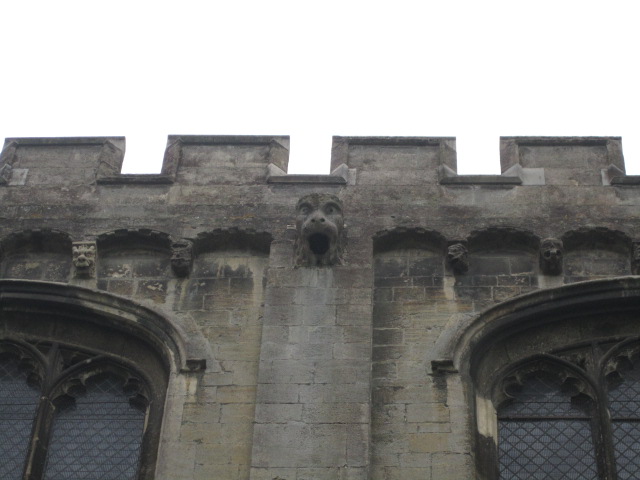
And, in fact, even the tackiness of the interior redesign couldn't dim my enthusiasm for one aspect of Ely Cathedral - the gargoyles. They were the first gargoyles I'd ever noticed, and I remember thinking as I gazed up at them, 'Ah, at last I understand what I was put on earth for - to be a gargoyle-maker'. Sadly, it didn't take long to discover that I'd been born far too late. Never mind - sometimes dreams are better than reality: I'd probably never have been able to match the sheer character of some of the works that adorn Ely now:




I divided most of my time between a) bicycling to the local village shop to buy boiled sweets and toffees, b) lying on my bed and reading while sucking the boiled sweets and toffees and c) developing a peculiarly intense relationship with the cottageowners' hamster, until he escaped my over-zealous attentions by disappearing down a burrow in the garden, (and was replaced by another rather more likeable and therefore less interesting specimen, bought from a stout woman with bad teeth who sold all kinds of vermin from a stall in Ipswich market).
There is no such thing as paradise on earth, of course, and therefore I was dragged away from sweets, books and furry animals from time to time, in order to be taken on 'excursions'. One of these was to Ely Cathedral.
I remember the place as very beautiful. Strangely, I don't any more. Nothing has actually changed in the intervening years, except that the Church of England has become revoltingly rapacious. Therefore, instead of entering the cathedral and being struck by the loveliness of the building's interior, you walk in and find yourself face-to-face with a large wall-mounted flat screen TV.
On the television, the absurdly large prices the church now charges visitors who want to enter the cathedral are displayed, together with information about the gift shop (which has been slotted into a space that I suspect was once a pretty chapel for private prayer). Somehow, this ugliness took the gloss of Ely's flying buttresses when I visited a couple of months ago, even though they're really just as lovely as they ever were.
And, in fact, even the tackiness of the interior redesign couldn't dim my enthusiasm for one aspect of Ely Cathedral - the gargoyles. They were the first gargoyles I'd ever noticed, and I remember thinking as I gazed up at them, 'Ah, at last I understand what I was put on earth for - to be a gargoyle-maker'. Sadly, it didn't take long to discover that I'd been born far too late. Never mind - sometimes dreams are better than reality: I'd probably never have been able to match the sheer character of some of the works that adorn Ely now:


Friday, 17 June 2011
More Heavenly Details
'I'm on the train', as my fellow passengers keep bellowing, in a variety of languges. I really am - they have a clever mobile internet connection that you can pay for, although it doesn't actully work that brilliantly (and the paws do get in the way a bit at the best of times - which I can freely acknowledge now I've got my secret off my furry chest - let alone on the train, when all the jolting and swaying makes things even more tricky).
But being on the train has made me realise that trains are something else that will have to play a big role in the heaven I would like - in fact, I'm hoping that the bulk of goods-trucking in heaven (and for those who say goods-trucking shouldn't have a place in heaven, I say, 'How do you intend to eat? Is it vegetable gardening and cow milking that you envisualise for eternity? Or - surely not - were you planning to give up eating?', an activity very high up in my top ten of life's pleasures) will be done by freight train, instead of going via the highways, and trains will be so cheap and widespread, with all the little stations everywhere reopening, that people will hardly need cars at all.
There is so little stress to a good train journey, particularly if it is conducted by Renfe, the Spanish train company, or Deutsche Bahn. I hesitate to mention the French mob, since, judging by their staffing arrangements, I find it hard to believe they will survive much longer.:
 (Yes, last week, all four of the people pictured were deemed necessary to check each ticket on one of their very fast trains.)
What little stress there is though comes from blaring overhead announcements. Therefore, in heaven, I would decree that there would be no electronic sound systems installed on any trains. Instead, the staff would have to do what they did in my childhood - walk through all the carriages, yelling out the lunch options and any other announcements that might come to mind (oddly enough, not many did come to mind in those days, when it involved a bit of effort.)
And, of course, the trains in heaven would all have proper dining cars - not snack bars that rely entirely on microwave ovens but places with tables and cutlery and damask table cloths and menus and waiters and a pleasant sense of occasion (but no flash - this would be seen as normal, rather than being an absurdly expensive and naff re-creation that is more about display of wealth than just living well). No noisy packets of anything (crisps et cetera) would be allowed anywhere within a hundred mile vicinity, although people who wanted to would be allowed to bring wrapped sandwiches to eat in their seats, provided the sandwiches were wrapped in nice, quiet waxed paper. There would be old-fashioned train food on offer in the dining car - fish in parsley sauce, roast lamb with vegetables, paprika chicken. The glasses would be crystal, the prices would be low.
Call me dreamy, but I am after all talking about heaven - and, perhaps, also about the past, which, it turns out, is not so much another country but another dimension: in my case, in many respects, the paradisical one.
But being on the train has made me realise that trains are something else that will have to play a big role in the heaven I would like - in fact, I'm hoping that the bulk of goods-trucking in heaven (and for those who say goods-trucking shouldn't have a place in heaven, I say, 'How do you intend to eat? Is it vegetable gardening and cow milking that you envisualise for eternity? Or - surely not - were you planning to give up eating?', an activity very high up in my top ten of life's pleasures) will be done by freight train, instead of going via the highways, and trains will be so cheap and widespread, with all the little stations everywhere reopening, that people will hardly need cars at all.
There is so little stress to a good train journey, particularly if it is conducted by Renfe, the Spanish train company, or Deutsche Bahn. I hesitate to mention the French mob, since, judging by their staffing arrangements, I find it hard to believe they will survive much longer.:

What little stress there is though comes from blaring overhead announcements. Therefore, in heaven, I would decree that there would be no electronic sound systems installed on any trains. Instead, the staff would have to do what they did in my childhood - walk through all the carriages, yelling out the lunch options and any other announcements that might come to mind (oddly enough, not many did come to mind in those days, when it involved a bit of effort.)
And, of course, the trains in heaven would all have proper dining cars - not snack bars that rely entirely on microwave ovens but places with tables and cutlery and damask table cloths and menus and waiters and a pleasant sense of occasion (but no flash - this would be seen as normal, rather than being an absurdly expensive and naff re-creation that is more about display of wealth than just living well). No noisy packets of anything (crisps et cetera) would be allowed anywhere within a hundred mile vicinity, although people who wanted to would be allowed to bring wrapped sandwiches to eat in their seats, provided the sandwiches were wrapped in nice, quiet waxed paper. There would be old-fashioned train food on offer in the dining car - fish in parsley sauce, roast lamb with vegetables, paprika chicken. The glasses would be crystal, the prices would be low.
Call me dreamy, but I am after all talking about heaven - and, perhaps, also about the past, which, it turns out, is not so much another country but another dimension: in my case, in many respects, the paradisical one.
Wednesday, 8 June 2011
Another Tweak to Paradise
In Paradise, when you start reading an article and it doesn't finish on one page, the rest of it will not be buried somewhere up the back, deep among the truss adverts (or whatever it is that's replaced the truss adverts.) In Paradise, if an article doesn't finish on one page, it will continue on the following page, and that will be that. To give it its due, the London Review of Books tries hard to emulate Paradise, in this regard at least.
Also, all waiters will be as efficient, attentive and generally sympathetic (but not intrusive) as the one that just served me lunch in the brasserie at the Gare de Lyon in Paris (some kind of delicious kind of tartare of tomatoes and olives plus palma ham, rabbit [not actually that brilliant] and rhum baba, [which was, disappointingly, not really rhum baba but brioche soaked in an alcoholic syrup - tout de meme, the whole effect was more than edible, inexpensive and without any pretension]).
Also, all waiters will be as efficient, attentive and generally sympathetic (but not intrusive) as the one that just served me lunch in the brasserie at the Gare de Lyon in Paris (some kind of delicious kind of tartare of tomatoes and olives plus palma ham, rabbit [not actually that brilliant] and rhum baba, [which was, disappointingly, not really rhum baba but brioche soaked in an alcoholic syrup - tout de meme, the whole effect was more than edible, inexpensive and without any pretension]).
Tuesday, 7 June 2011
Something I Forgot
In heaven, I hope that, if they sell stuff in bags to eat on the train or at the movies, they will make sure the bags are not made out of anything that crackles and scrunches in the annoying way that crisp packets (or chip packets, as we say, [rather stupidly, I think - it seems sensible to me to differentiate between hot cooked chips and the crunchy shop bought sliced things] in Australia) do, nor will they allow sweets with crinkly wrappers or popcorn in boxes that can be crunkled around in to be taken anywhere near public places.
Also in paradise, could museum attendants not breathe down your neck and suddenly ask to see your ticket, just as you're on the point of almost grasping exactly why Rubens is so bloody marvellous.
Also in paradise, could museum attendants not breathe down your neck and suddenly ask to see your ticket, just as you're on the point of almost grasping exactly why Rubens is so bloody marvellous.
Sunday, 5 June 2011
Heaven
Yesterday at a lunch which, following a pattern familiar in this part of the world, soon declined into a speech-making competition (what is it about Central Europeans and their passion for speeches?), my mind drifted (not an unusual occurrence even when speeches are absent). Perhaps inspired by David Eagleman's musings on the after-life, I began to wonder what I would like to find in heaven.
I'm sure I could think of more things, if I put my mind to it, but, just off the top of my head, here is what I came up with, as my companions yattered earnestly on:
The most comfortable shoes will not always be the ugliest.
Smoking will be quite good for you, and gin will make you both happy and wise.
Chocolate, cheese and cream will keep you slim and healthy - although too much of any of them will make you dangerously thin.
Red wine will retain its health-giving properties but lose its tendency to create a headache the day after use.
Films will always be slightly better than you expected.
Washing up will do itself - especially after Christmas lunch (and including putting itself away).
The kitchen will never need cleaning and nor will the bathroom, but ironing will remain an occasional - but not pressing (oh, the wit) - task.
All novels will be gripping, moving and full of insight, and everyone else will enjoy discussing them, but not in the stupid way the women do on First Tuesday Book Club, who say things like "I don't like The Man who Loved Children any more, because I'm a mum" (this makes me quite extraordinarily annoyed).
When you learn a poem off by heart, you won't find you've almost completely forgotten it three weeks later.
There will be no groin or hamstring injuries - or, at least, no one on the radio will tell you about them over breakfast.
Tattoos will hurt as much as they do now to apply but will vanish within a fortnight from the skin.
The taste of coffee will equal the wonderful smell that rises from the newly ground beans.
No-one will make the currently fashionable claim that, if you are not educated in science, you are not educated.
You will be able to read for many, many hours, never losing concentration, absorbing every word.
You will be able to wake and hear the cry of an Australian magpie and look through the window at blue sky and gum leaves in bright Antipodean sunlight and also be in the Globe Theatre after a two-hour train ride.
There will be enough time to do everything you enjoy and there will be nothing that you don't enjoy to do.
That's all I've got so far. I may think of more, in which case I'll come back with an update. What strikes me about the list so far is a) how greedy I am and b) how unambitious my dreams are - it appears I rather like life; just a few small changes is all that I require.
I'm sure I could think of more things, if I put my mind to it, but, just off the top of my head, here is what I came up with, as my companions yattered earnestly on:
The most comfortable shoes will not always be the ugliest.
Smoking will be quite good for you, and gin will make you both happy and wise.
Chocolate, cheese and cream will keep you slim and healthy - although too much of any of them will make you dangerously thin.
Red wine will retain its health-giving properties but lose its tendency to create a headache the day after use.
Films will always be slightly better than you expected.
Washing up will do itself - especially after Christmas lunch (and including putting itself away).
The kitchen will never need cleaning and nor will the bathroom, but ironing will remain an occasional - but not pressing (oh, the wit) - task.
All novels will be gripping, moving and full of insight, and everyone else will enjoy discussing them, but not in the stupid way the women do on First Tuesday Book Club, who say things like "I don't like The Man who Loved Children any more, because I'm a mum" (this makes me quite extraordinarily annoyed).
When you learn a poem off by heart, you won't find you've almost completely forgotten it three weeks later.
There will be no groin or hamstring injuries - or, at least, no one on the radio will tell you about them over breakfast.
Tattoos will hurt as much as they do now to apply but will vanish within a fortnight from the skin.
The taste of coffee will equal the wonderful smell that rises from the newly ground beans.
No-one will make the currently fashionable claim that, if you are not educated in science, you are not educated.
You will be able to read for many, many hours, never losing concentration, absorbing every word.
You will be able to wake and hear the cry of an Australian magpie and look through the window at blue sky and gum leaves in bright Antipodean sunlight and also be in the Globe Theatre after a two-hour train ride.
There will be enough time to do everything you enjoy and there will be nothing that you don't enjoy to do.
That's all I've got so far. I may think of more, in which case I'll come back with an update. What strikes me about the list so far is a) how greedy I am and b) how unambitious my dreams are - it appears I rather like life; just a few small changes is all that I require.
Thursday, 2 June 2011
In Transit
Waiting for a plane in Singapore the other day, I read the 25 April edition of the New Yorker. It included an article about a man called David Eagleman, who I'd heard of through my younger daughter, because earlier this year she sent me this excerpt from Sum, his piece of fiction speculating on the after life:
"In the afterlife you relive all your experiences, but this time with the events reshuffled into a new order: all the moments that share a quality are grouped together.
You spend two months driving the street in front of your house, seven months having sex. You sleep for thirty years without opening your eyes. For five months straight you flip through magazines while sitting on a toilet.
You take all your pain at once, all twenty-seven intense hours of it. Bones break, cars crash, skin is cut, babies are born. Once you make it through, it’s agony-free for the rest of your afterlife.
But that doesn’t mean it’s always pleasant. You spend six days clipping your nails. Fifteen months looking for lost items. Eighteen months waiting in line. Two years of boredom: staring out a bus window, sitting in an airport terminal. One year reading books. Your eyes hurt, and you itch, because you can’t take a shower until it’s your time to take your marathon two-hundred-day shower. Two weeks wondering what happens when you die. One minute realizing your body is falling. Seventy-seven hours of confusion. One hour realizing you’ve forgotten someone’s name. Three weeks realizing you are wrong. Two days lying. Six weeks waiting for a green light. Seven hours vomiting. Fourteen minutes experiencing pure joy. Three months doing laundry. Fifteen hours writing your signature. Two days tying shoelaces. Sixty-seven days of heartbreak. Five weeks driving lost. Three days calculating restaurant tips. Fifty-one days deciding what to wear. Nine days pretending you know what is being talked about. Two weeks counting money. Eighteen days staring into the refrigerator. Thirty-four days longing. Six months watching commercials. Four weeks sitting in thought, wondering if there is something better you could be doing with your time. Three years swallowing food. Five days working buttons and zippers. Four minutes wondering what your life would be like if you reshuffled the order of events. In this part of the afterlife, you imagine something analogous to your Earthly life, and the thought is blissful: a life where episodes are split into tiny swallowable pieces, where moments do not endure, where one experiences the joy of jumping from one event to the next like a child hopping from spot to spot on the burning sand.”
It turns out that Eagleman is not only a writer but a bit of an all-round genius. His main preoccupation is research into consciousness. and the phrase of his that particularly struck me in the New Yorker article refers to humanity and our relationship with time. "We're stuck in time like fish in water", is what he is quoted as saying, in passing.
Just as I read that phrase, my flight was called, and so I gathered up my belongings and set off towards the boarding gate where my plane was supposed to be waiting. My way took me along a kind of glassed-in suspended corridor that ran above the main level of the airport and, as I went along it, I looked down at the things on the floor below.
The first thing I saw was a pond containing about a dozen large, fat goldfish, who cruised about among its ferns. I wondered if the fish had any idea that they were spending their days in the enclosed world of an airport, rather than out in the wide open world. And then, of course, I wondered if in fact we are all, equally unwittingly, passing our allotted time inside some similarly complex vast enclosed structure, invisible to us, but there all the same.
"In the afterlife you relive all your experiences, but this time with the events reshuffled into a new order: all the moments that share a quality are grouped together.
You spend two months driving the street in front of your house, seven months having sex. You sleep for thirty years without opening your eyes. For five months straight you flip through magazines while sitting on a toilet.
You take all your pain at once, all twenty-seven intense hours of it. Bones break, cars crash, skin is cut, babies are born. Once you make it through, it’s agony-free for the rest of your afterlife.
But that doesn’t mean it’s always pleasant. You spend six days clipping your nails. Fifteen months looking for lost items. Eighteen months waiting in line. Two years of boredom: staring out a bus window, sitting in an airport terminal. One year reading books. Your eyes hurt, and you itch, because you can’t take a shower until it’s your time to take your marathon two-hundred-day shower. Two weeks wondering what happens when you die. One minute realizing your body is falling. Seventy-seven hours of confusion. One hour realizing you’ve forgotten someone’s name. Three weeks realizing you are wrong. Two days lying. Six weeks waiting for a green light. Seven hours vomiting. Fourteen minutes experiencing pure joy. Three months doing laundry. Fifteen hours writing your signature. Two days tying shoelaces. Sixty-seven days of heartbreak. Five weeks driving lost. Three days calculating restaurant tips. Fifty-one days deciding what to wear. Nine days pretending you know what is being talked about. Two weeks counting money. Eighteen days staring into the refrigerator. Thirty-four days longing. Six months watching commercials. Four weeks sitting in thought, wondering if there is something better you could be doing with your time. Three years swallowing food. Five days working buttons and zippers. Four minutes wondering what your life would be like if you reshuffled the order of events. In this part of the afterlife, you imagine something analogous to your Earthly life, and the thought is blissful: a life where episodes are split into tiny swallowable pieces, where moments do not endure, where one experiences the joy of jumping from one event to the next like a child hopping from spot to spot on the burning sand.”
It turns out that Eagleman is not only a writer but a bit of an all-round genius. His main preoccupation is research into consciousness. and the phrase of his that particularly struck me in the New Yorker article refers to humanity and our relationship with time. "We're stuck in time like fish in water", is what he is quoted as saying, in passing.
Just as I read that phrase, my flight was called, and so I gathered up my belongings and set off towards the boarding gate where my plane was supposed to be waiting. My way took me along a kind of glassed-in suspended corridor that ran above the main level of the airport and, as I went along it, I looked down at the things on the floor below.
The first thing I saw was a pond containing about a dozen large, fat goldfish, who cruised about among its ferns. I wondered if the fish had any idea that they were spending their days in the enclosed world of an airport, rather than out in the wide open world. And then, of course, I wondered if in fact we are all, equally unwittingly, passing our allotted time inside some similarly complex vast enclosed structure, invisible to us, but there all the same.
Subscribe to:
Posts (Atom)