I just heard a man on the radio say that the failure of the Apollo 13 mission was "a September 11 moment for America".
No, it wasn't. Leaving aside the fact that, as far as I can remember, no-one lost their life in Apollo 13, there is no such thing as "a September 11 moment", except September 11 itself. Nothing comes close to it. It is no good trying to appropriate it. The enormity of the crime that was perpetrated on that day is approached by nothing in recent times. Not even the recent act of terrorism in Boston can be classed as "a September 11 moment".
I do hope this usage doesn't spread.
Showing posts with label Usage. Show all posts
Showing posts with label Usage. Show all posts
Sunday, 21 April 2013

Monday, 8 April 2013
Finders Keepers
Having been alerted to the new non-creative approach to writing, I now am seeing bits of 'literature' trapped inside every bit of prose that I read. For instance, here is a 'poem', rescued from a review of a book about leaves I just read in the 7 February 2013 London Review of Books:
Unlike an animal, a leaf
is absolutely stuck
with its lot:
it cannot seek
shade when the sun gets
too hot,
it cannot go in search
of water
when the rains don't come
it cannot run away
from predators.
Poor leaves. I'd never thought of what a rotten time they have till I read that. Which is why I was moved to 'write' a 'poem'. Using someone else's words.
Unlike an animal, a leaf
is absolutely stuck
with its lot:
it cannot seek
shade when the sun gets
too hot,
it cannot go in search
of water
when the rains don't come
it cannot run away
from predators.
Poor leaves. I'd never thought of what a rotten time they have till I read that. Which is why I was moved to 'write' a 'poem'. Using someone else's words.
Saturday, 16 March 2013
More Mystery
I've hesitated for a while about where to put this passage from the Sunday Telegraph. Is it a sub-editing mistake, (in which case it should by rights be appearing at www.absentproof.blogspot.com), or is there someone out there who actually believes that Piers Morgan is 'luminous':
 Meanwhile, if you want genuine luminosity, look no further than this unkempt house around the corner from me:
 Untended, unencouraged, that crowd of crocii battles through the Ainslie clay each season, dazzling passers-by:


Tuesday, 12 March 2013
Words and Phrases - a Continuing Series
Speaking of fatness, (see yesterday), I've been wondering lately if, in our use of English, we are beginning to try to deny our own responsibility for things. The other day, for example, my husband pointed out that the word 'tragedy' is often used in place of 'outrage' - the case he was looking at was a news item about how hundreds of Australian sheep had been slaughtered very cruelly - and almost certainly unnecessarily - by some people in Pakistan.
My husband (as always) was right - this wasn't a tragedy. It wasn't the result of fate or any force beyond the power of humans to control. It was the result of the brutality of a whole lot of people who had actually signed agreements promising not to be brutal to Australian animals exported to their country - and of the incompetence of other people, employed by Australian taxpayers to ensure that those agreements were upheld.
In a similar fashion, no-one seems to be allowed to be fat any more. Which is not to say that there aren't a lot of fat people around. They remain very much with us, but now they have a condition - they are 'obese', which, perhaps because 'obesity' has a kind of pseudoscientific semi-medical aura around it, is a diagnosis a doctor is allowed to give a patient, whereas these days telling someone they are 'fat' is pretty much taboo. In some cases, of course, fatness (sorry, 'obesity'), may be due to an illness or a problem with glands et cetera, but in the majority of cases it is simply a failure of will.
But no, that's wrong. Apparently there is an 'obesity epidemic'. So that's all right. We're not to blame - after all an 'epidemic' is the result of infectious disease. All these poor people, they've simply caught 'obesity'. It's nothing to do with them.
Fatness, on the other hand, is not infectious. Fatness results from a lack of self-discipline, (another semi-taboo concept). It's not up to anyone's doctor to do something about it. It's not up to medical authorities to find a cure for the 'epidemic' of fat.
For those straying towards the tubby side of the spectrum, (and, before anyone accuses me of being unkind, I should point out that I include myself in that cohort), usually the solution is individual responsibility. It's a case of eat less, move more and when considering eating something, remember my mother-in-law's maxim: 'When in doubt, don't.'
My husband (as always) was right - this wasn't a tragedy. It wasn't the result of fate or any force beyond the power of humans to control. It was the result of the brutality of a whole lot of people who had actually signed agreements promising not to be brutal to Australian animals exported to their country - and of the incompetence of other people, employed by Australian taxpayers to ensure that those agreements were upheld.
In a similar fashion, no-one seems to be allowed to be fat any more. Which is not to say that there aren't a lot of fat people around. They remain very much with us, but now they have a condition - they are 'obese', which, perhaps because 'obesity' has a kind of pseudoscientific semi-medical aura around it, is a diagnosis a doctor is allowed to give a patient, whereas these days telling someone they are 'fat' is pretty much taboo. In some cases, of course, fatness (sorry, 'obesity'), may be due to an illness or a problem with glands et cetera, but in the majority of cases it is simply a failure of will.
But no, that's wrong. Apparently there is an 'obesity epidemic'. So that's all right. We're not to blame - after all an 'epidemic' is the result of infectious disease. All these poor people, they've simply caught 'obesity'. It's nothing to do with them.
Fatness, on the other hand, is not infectious. Fatness results from a lack of self-discipline, (another semi-taboo concept). It's not up to anyone's doctor to do something about it. It's not up to medical authorities to find a cure for the 'epidemic' of fat.
For those straying towards the tubby side of the spectrum, (and, before anyone accuses me of being unkind, I should point out that I include myself in that cohort), usually the solution is individual responsibility. It's a case of eat less, move more and when considering eating something, remember my mother-in-law's maxim: 'When in doubt, don't.'
Thursday, 7 March 2013
The Joy of Babel III
As I've mentioned before, while I enjoy learning languages, I'm not very good at it. Which is why I identified very much with this passage from Simon Winder's introduction to his book called Germania:
"...for many years I charged at language after language in the manner of someone running up against some massively barred and studded fortress door: Italian, Latin, Spanish, French, Russian, Arabic (in a moment of lunatic lack of self-knowledge), German, Ancient Greek - a catalogue of complete pointlessness."
Winder goes on to explain that he did manage to master Arabic script but then:
"... there was an awful awakening - Arabic beyond the script was even worse than French ... There was an unhappy sequel to this. I still vividly remember wandering around the abbey of St-Denis, north of Paris, where all the French kings were buried, and vowing to improve my knowledge of medieval monarchs. I had the sequence down from 1550 or so (everyone's called Louis, in order, with a handful of easily remembered, vivid exceptions) - but the huge accumulation of earlier people called Louis or Charles was a tangle.
This was when I realised the limits of the human brain. I had always assumed I could indefinitely add stuff - battles, capital cities, dynasties. As I loaded up those Merovingian and Capetian kings I felt my brain, like some desperately rubbish, home-assembled bathroom shelf, lurch suddenly to one side, and all the Arabic alphabet fall off the other end. Shortly after that the whole thing came off the wall, taking the pointless Merovingians with it too."
I know that feeling. Oh dear yes, I know that feeling very, very well.
"...for many years I charged at language after language in the manner of someone running up against some massively barred and studded fortress door: Italian, Latin, Spanish, French, Russian, Arabic (in a moment of lunatic lack of self-knowledge), German, Ancient Greek - a catalogue of complete pointlessness."
Winder goes on to explain that he did manage to master Arabic script but then:
"... there was an awful awakening - Arabic beyond the script was even worse than French ... There was an unhappy sequel to this. I still vividly remember wandering around the abbey of St-Denis, north of Paris, where all the French kings were buried, and vowing to improve my knowledge of medieval monarchs. I had the sequence down from 1550 or so (everyone's called Louis, in order, with a handful of easily remembered, vivid exceptions) - but the huge accumulation of earlier people called Louis or Charles was a tangle.
This was when I realised the limits of the human brain. I had always assumed I could indefinitely add stuff - battles, capital cities, dynasties. As I loaded up those Merovingian and Capetian kings I felt my brain, like some desperately rubbish, home-assembled bathroom shelf, lurch suddenly to one side, and all the Arabic alphabet fall off the other end. Shortly after that the whole thing came off the wall, taking the pointless Merovingians with it too."
I know that feeling. Oh dear yes, I know that feeling very, very well.
Thursday, 28 February 2013
In the Country, In the Countreeeeeeeee
I like my regular trips to Yass. Apart from the pleasures described so eloquently by Mr C Richard, there is always the excitement of witnessing the latest evidence of the education revolution at work:
 I also enjoy the feelings of poignance that advertisements like these evoke in me (and what, I can't help wondering, do the inverted commas around the word 'live' signify in the second picture?):

 I am sobered by the way in which notices like this remind me that, while city folk think they're so clever, they actually know nothing - there is a whole other language being spoken in rural Australia that few of us in the urban world even begin to understand:

 Best of all, today, in this advertisement for guinea pigs:
 I came face to face with my spiritual doppelganger:

While I'd have to admit that the one in the photograph has got her hair under control a bit better than I have, the look on her face, that expression of utter, overwhelming confusion, it's exactly the same one that I see whenever I look in the mirror.
It's comforting, somehow, to think that huddled in a hutch somewhere in Binalong there is a small, furry kindred spirit who is just as unable to make sense of existence - or hair care - as me.


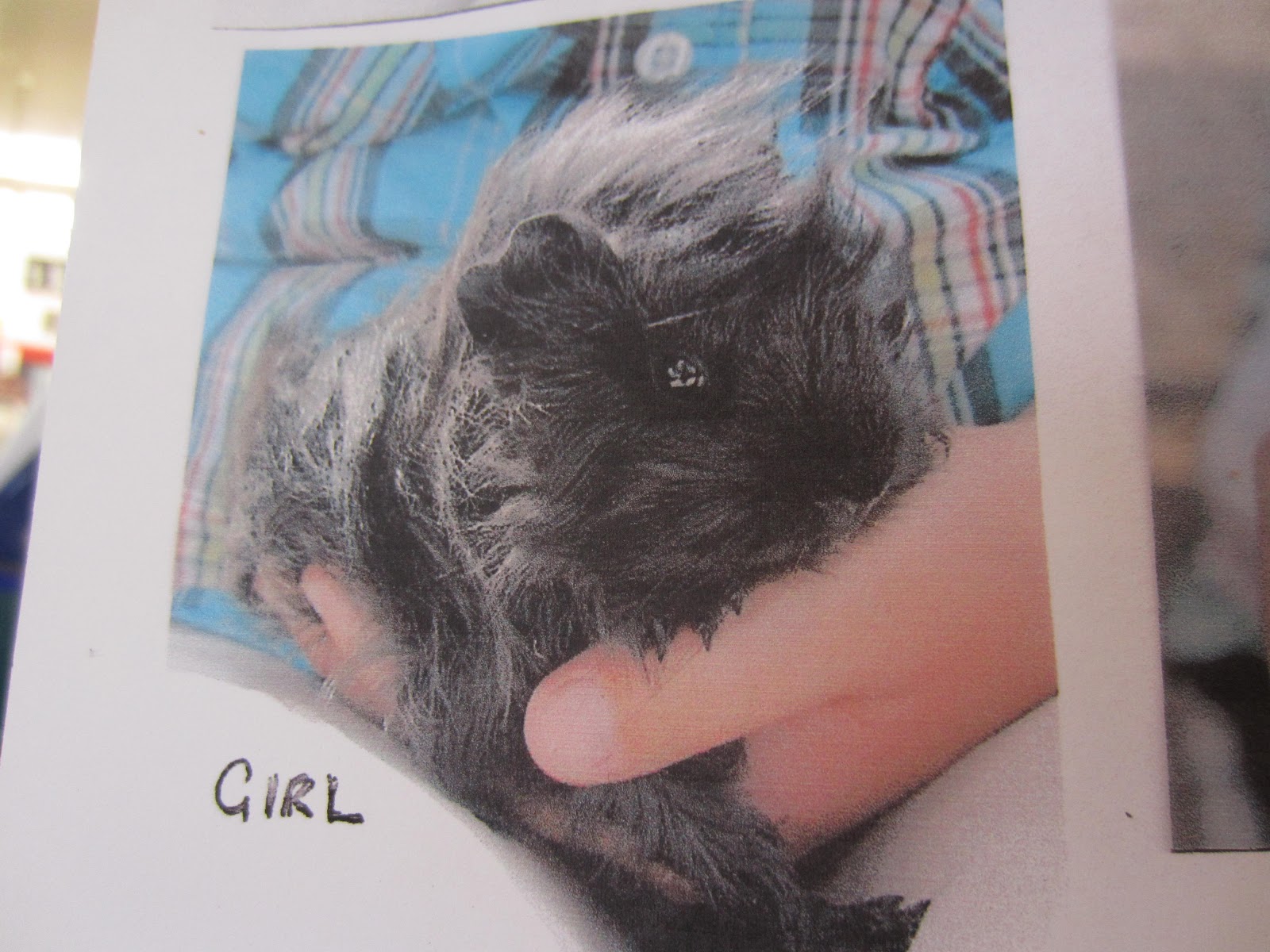
While I'd have to admit that the one in the photograph has got her hair under control a bit better than I have, the look on her face, that expression of utter, overwhelming confusion, it's exactly the same one that I see whenever I look in the mirror.
It's comforting, somehow, to think that huddled in a hutch somewhere in Binalong there is a small, furry kindred spirit who is just as unable to make sense of existence - or hair care - as me.
Tuesday, 26 February 2013
The Joy of Babel II
Yesterday, when we were watching the news about the Italian election, Mr Monti appeared on the screen. "What's the Italian for 'boring'?", my husband asked. "'Noioso,'" I said, 'or possibly 'fastidioso', although I think that means more irritating and tedious than dull exactly."
"What's the Italian word for 'fastidious' then, if 'fastidioso' means annoying?" my husband asked. We looked it up in my ancient and rather useless dictionary (so useless that when you look up 'boring' in the English section, all you get is an engineering term) and also in the electronic dictionary that came with my e-reader.
What we found illustrates one of the things I love about learning languages - the way in which underlying differences in the outlook of the speakers of another language are revealed in the language itself. In this case, almost all the words listed to translate the English concept 'fastidious' into Italian - 'difficile', 'esigente', 'schifiltoso' (which presumably comes from 'schifo') and 'incontentabile' - were negative.
The Italian language clearly assumes that its speakers will see someone who is fastidious in their approach to life and work - (the kind of person that I, as an editor, would regard as the apex of humankind) - as difficult and hard to please. The thing that interests me is whether this detail suggests that Italians actually regard the fastidious as a bit of a pain or whether it is just their language that prevents them from viewing such people in a more positive light. Do we shape language or does language shape us?
"What's the Italian word for 'fastidious' then, if 'fastidioso' means annoying?" my husband asked. We looked it up in my ancient and rather useless dictionary (so useless that when you look up 'boring' in the English section, all you get is an engineering term) and also in the electronic dictionary that came with my e-reader.
What we found illustrates one of the things I love about learning languages - the way in which underlying differences in the outlook of the speakers of another language are revealed in the language itself. In this case, almost all the words listed to translate the English concept 'fastidious' into Italian - 'difficile', 'esigente', 'schifiltoso' (which presumably comes from 'schifo') and 'incontentabile' - were negative.
The Italian language clearly assumes that its speakers will see someone who is fastidious in their approach to life and work - (the kind of person that I, as an editor, would regard as the apex of humankind) - as difficult and hard to please. The thing that interests me is whether this detail suggests that Italians actually regard the fastidious as a bit of a pain or whether it is just their language that prevents them from viewing such people in a more positive light. Do we shape language or does language shape us?
Monday, 25 February 2013
Limited Value
Usually, when learning a language, I am a dutiful plodder, accepting unquestioningly the rules of grammar and completing the dull exercises I'm set without a second thought. However, yesterday, as I was ploughing my way through a chapter on the Hungarian imperative in one of my Teach-Yourself-Hungarian-type books, I did find myself wondering about the verbs that had been chosen to illustrate the different classes of conjugation.
I mean, how likely is that I'm ever going to order anyone to do some milking, or indeed exclaim cheerfully, 'Let us milk'? And I trust I'm right in assuming that I'm never going to need to use the word 'kill' in any context, least of all the imperative - or is it a rule that, once in possession of knowledge, one will inevitably put that knowledge to use?
I mean, how likely is that I'm ever going to order anyone to do some milking, or indeed exclaim cheerfully, 'Let us milk'? And I trust I'm right in assuming that I'm never going to need to use the word 'kill' in any context, least of all the imperative - or is it a rule that, once in possession of knowledge, one will inevitably put that knowledge to use?
Tuesday, 12 February 2013
How Now Thou Lovely Plough
I love learning foreign languages, but I've gone on in detail about that before. At the time I also mentioned my curiosity about the loss of the 'thou' form in English. Why did we lose it, when did we lose it and does it mean we're all ice-cold swine?
Anyway, I should also have mentioned, while on that particular subject, that one of the things I find adorable about the fiendishly hard Hungarian language is the fact that, as well as having the 'you' and 'thou' forms familiar to anyone who's had a go at any of the Germanic, Slavic or Romance languages, it also has a third utterly unfathomable - to me at least - mode of address that is either more or less haughty than the other two (I've never been able to make out where it really fits in in the complex world of linguistic efforts to express the subtleties of human relationships).
Furthermore, Hungarians, already in possession of an extra nuance in their interchanges, (and two different verb declensions, depending upon whether the object of their sentence is vague - 'a', 'some', 'several' - or definite - 'the'), also have a verb form reserved specifically for activities that go on between a first person singular - 'I' - subject and a second person singular (or plural [ideal for orgies]) - 'thou' - object. Thus, there is 'I see him' and 'I see you' and 'he sees thou', but, as well, in the phrase 'I see thou', a special iteration of the verb is used to convey the exclusively intimate relationship that exists between an 'I' and a 'thou'.
Such nuance in a language's grammar strikes me as both sophisticated and sensitive. My mother tongue seems a rather primitive tool by comparison. Remembering how as a small child in primary school I baffled my teacher - (no, no, not lovely Miss Monck Mason, she would have understood immediately - it was that horrid Miss Pickard) - by writing a story - (at the school that I went to virtually all we ever did was write stories) - about a character called 'pudding hat' who led an uprising of the common nouns, demanding the same rights as proper nouns to have initial capital letters - (of course, 'pudding' should have moved to Germany I realised when I started learning that language decades later) - I wonder now whether it is in fact English verbs, rather than nouns, that should be revolting. Rise up, 'doing words', demand equality with your more subtle Hungarian chums.
Anyway, I should also have mentioned, while on that particular subject, that one of the things I find adorable about the fiendishly hard Hungarian language is the fact that, as well as having the 'you' and 'thou' forms familiar to anyone who's had a go at any of the Germanic, Slavic or Romance languages, it also has a third utterly unfathomable - to me at least - mode of address that is either more or less haughty than the other two (I've never been able to make out where it really fits in in the complex world of linguistic efforts to express the subtleties of human relationships).
Furthermore, Hungarians, already in possession of an extra nuance in their interchanges, (and two different verb declensions, depending upon whether the object of their sentence is vague - 'a', 'some', 'several' - or definite - 'the'), also have a verb form reserved specifically for activities that go on between a first person singular - 'I' - subject and a second person singular (or plural [ideal for orgies]) - 'thou' - object. Thus, there is 'I see him' and 'I see you' and 'he sees thou', but, as well, in the phrase 'I see thou', a special iteration of the verb is used to convey the exclusively intimate relationship that exists between an 'I' and a 'thou'.
Such nuance in a language's grammar strikes me as both sophisticated and sensitive. My mother tongue seems a rather primitive tool by comparison. Remembering how as a small child in primary school I baffled my teacher - (no, no, not lovely Miss Monck Mason, she would have understood immediately - it was that horrid Miss Pickard) - by writing a story - (at the school that I went to virtually all we ever did was write stories) - about a character called 'pudding hat' who led an uprising of the common nouns, demanding the same rights as proper nouns to have initial capital letters - (of course, 'pudding' should have moved to Germany I realised when I started learning that language decades later) - I wonder now whether it is in fact English verbs, rather than nouns, that should be revolting. Rise up, 'doing words', demand equality with your more subtle Hungarian chums.
Monday, 11 February 2013
Sydney Vernacular
I've been dealing with Sydney people lately. Sydney is different. Well, anywhere is different, when you live in Canberra. But there is a ridiculous kind of swagger adopted by a certain kind of young wheeler dealer in Sydney (estate agents particularly). One of the annoying little traits I've noticed as I've listened to them and communicated with them over the internet is the new habit of saying not, 'Send me an email', but 'Shoot me an email'. Why? Does it sound more exciting? Did they pick it up from some hipster movie? I know it doesn't matter; it's just that it jars.
Monday, 10 December 2012
Words and Phrases, a Continuing Series
I'm not sure the thing I'm objecting to today is actually a phrase so much as a franchise. It's certainly not a
Sunday, 9 December 2012
Tribbles and the Tin Man
Having headed a post 'The Name Game' yesterday, I was surprised to see this, on opening my daughter's
Friday, 7 December 2012
The Name Game
It gave me a shock to meet a grown-up Merlin the other day. I remember when I first heard the name
Monday, 8 October 2012
Sunday, 7 October 2012
Saturday, 25 August 2012
Sunday, 29 July 2012
Words and Phrases and Olympics Inspired Excrescences
I'd managed to forget 'medalled', such a loathsome usage, but, having just seen it on the Australian Broadcasting Corporation's site, I'm shuddering all over again.
'We've medalled plenty of times in this blue-riband event ...' the ABC tells us, (something to do with rowing, in this instance, I think).
Blistering barnacles, to quote Captain Haddock - 'medalled'? Eeeergh, ugh, gneaeuu, yuk, triple yuk.
I don't know if this usage is confined to Australian commentators - if it is, I hope it does not escape our shores. Unfortunately though, our usages - eg 'uni' - have a disturbing habit of spreading. So, if 'medalling' heads your way, please, please, please, just stamp it firmly out.
'We've medalled plenty of times in this blue-riband event ...' the ABC tells us, (something to do with rowing, in this instance, I think).
Blistering barnacles, to quote Captain Haddock - 'medalled'? Eeeergh, ugh, gneaeuu, yuk, triple yuk.
I don't know if this usage is confined to Australian commentators - if it is, I hope it does not escape our shores. Unfortunately though, our usages - eg 'uni' - have a disturbing habit of spreading. So, if 'medalling' heads your way, please, please, please, just stamp it firmly out.
Monday, 9 July 2012
Hotel Nonsense
I have already said enough on the subject of hotels and towels, but I feel I've hardly begun on the other mad things you find when you stay in one or other of the world's big chains. Here are two examples of loopy messages left for room occupants in a place I stayed recently. Each of them is probably the result of memos, meetings, policy documents and inter-departmental protocols. Each of them is batty:
 |
| Wearing a shower cap is such a mood changer - especially if you do it in a crowded restaurant or diplomatic cocktail party |
 |
| Who would have thought? |
Tuesday, 19 June 2012
Encounters with Futility
Despite making an effort to put aside at least ten to fifteen minutes of every day to study the Hungarian language, I seem to have got worse at speaking the bloody thing, rather than better. I've stuffed my head with all sorts of big, impressive looking bits of vocabulary, but they seem to have shoved out the words and phrases that are the building blocks of daily commonplace interchange. It's very disheartening.
Which is why I was amused when I came across a passage about Hungarian in Patrick Leigh Fermor's wonderful book Between the Woods and the Water (if you haven't read it and its forerunner, A Time of Gifts, I highly recommend them both. I think he was one of the greatest descriptive writers of modern times and the story he tells of his walk across Europe is wonderful).
In this extract he has just arrived in Budapest and is trying to get to grips with the local tongue:
'Coming from a great distance and wholly unrelated to the Teutonic, Latin and Slav languages that fence it in, Hungarian has remained miraculously intact. Everything about the language is different, not only the words themselves, but the way they are formed, the syntax and grammar and above all the cast of mind that brought them into being. I knew that Magyar belonged to the Ugro-Finnic group, part of the great Ural-Altaic family. "Just", one of my new friends told me, "as English belongs to the Indo-European." He followed this up by saying that the language closest to Hungarian was Finnish.
"How close?"
"Oh very!"
"What, like Italian and Spanish?"
"Well no, not quite as close as that ..."
"How close then?"
Finally after a thoughtful pause, he said, "About like English and Persian."'
Which is why I was amused when I came across a passage about Hungarian in Patrick Leigh Fermor's wonderful book Between the Woods and the Water (if you haven't read it and its forerunner, A Time of Gifts, I highly recommend them both. I think he was one of the greatest descriptive writers of modern times and the story he tells of his walk across Europe is wonderful).
In this extract he has just arrived in Budapest and is trying to get to grips with the local tongue:
'Coming from a great distance and wholly unrelated to the Teutonic, Latin and Slav languages that fence it in, Hungarian has remained miraculously intact. Everything about the language is different, not only the words themselves, but the way they are formed, the syntax and grammar and above all the cast of mind that brought them into being. I knew that Magyar belonged to the Ugro-Finnic group, part of the great Ural-Altaic family. "Just", one of my new friends told me, "as English belongs to the Indo-European." He followed this up by saying that the language closest to Hungarian was Finnish.
"How close?"
"Oh very!"
"What, like Italian and Spanish?"
"Well no, not quite as close as that ..."
"How close then?"
Finally after a thoughtful pause, he said, "About like English and Persian."'
Tuesday, 5 June 2012
Eating Humble Pie
I've banged on before, here and here and here, about how I hate the new habit of expressing appreciation for an honour by explaining how 'humbled' you feel. However, this morning, having heard the Queen thank her nation for her Jubilee celebrations by telling them that she feels 'humbled', I realise that I must admit complete defeat.
The Macquarie dictionary defines 'humble' as meaning 'low in station, grade or importance,' or 'modest, meek, without pride' and the verb as meaning 'to lower in condition, importance or dignity; abase' or 'to make meek'. I suppose it is the second meaning that the Queen is using the word in (she can hardly mean 'low in station' can she?) I still think it's a mad approach.
When countless people have spent millions to amaze you, dazzle you and show you a riproaring (if rather rainsodden) good time, I imagine they'd be hoping that you would respond with excitement, joy, delight and rapture. To tell them you feel modest at the end of it all seems to me to rather put a dampener on things.
But it appears that 'humbled' is the 'appropriate' response to such things these days, indicating that not for one minute does anyone delude themselves that they are better than anyone else or feel an instant of that dreadful thing called pride (a pinch might be allowed if you were a survivor of Gallipoli, but only a tiny pinch even then). And we would never want to be anything other than 'appropriate'.
The Macquarie dictionary defines 'humble' as meaning 'low in station, grade or importance,' or 'modest, meek, without pride' and the verb as meaning 'to lower in condition, importance or dignity; abase' or 'to make meek'. I suppose it is the second meaning that the Queen is using the word in (she can hardly mean 'low in station' can she?) I still think it's a mad approach.
When countless people have spent millions to amaze you, dazzle you and show you a riproaring (if rather rainsodden) good time, I imagine they'd be hoping that you would respond with excitement, joy, delight and rapture. To tell them you feel modest at the end of it all seems to me to rather put a dampener on things.
But it appears that 'humbled' is the 'appropriate' response to such things these days, indicating that not for one minute does anyone delude themselves that they are better than anyone else or feel an instant of that dreadful thing called pride (a pinch might be allowed if you were a survivor of Gallipoli, but only a tiny pinch even then). And we would never want to be anything other than 'appropriate'.
Subscribe to:
Posts (Atom)