Showing posts with label Australia. Show all posts

Saturday, 17 October 2026

Driving Across Australia - Day 1 - York, Western Australia

In early July, having flown from Europe to Perth and then caught the suburban train from the airport to Fremantle, where we recovered from jetlag for a day or two, we returned to the airport and collected a car we'd hired and headed towards York, which is billed as Western Australia's oldest inland town, and was supposedly named because the landscape reminded someone of Yorkshire (if Yorkshire had gumtrees, presumably).

Between Perth and York


We arrived in York late on a Sunday afternoon in winter, which is rarely the moment in the week that displays any town or city at its best. Nevertheless, it was lovely. We stayed in one of the town's many two-storey verandaed buildings and our landlady told us we would be sleeping in Sam Neill's bed. 

It turned out that Neill had been her guest for some weeks, while filming took place for a television courtroom drama. The courtroom in question was diagonally opposite the place where we were staying, on York's main street:


We strolled down this street as the sun was setting, admiring the architecture and, not for the first time, enjoying the special charm of country Australia:


We went down some side streets and found St Patrick's Catholic Church, which is now run by Somascans. Its stained glass windows were imported from Italy in the 1880s, which I found touching as I have the diary of a relative from around that time and, while on the Grand Tour, he seemed to spend most of his time in Italy ordering stained glass for his local church in the Western District of Victoria. 

The church in York, we discovered, was badly damaged in an earthquake in 1968 - during our travels we began to realise that, while we had been blithely unaware as children in the eastern states, over in the west some kind of dreadful seismic event happened in that year:


I loved the clash of tones here - the glorious message of the sign over this doorway and the banality of the cones on each side of it The note on the door, by the way, explains people cannot bring animals into the service. I liked the fact dogs were not specifically named, but the more generic "animals", prompting me to imagine a children's picture book in which people try to go to church with their pig or their horse or their goat but are all turned away. Only of course it would have to have a happy ending. Which might be that they are all allowed to worship at the outdoor grotto:
I though the priest's house lovely:

Venturing further, we discovered what I suppose might be described as a rival establishment, the Freemasons' Hall, now just someone's house:


And then we came upon York's astonishing town hall:

If you want evidence of the way that gold went to people's heads, this building is it. It is a building made for a thriving wealthy metropolis, surely. Meanwhile York has is a town of two and a half thousand people. 

This thing is magnificent outside and in:


I think the staircase is jarrah - it was certainly beautiful wood, whatever the species:

The fact that contemporary officials decided it would be fine to stick this extension on the back does make me wonder, (not for the first time), if we are totally lost as a culture:


Only one place was open for a meal, a magnificent former hotel, built in the 1890s but subsequently fallen into disrepair - that is, until 2018, when a group of local farmers banded together to renovate it.

I took a photograph of the photograph displayed inside the building, showing it immediately after the 1968 earthquake, which seemed to have stripped all the verandas from the building's facade:

Sadly, as it was dark by the time we reached the hotel and I forgot in the morning, I didn't take a picture of it as it is now. Instead, I will have to make do with another of the town's hotels, which is not hugely different in appearance:


I love these kinds of buildings. 

I also enjoyed sitting near this fine poster showing sheep breeds of Australia while eating dinner (I had beef, in deference to all those sweet, slightly dim faces - to eat their descendants in front of them struck me as bad form.)


There's a lot more I could say about York, but I wonder how many people want to hear more detail. The exhibition in the town hall was full of interesting displays, all very well done. I will only include one picture from those displays here, and I include it simply because I remembered it in amazement when some days later, having travelled by car, we eventually reached Coolgardie (a long, long way from York). The photograph shows a bloke setting off with a handcart to walk to Coolgardie, in hope of gold:


I found this little house behind the main street - it's the kind of building I could live in happily:

The style is distinctively Australian I think. I love it.

This building nearby was the trooper's cottage. It was built within the stable yard of the police station in around 1865 and occupied by Tommy Windich who was attached to the York Constabulary as a native assistant. I should add that there were fairly major hints in the historical plaques around the town that in this area at least the settlers from Europe were not welcomed with open arms:

A few other silly things:

Breakfast offerings, which I didn't have but which my husband did and which he enjoyed.

Only in Australia:

I thought this a nice piece of advertising, although I didn't take them up on it as there are few things I hate more than any kind of guided tour - and, if that isn't what they were offering, we didn't need it either since we were already self-driving:


This was a nice bit of unintended outback artistry, I thought:


For anyone minded to take David Betz seriously and pack their bags and get out of Europe before civil war gets really underway, here are some York real estate possibilities. Judging by the state of the sign, there hasn't been much competition for York's Premier Development Spot - so far.


I can think of many, many worse places in which to shelter from a political storm.


Friday, 2 December 2016

Battered Penguins (and others of that ilk) - Fatal Shore by Robert Hughes


The Fatal Shore, a History of the Transportation of Convicts to Australia, 1787-1868 by Robert Hughes, is a revelation, even for those of us who were educated in Australia and taught some Australian history. It is a book that leaves you awed by the propensity for cruelty that humankind displayed in the establishment of Australia.

In his Introduction, Hughes contends that:

“What the convict system bequeathed to later Australian generations was not the sturdy, skeptical independence on which, with gradually waning justification, we pride ourselves, but an intense concern with social and political respectability.”

I think he is right in this - and in the earliest incarnations of  Barry Humphries's Edna Everage, this is what was originally being made fun of.  Hughes's tale also helps explain why Australia as a nation appears less perturbed than some others by the idea of sending away groups we see as aliens to be processed on distant islands. From the beginning, this policy has been practised on us, with Norfolk Island the most infamous example of its implementation.

In his book, Hughes describes vividly the cruelty of the 18th century, not only in Australia but also in England. He tells of “the crush of jostling voyeurs” at Tyburn, the unspeakable conditions in the hulks, the blood lust and lack of humanity that developed among those who had power over prisoners, which led to unspeakable floggings for offences such as “Having turnips” or “Talking in Church”.

He also introduces the characters of influence during the various phases of Australia's penal history, although sadly his refusal to admire anyone wholeheartedly becomes a little irritating. Macquarie and Alexander Maconochie, both figures who did much worth applauding, cannot escape jibes about priggishness and self-righteousness.

Similarly, Hughes's account of what happened to Australia’s indigenous peoples is over-egged and prone to assertions unsupported by footnotes that might provide evidence of their truth. Included among these is the startling statement that Australian Aborigines “killed the infants they could not carry”. I've never heard of this practice before and I'd want to see some proof, beyond Mr Hughes's word, that it ever happened. Similarly, the contention that the possibility of converting Australian Aborigines to Christianity and farming was “an idea loathed and resisted by every white, no matter what his class” is hard to swallow - if every white genuinely loathed and resisted the idea, who came up with it in the first place?

But never mind - the book’s depth of research is generally extraordinary. It is also wonderfully written. This phrase, for instance, has an echo of The Tempest within it:

“The space around it, [Australia], the very air and sea, the whole transparent labyrinth of the South Pacific, would become a wall 14,000 miles thick.”

In dreadful circumstances, what is more, Hughes can occasionally be funny. An example is the wry comment he makes on a report that 50 or 60 cases of sodomy occurred each day on Norfolk Island:

“Since the total convict population of Norfolk Island at the time was about 600, this argues an impressive priapic energy on the prisoners’ part, perhaps caused by the sea air.” 

Thanks to Hughes's work, I am now able to conjure in my imagination some notion of the original figures whose names are already familiar from street names and titles of institutions - for instance, Bent Street in Sydney, which I’d always assumed was named for its shape, turns out to be named after an early legal man, while the Alexander Maconochie Centre in Canberra is named after a rather inspiring visionary, who hoped to reform penal services and, at least for a time, relieved the utterly hellish lives of the unfortunates on Norfolk Island.

Hughes argues that the national psyche is still shaped by our penal origins:

“Would Australians have done anything differently if their country had not been settled as the jail of infinite space? Certainly they would. They would have remembered more of their own history. The obsessive cultural enterprise of Australians a hundred years ago was to forget it entirely, to sublimate it, to drive it down into unconsulted recesses. This affected all Australian culture, from political rhetoric to the perception of space, of landscape itself. Space, in America, had always been optimistic; the more of it you faced, the freer you were - “Go West, young man!” In Australian terms, to go west was to die, and space itself was the jail. The flowering of Australian nature as a cultural emblem, whether in poetry or in painting, could not occur until the stereotype of the “melancholy bush,” born in convict perceptions of Nature-as-prison, had been expunged. A favourite trope of journalism and verse at the time of the Australian Centennial, in 1888, was that of the nation as a young vigorous person gazing into the rising sun, turning his or her back on the dark crouching shadows of the past.”

but he concludes, surprisingly, by saluting the penal system with which Australia was founded - or at least saluting the tokens left by those who suffered under its harsh disciplines:

“To ask what Australia would have been without convicts is existentially meaningless. They built it - if by “it” one means European material culture there - and their mute traces are everywhere: in the peckings and scoops of iron chisels on the sandstone cuttings of Sydney, hewn with such terrible effort by the work gangs; in the fine springing of one bridge at Berrima in New South Wales, and the earnest, slightly bizarre figures carved on the face of another at Ross in Tasmania; in the zigzags of the Blue Mountain road, where traffic now rolls above the long-buried, rusted chains of the dead; less obviously, in the fruitful pastures that were once primaeval gum forest.”

I remember a few years ago hearing a young Australian comedian's routine about how she had been born and brought up in Bondi. Every morning, she got up and looked out of her window and thought, "Wow, if this is the prison, what must England be like? It must be paradise on earth." The punchline was her arrival at Heathrow.

That little joke might not appear exceptionally funny, viewed from an English point of view, but to have reached the current situation - where the place to which the dregs of British society were banished is now a place where many in the United Kingdom would give a lot to be allowed to live permanently - does have a certain comedy to it, especially if you are lucky enough to be born Australian. What Hughes's book shows is that, in addition to being amusing, this result is also downright astonishing. Emerging from such fiercely cruel origins to become a thriving, middle-ranking nation is little short of miraculous. While Australia's early story lacks the romanticism of, for example, the founding myths of the United States, the creation of the modern nation of Australia -  (for all its faults; I don't claim it is perfect, any more than any human society is) - from the blood-soaked violence detailed by Hughes is an achievement both surprising and fairly wonderful.

Friday, 14 June 2013

No Laughing Matter

Almost the first joke I can remember - the very first one was "I never drink, I never smoke, I never swear. Damn, bloody hell, I left my pipe down at the pub", but I'm only telling you that in the interests of openness and honesty - is the one where someone asks you, 'Which would you prefer: to be executed or burnt at the stake?', and you reply, 'Executed' (or, I presume most people do, on the grounds that it's over quickly) and then the joker says, 'What, you'd prefer a cold chop to a hot steak?', (sound of cymbals, drum roll, et cetera).

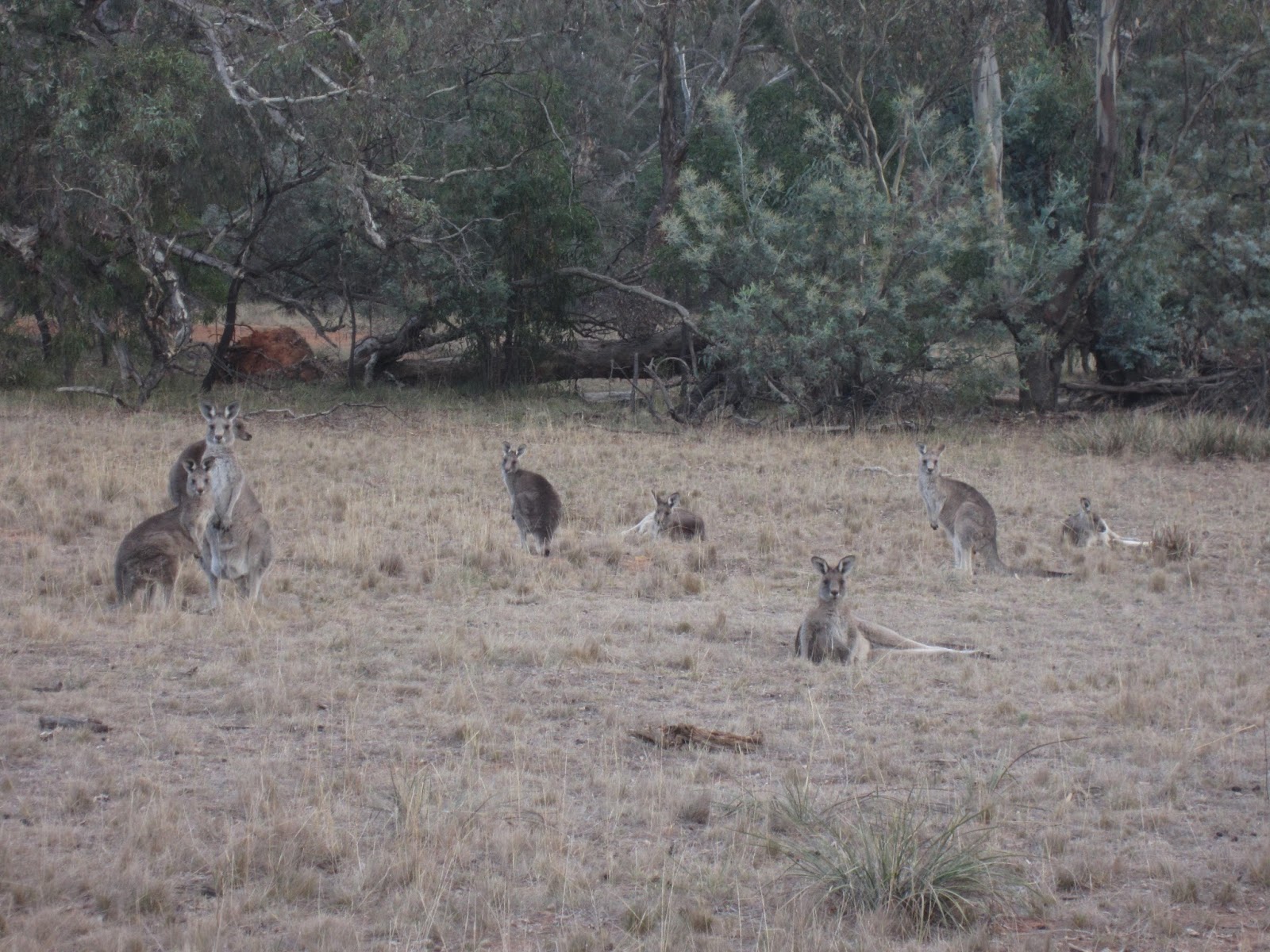
When I learned earlier in the week that a group of my fellow citizens were taking legal action to stop the culling of kangaroos in Canberra's various bits of pseudo bush, that joke's cymbals and drum rolls echoed once again in my ears. You see, I walk through one of those bits of so-called bush - (while it lacks houses, it does have a reservoir, a power plant and rangers driving through it in utes on a regular basis, not to mention numerous cyclists, dogs and walkers, which, to my way of looking at things, means that it is really a park, but never mind) - on a daily basis. As a result I've observed that, following a couple of really good seasons, the kangaroo numbers in the area have grown enormously. To give you an idea, here are photographs taken in just the last couple of days:


The place is getting kind of overcrowded, kangaroowise. To make things worse, we're having a pretty dry year this year and food for kangaroos is getting so scarce that many are coming further and further down the hill to forage. Many of them will soon be starving. Indeed, I startled one the other day that was clearly too weak to even run away. We stared at each other for an instant, and I've never seen such a movingly human look of fear, shame and utter sadness in an animal's eyes. I know I sound like I'm anthropomorphising, but I don't think that was quite what I was doing. I'm not sure how to explain it, except to say that perhaps when any creature reaches an extreme state of desperation it comes down to its essence as a living creature, rather than as a member of a species - and at that level all living creatures share a lot in common with their fellows whether they be human, kangaroo, bird or fish.

The strange thing was that what I wished for at that moment was a gun and the knowledge of how to use it. It would, in my view, have been kind to shoot that kangaroo. To kill it, quickly and cleanly, would have been violent, but it was less cruel than letting it limp off to die slowly and alone. And that's what the anti-cullers don't get, I reckon. They think they're being kind when what they're actually being is squeamish. They won't admit that many animals will die, one way or another, because there are too many for the food that's available. Our choice is the cold chop or the hot steak, as it turns out. We can kill them humanely, using experienced shooters who can dispatch them instantly, with one shot, or we can leave them to starve, which means a painful, long drawn-out, miserable kind of death.