This week I wondered if, no matter how nice a particular boss might be, some people are unable to see past the structure the position of "boss" implies. Those people remain obstructive and resentful, not necessarily because they dislike the individual but because they dislike the position the individual fills. Which makes things very tricky.
I then wondered why, when inevitably in any endeavour there always ends up being someone who gives the orders or at the very least coordinates the collective will, it is so appealing to smash up what are seen as elitist structures. Elitism is as ineradicable as couch grass, if you define elitism as a structure where some people have more power than others.
And, in any case, power structures can evolve, without violence, so why ever resort to violence to achieve ideological aims? If you look first at Austria and then at the countries to its east, it is fairly easy to see which approach achieves better outcomes - the non-violent one.
Post-war in both Austria and, for example, Romania, there was a class of landowning gentry. In Romania unspeakable cruelties were practised on the landowners, their estates were smashed, and so forth and now the country has an immense task ahead in rebuilding its economy - not to mention its civil society, to use Vaclav Havel's term. In Austria none of that class-targeted violence occurred. Yet in neither Austria nor Romania do the landowning gentry still dominate; the result was the same in both places, politically. So what was the point of all that brutality?
Then I saw this on www.otherlanguages.org and I wondered how some people actually become bosses.
Showing posts with label Romania. Show all posts
Showing posts with label Romania. Show all posts
Thursday, 23 July 2015

Friday, 9 November 2012
Wednesday, 3 October 2012
Thursday, 27 September 2012
Wednesday, 19 September 2012
Wednesday, 4 July 2012
Thank You Letters
We went the other day to a monastery in Romania where Patrick Leigh Fermor spent a night or two:

 In a little corridor to the side of the main church there was a display of the paintings people have donated over the years to say thank you for prayers answered. This one dates from 1934, the date Leigh Fermor was at the monastery:
 There are others that are older as well as some of a similar vintage and many more that are quite recent. They are touchingly naive. The recurring themes are bad driving and agricultural accidents:


 This one has a strange sense of Janet and John about it:


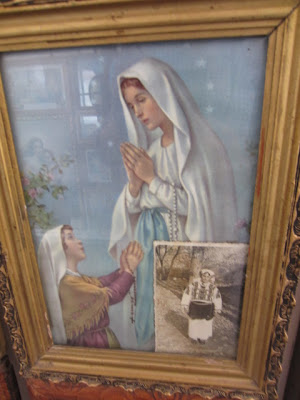

I think this is my favourite:


Thursday, 3 November 2011
Still Obsessing
I was telling a friend who lives in the country about seeing the map pins that Jobbik were selling on the anniversary of the 1956 uprising, and she in turn told me that in the village next to hers there is a restaurant where every Thursday is Big Hungary Day.
If you go for dinner there on Big Hungary Day, they serve you a schnitzel on a wooden plate that is carved in the shape of the old map of Hungary, before the Treaty of Trianon sliced chunks off it. The schnitzel you get comes in two pieces - one is in the shape of the current Hungary and the other, extra, encircling piece is in the shape of what was cut off - of which the major part was Transylvania.
When my friend asked if she could buy one of the wooden plates to take home with her, the restaurant owner explained that they didn't have many, as they were handmade and sent from Transylvania. He didn't tell her whether the manufacturers were Hungarian Romanians or Romanian Romanians. I suppose he didn't really need to.
If you go for dinner there on Big Hungary Day, they serve you a schnitzel on a wooden plate that is carved in the shape of the old map of Hungary, before the Treaty of Trianon sliced chunks off it. The schnitzel you get comes in two pieces - one is in the shape of the current Hungary and the other, extra, encircling piece is in the shape of what was cut off - of which the major part was Transylvania.
When my friend asked if she could buy one of the wooden plates to take home with her, the restaurant owner explained that they didn't have many, as they were handmade and sent from Transylvania. He didn't tell her whether the manufacturers were Hungarian Romanians or Romanian Romanians. I suppose he didn't really need to.
Sunday, 23 October 2011
Obsessions
You don't have to spend long in Hungary to learn that Trianon is a national obsession, together with the map of Hungary as it once was. Today, the anniversary of the start of the 1956 revolution, I came upon a Jobbik demonstration. Jobbik is an extreme rightwing party with all the usual unpleasant attributes.
To distinguish themselves from the hoy palloy they dress entirely in black, which is, to say the least, threatening. A few of them go for frogged woolen jackets, high black boots and jodhpurs, while the rest content themselves with Doc Martins into which they tuck their trousers, teaming these with black jackets that bear slogans like 'For a more beautiful future', or maps of Hungary before Trianon:

 Few Jobbik members look like the sharpest pins in the box. On the other hand, they do like pins:

 Those little black crosses have 'Trianon' written on them.
 The shields up the top have 'Erdely' written on them, which is the Hungarian word for 'Transylvania'.

As well as pins, beer was also available. It was a kind I haven't seen before: it had the old map, coloured in with the Hungarian flag, on its label and it was selling very well indeed. It was a beer that was intended exclusively for Hungarians, so, of course, I didn't buy a bottle:
 They were also flogging keyrings that I thought were rather pretty, but, sadly, I knew I couldn't have one. I may be conservative, but I'm not quite ready to go around carrying the insignia of the equivalent of the National Front.

To distinguish themselves from the hoy palloy they dress entirely in black, which is, to say the least, threatening. A few of them go for frogged woolen jackets, high black boots and jodhpurs, while the rest content themselves with Doc Martins into which they tuck their trousers, teaming these with black jackets that bear slogans like 'For a more beautiful future', or maps of Hungary before Trianon:


As well as pins, beer was also available. It was a kind I haven't seen before: it had the old map, coloured in with the Hungarian flag, on its label and it was selling very well indeed. It was a beer that was intended exclusively for Hungarians, so, of course, I didn't buy a bottle:


(I should point out that Jobbik's was not the only demonstration in Budapest today. There was also a larger - although also far from enormous - anti-Orban demonstration on the Elizabeth Bridge, coming at things from the other end of politics. All in all, despite the szomoru vasarnap kind of weather, it was cheering to see what a far cry it was from 23 October, 1956, when it came to freedom of expression today.)
Tuesday, 3 August 2010
Melbourne Film Festival - The Autobiography of Nicolai Ceausescu
The Autobiography of Nicolai Ceausescu is a very long film (180 minutes), made entirely from propaganda and news footage of Ceausescu's time in power. There is no commentary and no attempt to shape the material into any kind of structured narrative. It is less an evening's entertainment than an endurance test - at the screening I attended the exodus started as a trickle but, as the images flowed on and on, the numbers of viewers leaving the theatre grew and grew.
Sadly leaving was not a choice available to most Romanian people. Possibly, this was the goal of the makers of the film - to give an impression of what it was like to live in a country where broadcast information was controlled, where the truth you were shown in the media bore no relation to the truth you saw around you in your daily life. If so the method was quite effective. I visited Romania several times at the height of Ceausescu's worst excesses and saw with my own eyes that the shelves in the shops really were bare and people were cold and miserable and things were about as bad as you could imagine. Even so, after watching Ceausescu tour shops stuffed with bread and meat and fish and fruit and vegetables - sometimes with visiting international politicians (de Gaulle, Nixon, plus the usual Soviet suspects), sometimes by himself, (one of his interminable birthday celebrations appears to have included an all-day round of food shop visiting - inadvertently one section of this footage includes an off-camera frenzied conversation about whether or not the fish has arrived yet so that the usually empty cabinet can be hastily made to appear full), I was beginning to wonder if I'd allowed my memory to exaggerate just how bad things had really been.
The film includes footage of Ceausescu's overseas visits. The North Koreans and Mao-era Chinese produce dazzling displays of frenzied joy at his arrival. The British wheel out guardsmen and state coaches, but the Queen looks as if she is trying to stifle the desire to be quietly sick. Jimmy Carter looks unimpressive, as usual. Brezhnev strokes Ceausescu's face and Gorbachev complains about the heat.
What the film does not do is give any insight into Ceausescu's personality. Did he really believe the dreary Marxist Leninist drivel he spouted repeatedly? Could he possibly have been fooled by his own propaganda? Did he understand what suffering was being endured by his people? And what did the delegates to the annual party congresses think they were doing, rising as a man to yell support for him in unison - at the XIIth party congress even turning on one individual who was brave enough to challenge Ceausescu's unscrupulous manipulation of the system? Where are those people now? How do they live with themselves?
I don't think I could recommend The Autobiography of Nicolai Ceausescu, not only because it is so very long. The most remarkable and ultimately pointless thing about it is its utter neutrality - without previous knowledge, the viewer could leave the cinema no wiser about who Ceausescu was or what had brought him to the film's final scene, cornered in a country police station, refusing to answer questions and looking afraid. I suppose in that context, the film's achievement is that the audience has grown so heartily sick of this unimpressive little man that they are glad to be rid of him. What is missing though is a proper explanation of just what harm he did - boring people was the least of it. Because of this missing wider context, the film, despite some interesting and even comic moments, seems to me an exercise in futility - like Ceausescu's own endeavours, I suppose.
Sadly leaving was not a choice available to most Romanian people. Possibly, this was the goal of the makers of the film - to give an impression of what it was like to live in a country where broadcast information was controlled, where the truth you were shown in the media bore no relation to the truth you saw around you in your daily life. If so the method was quite effective. I visited Romania several times at the height of Ceausescu's worst excesses and saw with my own eyes that the shelves in the shops really were bare and people were cold and miserable and things were about as bad as you could imagine. Even so, after watching Ceausescu tour shops stuffed with bread and meat and fish and fruit and vegetables - sometimes with visiting international politicians (de Gaulle, Nixon, plus the usual Soviet suspects), sometimes by himself, (one of his interminable birthday celebrations appears to have included an all-day round of food shop visiting - inadvertently one section of this footage includes an off-camera frenzied conversation about whether or not the fish has arrived yet so that the usually empty cabinet can be hastily made to appear full), I was beginning to wonder if I'd allowed my memory to exaggerate just how bad things had really been.
The film includes footage of Ceausescu's overseas visits. The North Koreans and Mao-era Chinese produce dazzling displays of frenzied joy at his arrival. The British wheel out guardsmen and state coaches, but the Queen looks as if she is trying to stifle the desire to be quietly sick. Jimmy Carter looks unimpressive, as usual. Brezhnev strokes Ceausescu's face and Gorbachev complains about the heat.
What the film does not do is give any insight into Ceausescu's personality. Did he really believe the dreary Marxist Leninist drivel he spouted repeatedly? Could he possibly have been fooled by his own propaganda? Did he understand what suffering was being endured by his people? And what did the delegates to the annual party congresses think they were doing, rising as a man to yell support for him in unison - at the XIIth party congress even turning on one individual who was brave enough to challenge Ceausescu's unscrupulous manipulation of the system? Where are those people now? How do they live with themselves?
I don't think I could recommend The Autobiography of Nicolai Ceausescu, not only because it is so very long. The most remarkable and ultimately pointless thing about it is its utter neutrality - without previous knowledge, the viewer could leave the cinema no wiser about who Ceausescu was or what had brought him to the film's final scene, cornered in a country police station, refusing to answer questions and looking afraid. I suppose in that context, the film's achievement is that the audience has grown so heartily sick of this unimpressive little man that they are glad to be rid of him. What is missing though is a proper explanation of just what harm he did - boring people was the least of it. Because of this missing wider context, the film, despite some interesting and even comic moments, seems to me an exercise in futility - like Ceausescu's own endeavours, I suppose.
Subscribe to:
Posts (Atom)