Tuesday, 9 August 2011
More Mad Marketing
The bicycle repair shop closest to me decided to change its name to MalAdjusted. Needless to say, it has now closed.

Monday, 8 August 2011
Department of Mad Marketing
Thinking about punnets of strawberries yesterday reminded me of the time my father and I were going to visit his sister, a woman for whom the word 'redoubtable' was invented.
Ten minutes from her house, it suddenly occurred to my father that we should not arrive empty handed. Seeing a sign by the side of the road, advertising strawberries for sale, he swerved into the lay-by where someone had set up a stall.
There was nobody there when we arrived, except a rather unkempt looking woman standing behind a makeshift counter. The only thing on the counter was a black tin cash box.
'Hello,' said my father, 'I'd like four punnets of strawberries - I need a present for my sister.'
'We've got no more strawberries,' the woman answered, 'but we've got plenty of potatoes - I could put a couple in a punnet and you could take her them instead.'
Ten minutes from her house, it suddenly occurred to my father that we should not arrive empty handed. Seeing a sign by the side of the road, advertising strawberries for sale, he swerved into the lay-by where someone had set up a stall.
There was nobody there when we arrived, except a rather unkempt looking woman standing behind a makeshift counter. The only thing on the counter was a black tin cash box.
'Hello,' said my father, 'I'd like four punnets of strawberries - I need a present for my sister.'
'We've got no more strawberries,' the woman answered, 'but we've got plenty of potatoes - I could put a couple in a punnet and you could take her them instead.'
Sunday, 7 August 2011
Policies that Might Make Me Vote for the Greens: No. 1
I might vote for the Greens if they banned the plastic boxes that tiny tomatoes, strawberries, blueberries and many other fruit and vegetables are now sold in and returned to the little wicker punnets of my youth.
Friday, 5 August 2011
Neater Abroad
In response to this, Umbagollah sent me a link to a poem by Les Murray - I was going to say a lovely poem by Les Murray but the lovely goes without saying really - that I hadn't read before. Here it is:
They've had so many jobs:
boiling African porridge. Being printed on.
Paving Paris, flying in her revolutions.
Supporting a stork's nest in Spain.
Their suits are neater abroad,
of denser drape, unnibbled:
they've left their parasites at home.
They flower out of bullets
and, without any taproot,
draw water from way deep.
When they blow over
they reveal the black sun of that trick.
Standing round among shed limbs
and loose slabbings of bark
is homeland stuff
but fire is ingrained.
They explode the mansions of Malibu
because to be eucalypts
they have to shower sometime in Hell.
Their humans, meeting them abroad,
often grab and sniff their hands.
Loveable singly or unmarshalled
they are merciless in a gang.
Eucalypts in Exile
Les Murray
They've had so many jobs:
boiling African porridge. Being printed on.
Paving Paris, flying in her revolutions.
Supporting a stork's nest in Spain.
Their suits are neater abroad,
of denser drape, unnibbled:
they've left their parasites at home.
They flower out of bullets
and, without any taproot,
draw water from way deep.
When they blow over
they reveal the black sun of that trick.
Standing round among shed limbs
and loose slabbings of bark
is homeland stuff
but fire is ingrained.
They explode the mansions of Malibu
because to be eucalypts
they have to shower sometime in Hell.
Their humans, meeting them abroad,
often grab and sniff their hands.
Loveable singly or unmarshalled
they are merciless in a gang.
Nudging Opinion
In an article on European postal services (no, really, it was actually very interesting - chiefly because it explained to me how a lot of them are being out-sourced to home-workers, who are paid badly and cannot keep up with the number of deliveries they are expected to make) in the London Review of
Books, a rising star in the Post Office in Britain is described thus:
"Michael Fehilly, Gatwick's manager, strode around in a grey pinstripe suit, brown loafers and an open-necked pink shirt."
When I read that, I immediately thought, 'Why am I being told about what he's wearing?' The information adds nothing at all to the strength of the writer's argument that the changes in 'work practices' are not entirely positive for everyone. However, it is possible these details are meant to shape my opinion about one of the people behind the changes.
Leaving aside the fact that I'm not quite sure in what way my opinion is supposed to be shaped - should I disapprove of Mr Fehilly's decision to combine a grey suit with brown shoes (and from there should I make the leap to deciding that, if he makes bad dress choices, he is therefore going to make bad business choices?); is a pink shirt some kind of obscure code for 'irredeemably naff''?; or have I got things quite wrong, (is the description of his outfit actually supposed to indicate the man's excellent taste?) - I don't like being manipulated. The article is supposed to be about the consequences of a shift in the way business is being done across Europe, rather than about a particular individual, and I want to be presented with arguments, not ad hominem attacks through the medium of clothing.
The writer's defence for including these details would probably be that he was adding colour to his story. However, I think he's just trying to colour the way I think.
Another example, taken from a recent edition of the New Yorker, illustrates this even more clearly. At the start of an article about a woman who has been diagnosed as mentally ill but challenges the diagnosis, readers are told:
"A tall, athletic fifty-one-year old, with blue eyes and a bachelor's degree in art history from the University of New Hampshire, Linda had been admitted to the hospital in late October, 2006, after having been found incompetent to stand trial for a series of offenses."
Readers have to wade through three more pages before they are allowed to discover what the offences were that the woman had committed, even though that information, it seems to me, is far more relevant to an understanding of what she is like than the fact that she has an art history degree, blue eyes and looks athletic. However, being told upfront that she flipped her car while drunk, threw a cup of urine at a corrections officer and struck someone with a broomstick would be unlikely to make us enormously sympathetic to her cause.
But those are the things she did, however blue her eyes may be. Eye colour has nothing to do with mental illness (I hope, since I also have blue eyes.) Shoe colour has nothing to do with moral strength. The things that are worth reporting are words and actions. They provide genuine insights. For instance, later in that LRB postal article, the chief executive of UK Mail, Royal Mail's competitor, comments on the pre-tax wages - 20,000 pounds per year for a 40-hour week - of a Royal Mail postman:
"'That's a lot of money in current terms,'" he says.
There is really no need to tell us anything extra about his physical features, his higher education or his clothing. We can already guess what his salary is - or at least that it is several multiples of the one he describes as 'a lot of money' - and we can be certain he would not enjoy trying to live on a postman's salary, let alone working that physically hard. Without reference to cravats or cuban-heeled Oxford brogues or subtle, but bright green, highlights, the writer has conveyed the man.
Books, a rising star in the Post Office in Britain is described thus:
"Michael Fehilly, Gatwick's manager, strode around in a grey pinstripe suit, brown loafers and an open-necked pink shirt."
When I read that, I immediately thought, 'Why am I being told about what he's wearing?' The information adds nothing at all to the strength of the writer's argument that the changes in 'work practices' are not entirely positive for everyone. However, it is possible these details are meant to shape my opinion about one of the people behind the changes.
Leaving aside the fact that I'm not quite sure in what way my opinion is supposed to be shaped - should I disapprove of Mr Fehilly's decision to combine a grey suit with brown shoes (and from there should I make the leap to deciding that, if he makes bad dress choices, he is therefore going to make bad business choices?); is a pink shirt some kind of obscure code for 'irredeemably naff''?; or have I got things quite wrong, (is the description of his outfit actually supposed to indicate the man's excellent taste?) - I don't like being manipulated. The article is supposed to be about the consequences of a shift in the way business is being done across Europe, rather than about a particular individual, and I want to be presented with arguments, not ad hominem attacks through the medium of clothing.
The writer's defence for including these details would probably be that he was adding colour to his story. However, I think he's just trying to colour the way I think.
Another example, taken from a recent edition of the New Yorker, illustrates this even more clearly. At the start of an article about a woman who has been diagnosed as mentally ill but challenges the diagnosis, readers are told:
"A tall, athletic fifty-one-year old, with blue eyes and a bachelor's degree in art history from the University of New Hampshire, Linda had been admitted to the hospital in late October, 2006, after having been found incompetent to stand trial for a series of offenses."
Readers have to wade through three more pages before they are allowed to discover what the offences were that the woman had committed, even though that information, it seems to me, is far more relevant to an understanding of what she is like than the fact that she has an art history degree, blue eyes and looks athletic. However, being told upfront that she flipped her car while drunk, threw a cup of urine at a corrections officer and struck someone with a broomstick would be unlikely to make us enormously sympathetic to her cause.
But those are the things she did, however blue her eyes may be. Eye colour has nothing to do with mental illness (I hope, since I also have blue eyes.) Shoe colour has nothing to do with moral strength. The things that are worth reporting are words and actions. They provide genuine insights. For instance, later in that LRB postal article, the chief executive of UK Mail, Royal Mail's competitor, comments on the pre-tax wages - 20,000 pounds per year for a 40-hour week - of a Royal Mail postman:
"'That's a lot of money in current terms,'" he says.
There is really no need to tell us anything extra about his physical features, his higher education or his clothing. We can already guess what his salary is - or at least that it is several multiples of the one he describes as 'a lot of money' - and we can be certain he would not enjoy trying to live on a postman's salary, let alone working that physically hard. Without reference to cravats or cuban-heeled Oxford brogues or subtle, but bright green, highlights, the writer has conveyed the man.
Thursday, 4 August 2011
Words and Phrases that Cause Me Pain
On the news yesterday, they said, 'Small business is hurting', and 'New South Wales and the ACT are hurting.' I know this is quicker than saying 'Small business is having a difficult time' and 'Things in New South Wales and the ACT are tough just now,' but sometimes making things shorter doesn't mean making things clearer, in my view. 'Hurting' in this context hurts my brain.
While on painful subjects, what did we say, before we talked about 'self-harm'?
While on painful subjects, what did we say, before we talked about 'self-harm'?
Wednesday, 3 August 2011
Gum Love
Last year I went to see an exhibition of paintings by Hans Heysen, a German who migrated to Australia in the late nineteenth century. Heysen's paintings fetch enormous prices - in fact, an old schoolfriend of mine used the proceeds from one, bequeathed to her by a godmother, to buy a dear little Victorian house in Sydney's Double Bay ( moral of the story - choose your children's godparents with care.)
All the same, Heysen's paintings have always puzzled me, because, despite their value and popularity, I have never liked them. Until I went to that exhibition last year, I could never understand why. It was only when I got the opportunity to look at lots of them, all collected together, that I at last recognised what my problem with them was.
Even though Heysen's representations of the bush - particularly his renderings of gumtrees - are very observant and superficially accurate, it seemed to me that he hadn't accepted what he saw in front of him on its own terms. While trying to produce a likeness of the landscape of Australia, he was still attempting to shape it to an idea of how he thought it ought to look, which derived from the appearance of the continent in which he'd been born. He couldn't resist peachifying the colours of Australia and bosoming out the spikiness of our trees and bushes. He couldn't help nudging the utter muddle that is a stand of gumtrees into something just a little cosier and neater than reality. He couldn't help trying to make the bush charming, just like home.
But the Australian bush is not - and never will be - charming. It is messy and untidy. It is, at first sight, predominantly grey and dusty. It is crowded with trees that spend most of their time imitating slovenly drunks at the end of an evening, dropping their bark, like discarded clothing, in dishevelled heaps about their feet:


 And it is all too easy to assume that that's all there is to it, to focus on the mess, which admittedly is worse than a teenager's bedroom, to see nothing but a blur of broken sticks and dirt, to mistake the riotous tangle of dull leaves and branches and layered bark for unattractiveness, especially when comparing it with the obvious prettiness of lush green meadows and hedgerows criss-crossing a carefully tilled valley. However, the bush, while not charming, is actually full of beguiling features; its charms are abundant but they are not always instantly noticeable. Its beauty is subtle, not cloying; it surprises you rather than shoving itself in your face.
Those trees in the pictures are actually a perfect illustration of what I mean: while the first thing to strike you about them might be the untidy heaps piled about their feet, they are also extremely lovely. If you divert your attention from the chaos at ground level and look upwards, the stretch of silken trunk that is the result of all that discarded rubbish is hard not to admire:

In this respect, the bush reminds me of those people you meet from time to time in life - well, I do, anyway - who at first appear grumpy and prickly and difficult to get to know but who on closer acquaintance (these people are usually work colleagues, I find, since, if it weren't involuntary you probably wouldn't bother to pursue their company) turn out to be hilarious, intelligent and invaluable friends. In the same way, the bush requires time and attention. Only then will it reveal itself, surprising you one morning by sending out shoots of new life from apparently dead branches:


 covering dark tough foliage with tender new growth:


producing delicate flowers in the midst of detritus and twigs:


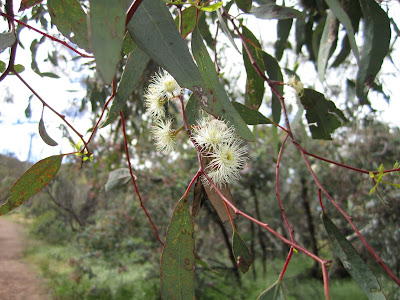


and, of course, creating delicate sprays of budding wattle, (no, I could not leave that out, despite the prominence I've given it in earlier posts - wattle is always too lovely to ignore):


All the same, Heysen's paintings have always puzzled me, because, despite their value and popularity, I have never liked them. Until I went to that exhibition last year, I could never understand why. It was only when I got the opportunity to look at lots of them, all collected together, that I at last recognised what my problem with them was.
Even though Heysen's representations of the bush - particularly his renderings of gumtrees - are very observant and superficially accurate, it seemed to me that he hadn't accepted what he saw in front of him on its own terms. While trying to produce a likeness of the landscape of Australia, he was still attempting to shape it to an idea of how he thought it ought to look, which derived from the appearance of the continent in which he'd been born. He couldn't resist peachifying the colours of Australia and bosoming out the spikiness of our trees and bushes. He couldn't help nudging the utter muddle that is a stand of gumtrees into something just a little cosier and neater than reality. He couldn't help trying to make the bush charming, just like home.
But the Australian bush is not - and never will be - charming. It is messy and untidy. It is, at first sight, predominantly grey and dusty. It is crowded with trees that spend most of their time imitating slovenly drunks at the end of an evening, dropping their bark, like discarded clothing, in dishevelled heaps about their feet:


Those trees in the pictures are actually a perfect illustration of what I mean: while the first thing to strike you about them might be the untidy heaps piled about their feet, they are also extremely lovely. If you divert your attention from the chaos at ground level and look upwards, the stretch of silken trunk that is the result of all that discarded rubbish is hard not to admire:

In this respect, the bush reminds me of those people you meet from time to time in life - well, I do, anyway - who at first appear grumpy and prickly and difficult to get to know but who on closer acquaintance (these people are usually work colleagues, I find, since, if it weren't involuntary you probably wouldn't bother to pursue their company) turn out to be hilarious, intelligent and invaluable friends. In the same way, the bush requires time and attention. Only then will it reveal itself, surprising you one morning by sending out shoots of new life from apparently dead branches:


producing delicate flowers in the midst of detritus and twigs:


and, of course, creating delicate sprays of budding wattle, (no, I could not leave that out, despite the prominence I've given it in earlier posts - wattle is always too lovely to ignore):


Subscribe to:
Posts (Atom)