Monday, 16 April 2012
What I Did on My Holidays V
Gathered the odd entry for Absent Proof, in my spare time from culture vulturing.

Sunday, 15 April 2012
Battered Penguins XIX

I went to university in Australia where the system is - at least in the Arts faculties, (if any still exist) - that you start off with four subjects in your first year and then go on to do three each year after that, ideally making those three into majors, (that is, consecutive units of the same subject), or even double majors, leading to a degree on its own or to a fourth honours year, in which you write a thesis.
Unfortunately, the first year I started university, I arrived late, because I'd been travelling and lost track of the time. As a result, I wasn't allowed to study the languages I wanted to study, because I'd already missed too many lessons to ever catch up, so instead I enrolled in English 1A and 1B and Latin and something else I've forgotten. English 1A covered late 19th century and early 20th century literature - lots of DH Lawrence, James Joyce, Yeats, Auden, TS Eliot, JM Synge, George Bernard Shaw, Joseph Conrad and a mass of American stuff, (2A, the subject you would take in the subsequent year, should you decide to continue with English, went backwards to the 18th century and 3A back again to the 16th and 17th century - don't ask me why). English 1B started with a book I thought I remembered was called The Medieval English Lyric but I think may actually have been The Oxford Book of Medieval English Verse and, concomitantly, Piers Plowman (the B text?).
Sadly, English 1B was my downfall. If languages were going to be hard to catch up on then English 1B was impossible. On my fourth or fifth day, I was faced with the task of writing an essay on the medieval English lyric and I was stuck. I realise, looking at them now, that I was being idiotic. They are actually rather beautiful and I could probably think of lots of things to write in an essay about them if I had to today, but at the time I struggled to think of anything at all to say, apart from pointing out the obvious fact that all the anonymous writers of the form seemed to be very, very fond of alliteration. So I filled up several pages with this observation, articulated in a variety of ways, and interspersed my dreary text with the dazzling additional perception - rhyme was something they seemed pretty keen on as well.
A week or two later, I, along with the seven or so other students who had elected to take English 1B, (probably for equally uninspired reasons as my own), shuffled into our weekly tutorial on the subject. The tubby man who had been given the task of bringing the good news about the medieval English lyric to the heathen of the ACT bounded in after us, his plastic leather jacket creaking, his black ribbed poloneck straining across his well-fed form, his extra chins, inadequately disguised by his sparse beard, spilling over the top.
'Could we have a chat about your essay after class', he muttered to me as he hurried by me. I nodded and crumpled into a chair at the back of the room. My thoughts roared about in more of a disorganised frenzy than ever - and they are not particularly orderly even at the best of times. I'd never failed at anything before. I'd never been asked for a discreet chat after any class. I couldn't bear the thought of being alone with that horrid man, discussing my manifold inadequacies.
I came to an instant decision. 'Excuse me', I said, putting up my hand, (I was not long out of school at the time and hadn't quite rid myself of such habits), 'I have to leave.' Then I got up and hurried from the room. I made my way from there straight to the Dean's office where I withdrew from the university. Then I went home, packed and went to the railway station, where I caught a train to Sydney (something that would be impossible today). I had an old friend who was living in Bondi. I moved into her place - taking no notice of the fact that she hadn't invited me and didn't much want me sleeping on her sofa. The next day I hunted through the classified ads in the Sydney Morning Herald and before you could say knife I had found a job as a motorbike courier (there's actually a longer story there, with a few twists and turns, but none of us have got all day, so I'll save those for some other time.)
As it turned out motorbike couriering was rather a pleasant way to spend one's life - and not badly paid either. All was going well and I was beginning to envisage a two-wheeled lifetime career stretching out before me. However, just as the beginning of the academic year came round again, unprecedented storms hit Sydney. All of a sudden, the job transformed into something really rather horrible, involving an awful lot of wading about in Pitt Street dragging a conked out motorbike through knee deep tropical rainwater. Viewed from that perspective, the prospect of sitting around reading books in warm,dry university libraries began to look rather appealing. Once again, I acted quickly. Before you could unfurl an umbrella, in fact, I was back at the university. But this time I didn't enrol in English 1B.
I did enrol in English 1A though. And, despite the fact that the professor of the department gave precisely the same opening lecture - word for word - on Yeats as he had done at the beginning of the year before, I stuck it out until the end of the year. I then dropped English and continued on with the subjects I really wanted to do.
Which brings me (at last) to the subject of this post - William Faulkner. He was one of the major figures on the English 1A syllabus. As part of the course, we were supposed to read The Sound and the Fury, As I Lay Dying and Light in August. This was in addition to numerous other novels, plays, wads of poetry and so forth by numerous other authors. Which should be a cue for me to bewail the state of current Australian university first year courses, where a large number of videos are shown and excerpts from one or other of the Norton Anthologies of English Literature are usually as much the students are expected to actually read.
It would be a cue, were it not for the fact that I somehow managed to get through English 1A, presumably answering exam questions, (and the fact that I can't even remember what I did answer questions on is pretty damning in itself), on Faulkner, without ever getting past page five of The Sound and the Fury and not even getting that far with the others. So I don't think I can really start crying foul about dropping standards - possibly the students of today, if they actually get right through their relevant Norton Anthology, are rather better read than I was - I mean, it's not really enough just to have various texts sitting on one's shelf.
And I have had the Faulkners sitting on my various shelves ever since my first year of university. And what is more I have at last read The Sound and the Fury. It's taken about 35 years but I have finally got around to it, which just goes to show that you should never throw things out - particularly books.
Of course, after such a long wait, one would expect that the thing would have to be an anti-climax. But one would expect wrong. The Sound and the Fury is absolutely great. I loved it. It is brilliant. It is a major work of art - but you don't need me to tell you that. What particularly pleases me is that I think it's probably a good thing I left it so long. I very much doubt that I would have appreciated it when I was 17. In fact, I know I wouldn't have, because that is the reason I gave up on it. I was in the midst of invulnerable youth. Somehow, the very idea of a mentally defective narrator seemed peculiarly depressing when one was hail and hearty and happy and young, whereas once one is decrepit somehow one can put up with anything.
Mind you the book is only told to begin with by an idiot (to use his younger brother Jason's description of him). The idiot, who is called Benjy, has an older brother who gives us the second part, and a younger brother, (the aforementioned Jason), who gives us the third. The final part is told more or less from the point of view of the old servant, Dilsey, but not in her voice. Each section gives us the narrative of a different day in the life of a Southern family, (although, due to Benjy's odd sense of time, the first section drifts about in time a lot), who have black servants, who they do not really recognise as humans, (Jason, in fact, refers to them routinely as 'niggers'), despite the fact that one of them at least - Dilsey - is by far the finest human being in the book.
I cannot say that I completely understood the book, but this is, oddly, not a criticism, (at least, not of the book). The stream of consciousness Faulkner employs in the first two sections does not provide a clear story thread, but it does create a vivid glimpse of chaotic individual reality, which I found more interesting and affecting than a conventional plot-driven tale. In addition, the lack of clarity in the narrative stream is mirrored by the fact that the figure of Caddie, who stands at the centre of all the characters' lives, barely appears within the narrative and remains an almost total enigma. Caddie is beloved by two of her brothers, Benjy and Quentin and hated by her other brother, Jason - but then he hates almost the entire world.
One of the major aspects that sustains the reader's interest is the fact that Faulkner writes extraordinarily lyrically. I know that 'lyrical' is often a polite way of saying that someone's writing is mannered, mincing, dull, ghastly and pretentious, but, in fact, the prose in this book really is quite breathtakingly beautiful, (and why is it that I feel embarrassed to be so gushingly positive, as if the Pseuds' Corner police will be down on me any minute like the proverbial ton of bricks?) To illustrate the kind of thing I mean, I find upon opening the book at random this lovely phrase - "Trees leaned over the wall, sprayed with sunlight" - which demonstrates Faulkner's gift for choosing the single word that transfoms, (in this case, 'sprayed'). Moving a few pages further on, I find this sentence in which Faulkner describes a defeated Jason 'sitting quietly behind the wheel of a small car, with his invisible life ravelled out about him like a wornout sock.'
Strikingly though, it is the very aspect that put me off all those years ago, the figure of Benjy, that I now regard as one of the finest elements of this very fine book. Faulkner draws Benjy with enormous compassion but without any sentimentality, leading us to feel real fondness for this poor unloved soul and even endowing him with a kind of dignity in his steadfast mourning of his long gone sister. Apart from her, only Dilsey shows him any affection - but even she cannot reach him. Only reminders of his sister seem to bring him any real emotional sustenance. He hangs around the golf course that has been built on the piece of land near the house that was sold to pay for Caddie's wedding and his brother's Harvard education, in order to hear his sister's name spoken when the players call out 'Caddy'. When really upset the only thing that can calm him is a shoe that belonged to Caddie, 'a white satin slipper. It was yellow now, and cracked and soiled, and when they placed it into Ben's hand he hushed for a while.' It is Benjy that Faulkner chooses to close the book with, picturing him sitting in the back of a cart, on his way to visit the cemetery, "... his eyes ... empty and blue and serene again, as cornice and facade flowed smoothly once more from left to right; post and tree, window and doorway, and signboard, each in its ordered place.'
(In some editions, a later appendix by Faulkner has been attached to the text. While it does spell out for the reader pretty much exactly what has been going on, I think it does nothing to enhance the novel. In this context, a quotation from Harold Bloom that I came across the other day, while reading an article on US military reading lists, seems relevant. Supposedly, Bloom, in The Western Canon described the culture's seminal books as possessing "strangeness, a mode of originality that either cannot be assimilated, or that so assimilates us that we cease to see it as strange" - Faulkner's work, I think, has that strangeness and unassimilable originality that Bloom refers to and his attempt to make his text less strange through his appendix is, if anything, counter-productive.)
Saturday, 14 April 2012
What I Did on My Holidays IV
I discovered a whole lot of Vermeers, quite a few of which I didn't even know existed, (I had the idea that only about 30-35 existed anywhere), lurking in the Metropolitan in New York:


 (I think this chair appears in Washington as well, see below)

 Here's what the Met has to say about this painting:
 (oddly in an auction catalogue list from only 40-odd years after it was painted, the picture is actually described, rather unfairly I think, as 'A drunken sleeping maid at a table' - and it appears to have sold for a mere 62 gelders).


Here's what the Met have to say about this one:


 I don't know why I didn't record what the Met had to say about the girl in the picture before this, but this was the wisdom on the wall for this:

and in the National Gallery in Washington:


 (I'm sure I've seen this carving on furniture in other Vermeer paintings, including the Woman in the Red Hat just preceding this one - and yes, it turns out that the Wikipedia article on the artist quotes a Time-Life book called The World of Vermeer, by Hans Koning, thus: "Almost all his paintings are apparently set in two smallish rooms in his house in Delft; they show the same furniture and decorations in various arrangements and they often portray the same people, mostly women" - I think at last I understand the comment by Gogol or Gorky or Chekhov that I read long ago, [so long ago, I cannot remember who actually made the comment], that the whole of life can be described simply by describing the room you are sitting in.)

 (if you're interested in a scholar's speculations on Vermeer's fondness for painting people writing, here is an interesting link)


I suppose everybody else already knew this, but I was astonished by how modern some of these paintings by Vermeer were - that red hat one in particular - and also by how much Bonnard must have been influenced by the artist - see, particularly that one of the dozing girl at a table, from the Metropolitan Museum. I am straying, however, into another of my shameful confessions of a visual illiterate, in which I display my 'I don't know much but I know what I like' ignorance, so at this point I'll shut up, but not before pointing anyone who might be interested towards a copy of a document showing what a bargain a Vermeer might be, were it only possible to time travel - it is to be found here - and also towards a discussion of his work that, possibly stating the bleeding obvious a bit, pinpoints Vermeer's talent for 'infusing scenes of daily life with timelessness and profundity' and comments that 'few artists can claim the consistent level of excellence that Vermeer maintained' (van Eyck, Durer and Holbein spring to mind immediately as other examples of artists who achieve something transcendent through the pursuit of intense technical excellence, and others crowd after them, but still).
(I should also mention that 'Woman Holding a Balance' was also in Washington, but it was not new to me, which is why I didn't include it here - I am fairly sure that anyone looking at this blog will be familiar enough with the image not to want to look at my second-rate pictures of it and I'd already had a good look at it last year in Munich, where it was on a summer holiday [at least, I think it was the same painting).
PS I forgot to include this Vermeer, also in the Metropolitan:


Here's what the Met have to say about this one:


and in the National Gallery in Washington:
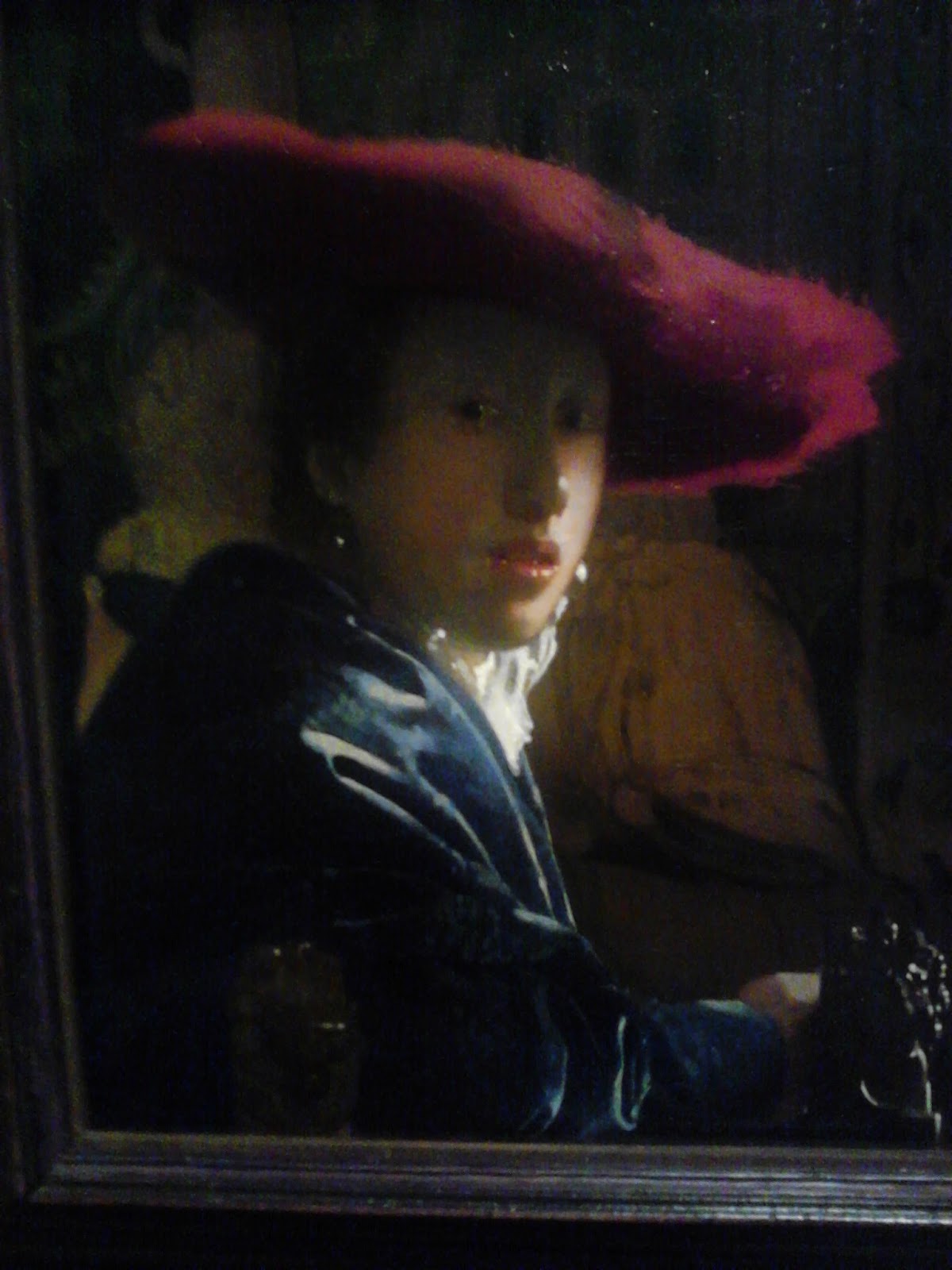 |
| The Girl with the Red Hat, oil on panel, 1665 |


 |
| Girl with a Flute, attributed to Vermeer |


 |
| A Lady Writing, oil on canvas, 1665 |


I suppose everybody else already knew this, but I was astonished by how modern some of these paintings by Vermeer were - that red hat one in particular - and also by how much Bonnard must have been influenced by the artist - see, particularly that one of the dozing girl at a table, from the Metropolitan Museum. I am straying, however, into another of my shameful confessions of a visual illiterate, in which I display my 'I don't know much but I know what I like' ignorance, so at this point I'll shut up, but not before pointing anyone who might be interested towards a copy of a document showing what a bargain a Vermeer might be, were it only possible to time travel - it is to be found here - and also towards a discussion of his work that, possibly stating the bleeding obvious a bit, pinpoints Vermeer's talent for 'infusing scenes of daily life with timelessness and profundity' and comments that 'few artists can claim the consistent level of excellence that Vermeer maintained' (van Eyck, Durer and Holbein spring to mind immediately as other examples of artists who achieve something transcendent through the pursuit of intense technical excellence, and others crowd after them, but still).
(I should also mention that 'Woman Holding a Balance' was also in Washington, but it was not new to me, which is why I didn't include it here - I am fairly sure that anyone looking at this blog will be familiar enough with the image not to want to look at my second-rate pictures of it and I'd already had a good look at it last year in Munich, where it was on a summer holiday [at least, I think it was the same painting).
PS I forgot to include this Vermeer, also in the Metropolitan:


Friday, 13 April 2012
What I Did on My Holidays III
I looked at this Stubbs painting in the National Gallery in Washington:


 and liked the absurdity of its title:
 from which is missing the name of the only creature in the whole picture who Stubbs appears to have had any real interest in:
 What a sensitive and noble face.
 (I also liked this one, by the same artist, of a rather worried looking poodle, standing on a punt):


Thursday, 12 April 2012
What I Did on My Holidays II
Admired the humour of whoever arranged this display in a Boston bookshop:


Tuesday, 10 April 2012
What I Did on My Holidays I
Got annoyed, yet again, at the use by the British 'hospitality' (and there's another abused word, right there) industry of the word 'discretionary':
 I should make clear that I have nothing against a service charge being levied - it is the dishonesty of calling it 'discretionary' when it is not (try querying it and see what happens, if you don't believe me).
(Warning: coming up over the next few weeks - or whenever I get around to it - will be a series of blog equivalents of that longlost 1950s suburban 'entertainment': long, dull slide nights of all the things I saw and did over the last month.)

(Warning: coming up over the next few weeks - or whenever I get around to it - will be a series of blog equivalents of that longlost 1950s suburban 'entertainment': long, dull slide nights of all the things I saw and did over the last month.)
Wednesday, 4 April 2012
Someone Else Got There First
Once again, I discover my own unoriginality. This time it is in the Georgetown branch of Urban Outfitters. I am standing around waiting, while one of my daughters makes a valiant effort to persuade herself that the expensive garments on offer do not look as if they've been made from Ye Olde Tea Shoppe's discarded lace tablecloths and someone's great aunt's boarding house curtains circa 1957. In fact, she is doing more than that - she is engaged in an attempt to suspend her own disbelief and brainwash herself into believing that these misshapen, ill-formed rags might actually appear smart, even elegant and chic, should she ever pluck up the courage to wear them in public view.
I pick up a book (Urban Outfitters sells them too, along with 'quirky knick knacks', in case you've never had the pleasure of entering the store). I don't notice the book's name. The Hundred Best Things Anyone Said? The Hundred Most Brilliant Statements Ever Made? A Hundred Things to Know Before You Die (that 'before you die' franchise is doing surprisingly well, considering its dashing use of the great unmentionable ie death)?
Inside there are a load of banalities by Alain de Botton and other such burblers. Then I turn a page and find this:
"A true friend is the greatest of all blessings and that which we take the least care of all to acquire". La Rochefoucauld.
Yes, I think, that's what I was trying to say.
(The daughter failed to persuade herself, by the way, which may possibly be a sign: if you're holding Urban Outfitters shares, you might want to tell your broker to sell).
I pick up a book (Urban Outfitters sells them too, along with 'quirky knick knacks', in case you've never had the pleasure of entering the store). I don't notice the book's name. The Hundred Best Things Anyone Said? The Hundred Most Brilliant Statements Ever Made? A Hundred Things to Know Before You Die (that 'before you die' franchise is doing surprisingly well, considering its dashing use of the great unmentionable ie death)?
Inside there are a load of banalities by Alain de Botton and other such burblers. Then I turn a page and find this:
"A true friend is the greatest of all blessings and that which we take the least care of all to acquire". La Rochefoucauld.
Yes, I think, that's what I was trying to say.
(The daughter failed to persuade herself, by the way, which may possibly be a sign: if you're holding Urban Outfitters shares, you might want to tell your broker to sell).
Subscribe to:
Posts (Atom)