I've banged on before, here and here and here, about how I hate the new habit of expressing appreciation for an honour by explaining how 'humbled' you feel. However, this morning, having heard the Queen thank her nation for her Jubilee celebrations by telling them that she feels 'humbled', I realise that I must admit complete defeat.
The Macquarie dictionary defines 'humble' as meaning 'low in station, grade or importance,' or 'modest, meek, without pride' and the verb as meaning 'to lower in condition, importance or dignity; abase' or 'to make meek'. I suppose it is the second meaning that the Queen is using the word in (she can hardly mean 'low in station' can she?) I still think it's a mad approach.
When countless people have spent millions to amaze you, dazzle you and show you a riproaring (if rather rainsodden) good time, I imagine they'd be hoping that you would respond with excitement, joy, delight and rapture. To tell them you feel modest at the end of it all seems to me to rather put a dampener on things.
But it appears that 'humbled' is the 'appropriate' response to such things these days, indicating that not for one minute does anyone delude themselves that they are better than anyone else or feel an instant of that dreadful thing called pride (a pinch might be allowed if you were a survivor of Gallipoli, but only a tiny pinch even then). And we would never want to be anything other than 'appropriate'.
Tuesday, 5 June 2012

Monday, 4 June 2012
Feeling All Fotherington-Thomas Today
It was very foggy this morning and I was in two minds about going for a walk. When I got to the top of the mountain though, I saw something that is not really anything very special, but it made me glad I was out and able to spot it before it vanished:
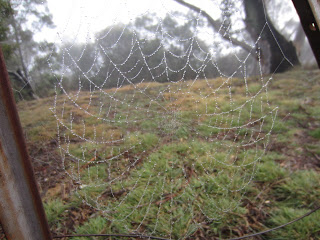 Am I getting sentimental, or is that a bit of wonder?
 While I am being soppy, here's some pictures of yesterday evening at my mum's place - the light, Mr Kurtz, the light, to wilfully misquote Conrad:


Sunday, 3 June 2012
It Was the Bauhaus What Done It
Whenever I go to the German-speaking world, I'm struck by the passion there for cluttering up all domestic architecture and interiors with little bits of handicraft and decorative gee-gaws, heart-shaped wherever possible. I'd always imagined this frilly, homespun, 'traditional' aesthetic was something deeply ingrained in the warp and/or weft of the German-speaking soul. Then I heard an architecture critic called Jonathan Glancey describe the reaction of people given houses in the one and only pure-Bauhaus housing project to be erected. This is what he said:
"When the Bauhaus did actually design some houses, famously, at, I think it's the Torten estate in Dessau - that is mass produced concrete houses, 334 of them; they were rushed up in prefabricated concrete - almost instantly the residents started customising them."
Now I wonder whether in fact the frilly, homespun, 'traditional' German aesthetic is really just a 'customising' reaction to the austerity of the Bauhaus.
"When the Bauhaus did actually design some houses, famously, at, I think it's the Torten estate in Dessau - that is mass produced concrete houses, 334 of them; they were rushed up in prefabricated concrete - almost instantly the residents started customising them."
Now I wonder whether in fact the frilly, homespun, 'traditional' German aesthetic is really just a 'customising' reaction to the austerity of the Bauhaus.
Saturday, 2 June 2012
Bells and Whistles
While in New York in April, I went to the city's beautiful library:

Downstairs, there was an exhibition about Percy Bysshe Shelley. It included fragments of Mary Shelley's manuscript of Frankenstein, with his editorial annotations, plus diaries from his schooldays, memoirs of schoolfriends, (apparently "The expression of his countenance was one of exceeding sweetness and innocence"), and this book, which, although printed during his lifetime, seems to have been included more to amuse than inform:


The impression it was hard not to form by the end of the exhibition was that Shelley, despite having written one of the few poems in the English language that practically commits itself to memory without effort, (I'm thinking of the beautiful Ozymandias; the only other I've come across that comes close in terms of ease of learning is Yeats's Second Coming), was a spoilt bombast who went through life strewing emotional chaos and misery around him. However, if you had already looked at the first item on display in the exhibition, this could hardly have come as a great surprise:


If you're given pure gold and coral to cut your teeth on, your sense of entitlement will surely be so ingrained by the time you reach adulthood that you cannot avoid being insufferable.
Thursday, 31 May 2012
Words and Phrases - an Everyday Story of Pedantic Folk
A friend baffled me the other day by saying she had to have a 'procedure'. Eventually, we worked out that she was going to have what used to be called an operation - or 'op', as in, 'The quack reckons I need an op on my bunions, but I reckon I can struggle on for a year or two more.'
Where did this 'procedure' thing come from? When I hear the word used in the medical context, I immediately assume they're going to tattoo the council by-laws on dog fouling across my lower abdomen (and there's a horrid word, 'abdomen', don't know why I'm using it - this medical jargon is clearly infectious).
Although, speaking of infections, I'm never going to pick up the virally spreading usage that is 'medication' - what the hell is wrong with the perfectly good word I've used all my life, namely 'medicine'. 'A spoonful of sugar helps the medication go down' doesn't have quite the same ring to it, in my opinion - ditto 'Laughter is the best medication'. Ugh, ugh, ugh
Wednesday, 30 May 2012
Battered Penguins - The Case of the Late Pig

As I think I have already conveyed in an earlier post, I love Margery Allingham. I've loved her from the first moment I opened one of her books, but I've loved her even more since I read a short biography of her, which suggested she had a far from easy love life and died a pretty miserable death. How could this be, when she was both funny and wise - and wrote so beautifully?
Allingham's best known creation is Albert Campion, an enigmatic figure, who dabbles in detective work - describing himself thus: "I am not one of these intellectual sleuths, I am afraid. My mind does not work like an adding machine, taking the facts in neatly one by one and doing the work as it goes along. I am more like the bloke with the sack and spiked stick. I collect all the odds and ends I can see and turn out the bag at the lunch hour" - and has a rather large, redeemed ex-criminal as his man-servant, a fellow called Lugg who, as Campion puts it, 'in spite of magnificent qualities has elements of the Oaf about him'.
In The Case of the Late Pig Campion emerges a tiny bit from his usual mysteriousness by telling the story in the first person - although readers hoping for any real self-revelation will, I should immediately point out, be fairly disappointed. One thing one does learn, however, is that as a child he had a 'collection of skeleton leaves'; another is that he is, despite his reservations, quite devoted to Lugg. In addition, we discover that he was once smitten by a girl called Janet who he has known 'on and off, for twenty-three years. When I first saw her she was bald and pinkly horrible. I was almost sick at the sight of her, and was sent out into the garden until I had recovered my manners.'
As must be obvious from the above, we are not dealing here with an angst-ridden, hard-boiled gumshoe. Angst and hard-boiledness are not at all what Allingham's books are about - or at least not overtly. Instead of grit and horror, what you get in a Campion story is humour and wisdom. While the thread of the mystery ambles through the text, giving it a beginning, middle and end, we do not feel a tremendous urgency about finding its solution. Whodunnit is the genre but it is not what really holds the reader's - or this reader's anyway - main attention.
Instead of excitement and a desperate need to find out the name of the perpetrator, what carries you along in these books is the pleasure of the scenery you pass through. Allingham conjures up a Wooster-like world, full of buildings topped with parapets that 'finish off the flat fronts of Georgian houses and always remind me of the topping of marzipan icing on a very good fruit cake' or fronted by 'great white pillars ... built by an architect who had seen the BM and never forgotten it' - each one 'a millstone round somebody's neck' - and peopled by characters such as 'Guffy Randall' and 'Lofty, who is now holding down his seat in the Peers with a passionate determination more creditable than necessary'.
Onto this framework - and that of the murder story - Allingham then throws amusing observations and rather lovely descriptions such as the ones that follow, switching in tone between flippant and elegiac without apparent effort:
"A funeral is an impressive business even among the marble angels and broken columns of civilization. Here, out of the world in the rain-soaked silence of a forgotten hillside, it was both grim and sad."
"Even at twelve and a half Pig had had several revolting personal habits."
"It is about as easy to describe Whippet as it is to describe water or a sound in the night ... I don't know what he looks like, except that presumably he has a face, since it would be an omission that I should have been certain to observe. He had on some sort of grey-brown coat which merged with the dead cow-parsley and he looked at me with that vacancy which is yet recognition."
"Leo had very bright blue eyes which, like most soldiers', are of an almost startling innocence of expression."
"...it struck me then as odd that the boy should really be so very much the father of the man. It's a serious thought when you look at some children."
"No English country house is worthy of the name if it is not breathtaking at half past six on a June evening..."
"...the sweet cool fragrance of old wood and flowers which is the true smell of your good country house..."
She adds in exchanges like this one, which reminds me of the kind of conversation I would sometimes have with my father, in which for a moment I glimpsed whole orders of until-then hidden rules for life:
"'What were you playing? Bridge?'
Leo looked scandalising. 'Before lunch? No my dear boy. Poker. Wouldn't play bridge before lunch.'"
Last but not least, she chucks in a villain, who, given her obvious conservatism, (and I should point out that I don't use that word in any kind of hostile way), it is hard not to recognise as such, long before his culpability is eventually confirmed:
"He was a red-hot innovator, we discovered. He spoke with passion of the insanitary condition of the thatched cottages and the necessity of bringing culture into the life of the average villager, betraying, I thought, a lack of acquaintance with either the thatched cottage or, of course, the villager in question, who, as every countryman knows, does not exist."
A wrong un, clearly. Case closed.
Tuesday, 29 May 2012
Bilding the Edukashon Reverlushion
In my mother's local town this morning, I was glad to see so many signs of Australia's rapidly improving educational system:
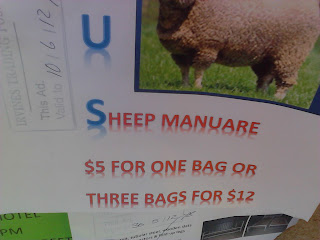
 (presumably the table became soild because they stored the manuare on top of it?)


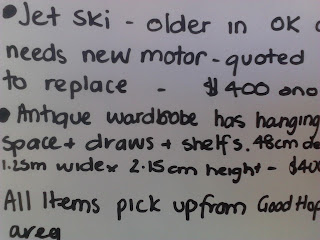 (One artist in the family's plenty - I don't need a cupboard that draws).


Subscribe to:
Posts (Atom)