Wednesday, 11 November 2015

Everything Was Illuminated

I know nothing about manuscript illumination, except that, when I was a child I planned to be either a gargoyle carver or an illuminator when I grew up. Both ambitions were doomed, needless to say, because I was born at the wrong time - and, had I been born at a time when either of these occupations were growth industries, I don't suppose I'd have had a look in anyway, since I am, chiz, a gurl. Also I'm left handed so I imagine all my manuscripts - had I been allowed to produce any -  would have been horribly smudged, since moving left to right with a left hand generally produces this result.

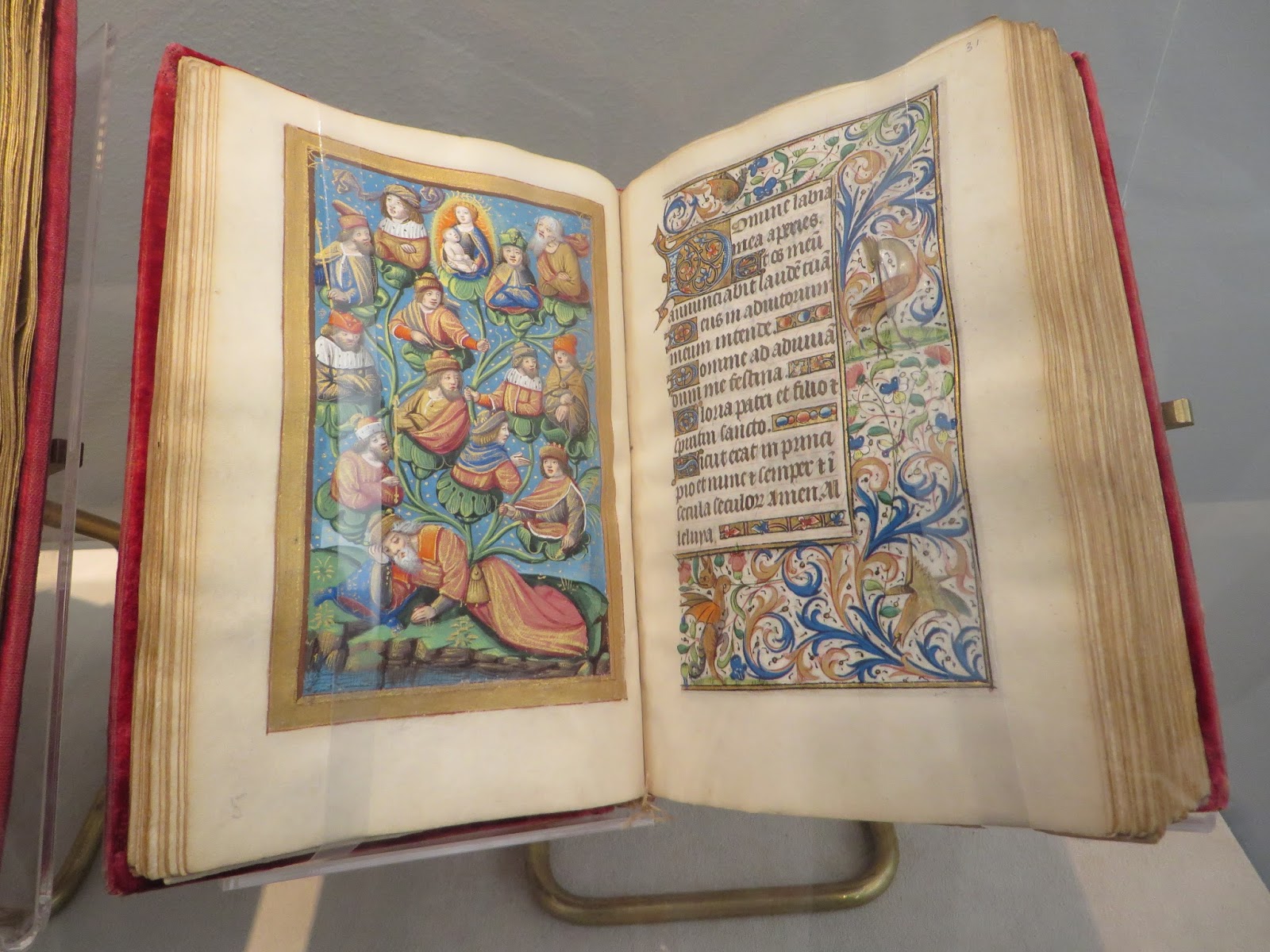
But, to quote the ever useful adage, "I know what I like" when it comes to illuminations, and I liked almost all the ones I saw at Frieze Masters. I was also very grateful when the dealers from Basel -www.guenther-rarebooks.com - noticing my interest, kindly gave me two of their catalogues. I plan to read them and thus become someone who actually knows something about illuminated manuscripts.


Compendium made for Juan II of Spain, 1425


Hofmann prayer book in German, illustrated by Nikolaus Glockendon, 1513-14, Nurnberg

Book of Hours, (use of Rome), Austria, Salzburg, 1450-60

Book of Hours, in Dutch (use of Utrecht), illustrated by the Masters of the Zwolle bible and the Masters of  Margriet Uutenham, Netherlands, Arnhem and Zwolle, c. 1470


Gagne book of hours, illuminted by the Masters of the Burgundian Prelates, Autun or Dijon, 1480-90


Book of Hours, use of Tours, illuminated by Master of Claude of France & workshop, Tours, 1500-08


Ludolphus Cartusiensis, Vita Christi, translated by Guillaume Lemenand, Vol. II, illustrated by the Master of the Chronique Scandaleuse, 1506-08, Paris


Book of Hours, use of Cambrai, illuminated by Charles V & a second artist, Hainaut, Valenciennes/Cambrai (?) c.1520


Book of Hours, use of Rome, in Latin, French calendar, illuminated by Master of Petrarch's Triumphs, Tours, 1490-1500


House of Charles V, use of Rome, illuminated by Gerard Horenbout, Flanders, Malines (?), 1515-1520


Giovanni Bocaccio, Des Cas des nobles hommes et femmes, French translation by Laurent de Premierfait, illuminated in the circle of Maitre Francois, Paris, 1470 


Book of Hours, for the use of Troyes, in Latin, with French calendar, illuminated by the Master of Grand Heures de Rohan, Troyes, 1415-1420


Book of Hours, use of Paris, illuminated by the Mazarine master, the Boethius master & two other artists, Paris, c.1405-15


This plus next two pictures: Titus Livius, Les Decades, translated into French by Pierre Bersuire, illuminated by Henri d'Orquevaulz, written by the scribe Jeannin de Rouen, Metz, dated 1410


This picture, plus next four: from the Zwolle Bible, illuminated by the Masters of the Zwolle Bible, Zwolle, 21st December, 1474


St John, historiated initial I from a leaf of The Homilies of St Augustine, at Octave of St John, Italy, 1150

This, plus next three pictures: The Adoration of the Magi, from an illuminated antiphonal, Tournai, (?), 1400-10, tempera & gold leaf on vellum 


This & next: also from an illuminated antiphonal, as above


This picture, plus next two: Leaves from an annotated pontifical for Roman use, illuminated within the circle of St Marco, Barcelona, 1350-1360


Biblia Latina, pocket Bible, with the prologues ascribed to St Jerome, calendar & the interpretation of Hebrew names, Paris, c.1250


Beauchamp-Corbet hours, Book of Hours, use of Sarum, in Latin & Anglo-Norman, illuminated by the Milimete workshop, (de Bois master), London, c.1328


This picture, plus next: Biblia Latina, illuminated by the workshop of the "Bible Moralisee", Paris, 1220-30


This picture plus next three: Despite the fact that this was one of the star attractions, I've lost all details of it, except that the illuminator was the Master of the Toison d'Or, I think (hopeless of me, I know)


The Moneypenny Hours with 49 images by the Master of the Chronique Scandeleuse, use of Paris, in Latin & French, 1490 


The Guyenet- Lardanchet Hours, with 19 miniatures by the Master of the Troyes missal, use of Paris, Troyes, 1460


Book of Hours from Lyon with 14 miniatures by Guillaume II Le Roy, Lyons, 1495-1510


The Villeneuve Hours with 22 miniatures by the Masters of the Gold Scrolls, Bruges, 1450 


A book of hours for export to England, with 47 miniatures by Willem de Vrelant of Bruges,  Bruges, c.1450-75


The Bliss Hours, with 15 miniatures by the Master of the Geneva Latini, Rouen, c1465


The Ovray Hours, for export to England with signed miniatures by the Master of Otto van Mordrecht, likely Bruges, c-1430 to before 1449


Book of Hours with 15 miniatures by an early Netherlandish artist, Paris, 1415-20


The only known manuscript of Philippe de Vigneuilles's La Chanson de Geste de Garin Le Loherain, Metz, 1515-1527/8


Astronomical handbook on the planets, in the tradition of Ptolemy, Verona, c.1580-1600


Gawain & His Nine Companions in Search of Lancelot, Dunois Master, possibly Jean Haincelin, active in Paris, c.1435-1450s


Gawain Fighting Gloadain the Seneschal, artist as above


Mocking of Christ, Maestro dei Fondi Giallini, active in Cremona c.1450-1482


Monks Singing, Nicolo di Giacomo, active Bologna, documented from 1349- c.1403


St Catherine of Alexandria, German artist, perhaps Cologne, c.1450


Joseph of Arimathea & Nicodemus in the Passion of Christ, from the Prayerbook of the Enriquez de Ribera family, artist Simon Bening, born 1483 Ghent; died 1561 Bruges)


The long lost first volume of the bible of Louis de Harcourt, patriarch of Jerusalem and Bishop of Bayeux, Paris, 1260-80


The book of Sydrac of Joan of France, Queen of Navarre, Paris, c.1325-50


Barbet Book of Hours, use of Paris, illuminated by at least three masters, Paris c.1400-10


Prayer book written in the local vernacular, Cologne, c.1486


This, plus next three pictures: Book of Hours, use of Paris, in Latin, early 15th century


Thursday, 5 November 2015

Go Now

I was in Antwerp yesterday & I went into the Cathedral of Our Lady. They have an exhibition there which I have only just realised is temporary. Among the paintings on display is Rubens's Descent from the Cross. It belongs to the cathedral, but no one could tell me if it will be on display after the exhibition, called Reunion, ends, on 15 November.

Just in case it isn't, I recommend that everyone in the world down tools & head for Antwerp. The Descent from the Cross  is one of the most beautiful & moving paintings I have ever seen. Pictures do not do it justice. Flock to see it now. It will take your breath away

Monday, 2 November 2015

Through a Glass Darkly

What is it the White Queen in Alice Through the Looking-Glass says?

"Sometimes I can believe six impossible things before breakfast"?

If not that exact phrase, something pretty close.

And what about the miraculous Mr Cheika, wizard coach of the Australian rugby team? He expressed a similar sentiment when someone asked him about the Australian team's improvement since he began working with them.

"Believing has to start somewhere", he said, "one person starts, you get another person and build a bit of a crowd."

As we drove from Brussels towards the North Sea coast the other day, I was thinking about these peculiarly belief-based approaches to reality. Beyond the car window, the landscape rolled out, dead flat, to the horizon. Most of the view was taken up by a vast dull sky.

At least it was until I put on my dark glasses.

As soon as I did, the apparently dull sky became transformed. Where before I had seen an array of flat clouds, barely distinguishable one from another in their very faintly graded shades of off-white, now what opened out before me was a radiant, mother-of-pearl panorama of pale blues and purples and pinks and oranges. Suddenly, the scene was transformed into something as glowingly irridescent as a Tiepolo ceiling. 

So which was reality? Which should I believe in? Was it the dreary vision I saw without my dark glasses or was it the beautiful one revealed by polarisation - or whatever mechanism was at work as I looked through my light reducing lenses? And how many other impossible wonders are we surrounded by, invisible to us simply because our minds prevent us from seeing them?

Sunday, 1 November 2015

Hanging Out the Washing

Continuing my stately tour through this year's Frieze Masters, we arrive at the Bologna gallery P420, who were displayng the work of Anna Lunas.

Lunas lives in Cluj/Kolozsvar, and the work on display was made in the 1960s. Lunas belonged to an organisation called Atelier 35, which my Romanian friend tells me was formed in the 1970s, to promote artists under 35. Lunas is now 75 and, the gallerist told me, a very strong character, whatever that may mean.

I am always interested in textiles, as I do a lot of sewing and therefore feel an affinity, if that makes any kind of sense. I especially liked the enigmatic subversiveness I thought, (hoped?), I detected in  Lunas' pieces. Just as the film Stalker, (indeed all Tarkovsky's work), could not allude directly to the Soviet regime or any of its faults, so Lunas' work had to remain cryptic, I presume.

Of course, I may be over-interpreting. Possibly Lunas had no view at all about the regime in power. To me at least though, these works - all made in 1969 and all called Identity Shirt - seem to allude to prison uniforms, and thus to oppression:


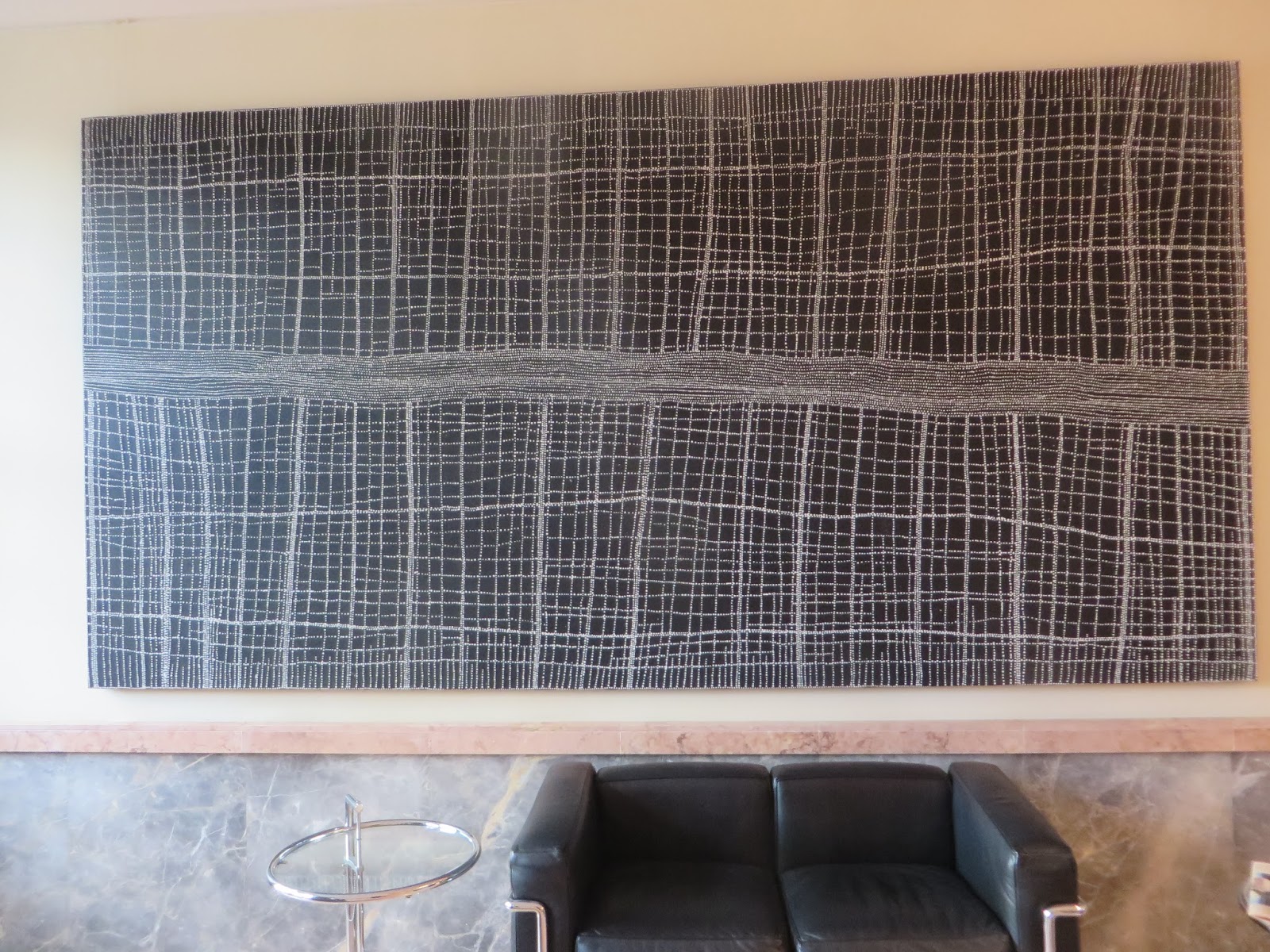
This one, with its little markings to show "Village" and "City", reminds me, oddly, of paintings by Australian Indigenous artists:


- things like this one, for example, which is by Dorothy Napangandi and depicts the creation site at Mina Mina, where the ancestral women of the Karntakurlangu Women's Dreaming performed an important ceremony:


These works by Lunas again bring some similar Indigenous Australian paintings to mind, although I very much doubt she knew anything about such works:


The loveliness of the next three is very hard to capture in a photograph. The first is a coat for reaching heaven:
The one on the left is a coat for reaching purgatory and the one on the right is a coat for reaching the sun:
This photograph and the next one shows a piece of momentary art called Humid Installation, organised by Lunas in 1970, in which the villagers of Margau in Transylvania hung out their washing on a hillside. Given that the village is identified in the photograph as "Dorf Margau" it is possible it was a Saxon village and therefore a Ceaucescu target - although his plans came to nothing, he was eager, in his benevolent way, (yes, that is irony, don't worry), to raze many traditional villages, most particularly those of ethnic minorities, and provide "townhouse style accommodation" for his rural people instead. I hope Lunas was attempting to undermine such foolishness with this work:


In the next booth, coincidentally, Boris Michailov, a Ukrainian photographer working around the same time as Lunas, picked up the theme of washing hanging out to dry: