I discovered Rachel Cusk last year, and spent most of an overnight stay in St Florian reading her recent trilogy, while my husband tossed and turned, disturbed by monastery bells. Now I have read The Country Life, Arlington Park, The Temporary and In the Fold as well. I am looking forward to reading everything she writes
Interviewed about that recent trilogy, (Outline, Kudos and Transit) Cusk has declared the death of character. While I think such a statement is ridiculous in general, inasmuch as it applies to her own enormous but particular talent it is probably sensible. That is to say, character is not her strength. Nor is plot. What she is good at is analogy and what she is truly brilliant at is clear, careful, detailed observation. Her descriptive writing is, as someone I know put it, "forensic".
As I read most of the books that I have read by Cusk on a Kindle, I have an electronic list of all the parts of them that I highlighted because I thought them so strikingly good. Looking through them, I see that Cusk can be very, very funny, but, to reiterate, the thing I especially admire in her work is her ability to describe with perfect accuracy phenomena that I have observed and long wished to describe, without ever finding the words.
Rather than download my full and very lengthy collection of admirable quotes from Cusk's writing, I have chosen just one as an example, taken from In the Fold. In it, Rachel Cusk describes the kind of busy road one drives along so often in overcrowded Britain, the kind that slices through an area of housing that was never built with motor vehicles in mind. Her careful - forensic? - choice of words means an everyday scene that on the face of it is dull and ugly, a scene that many writers would simply ignore, is evoked as the unbearable place to live that such places are in reality for so many:
"There the coast road passed through, a fuming, hooting, rattling cascade of metal the narrow, decorous terraces struggled to contain. Great lorries like dinosaurs manoeuvred on the small roundabouts. Dirty trucks freighted with skips and scaffolding roared past, driven by men who gazed blankly through their spattered windscreens. Beside them the pavements and brick walls of front gardens looked miniature: the gardens and the facades of the houses shook like toys as the lorries passed and the daffodils seemed to jolt from side to side in the grass. The houses looked so vulnerable next to the pounding road that it was difficult to believe in the world in which they had been constructed. Some of the terraces were only fifty or sixty years old but they seemed rooted in a past that had become meaningless. Great weights hurtled back and forth at high velocity past the little, unaccustomed rows of houses, four feet from their front gates."
Helen Garner shares Rachel Cusk's ability to observe the physical world and the people she meets “forensically” and then to translate her observation into words. Although she is one of my favourite writers, given that I don’t like the intrusive nature of biographies, I don’t quite know why I borrowed Bernadette Brennan’s prizewinning biography of Garner from the library. I must admit that, within its genre, it is an excellent book and almost as readable as Garner’s own works. However, by the end, I felt that I had been nosily rummaging about in the subject’s underwear drawer and, unsurprisingly, had emerged with a slight sense of disappointment.
Until I read the biography, there was only one element of Garner’s work that I did not admire - that was a slight tendency to overblown emotion, tipping into sentimentality. Unfortunately, the picture of Garner that emerges from the book suggests that she is capable of an impulsive emotional volatility. This made me suspect that the sentimentality I detected in some of the work might be the mere tip of the iceberg. I was left with a disturbing impression of someone more narcissistic and less wise than I had imagined.
I was also shocked that Garner identified with Anu Singh, the murderer of Joe Cinque and that she does not believe evil exists. To me the story of Joe Cinque’s death is a story of how evil does exist, but only when we make the choice to embrace it. In my view, every day of our lives is a day in which we make countless decisions about whether to be good or not - impatience, my besetting fault, is a small concession to evil, because it usually entails a choice not to be kind. Kindness is a denial of evil and evil is a decision to love yourself instead of others. I’m shocked that Garner does not recognise this, as I thought her writing was at heart deeply moral.
Forensic is not a word one would,use about Bill Shorten - although ruthless might fit the bill. David Marr’s Quarterly Essay about the man who I am almost convinced will become Australia’s next Prime Minister at the federal election due in May is not very edifying. Our probable next leader is a man who understands power, who wants to be Prime Minister, but who seems to believe in nothing. You need to be tough in politics, but this person appears to have no loyalty to anyone or anything. He also does not seem very interested in ideas or the life of the mind. I suppose everything will muddle along though, just as before, bug with a few more taxes and a lot more irritating initiatives to remodel society in the shape of whichever new identity interest group shouts loudest on the day. Marr is a good writer, capturing vignettes of party conference scenes and plotters’ meetings very well, but there is, inevitably, quite a lot of detail about the process of Shorten’s political career within the union movement and later the Labor Party that I found hard going.
I also read Cure by Jo Marchant. It describes a number of cases and studies that have demonstrated that placeboes are effective, even when those being given them know that they are placeboes. It is one of the most staggering things I have ever read, seeming to prove irrefutably that physical health is intimately tied up with mental state. Fascinating.
Saturday, 9 March 2019

Friday, 8 March 2019
Bristol and Birmingham Stone Faces
I was in Birmingham yesterday and I’m in Bristol today. I saw some nice faces on the facades of buildings and I put them on an Instagram account I’ve just begun, as a way of feeding my fondness for photographing architectural decoration that I see. The account is called oldfacesoldplaces
Wednesday, 6 March 2019
Farce - French versus English
There is a new production of Moliere’s Tartuffe at London’s National Theatre and, while in London the other day, we went along. Tartuffe is usually described as a satire but this production played it mainly as a farce, and we enjoyed it a lot, (for more detail, look here).
A couple of days after seeing Tartuffe, we went to Bateman's, Rudyard Kipling’s house in Sussex and enjoyed another, more English form of farce.
Bateman's is a National Trust property, and when we arrived we were asked if we were Trust members. When we said we weren't, the woman at the ticket office reacted with such astonishment, she might have been in a pantomime - can she really never have encountered others of our ilk?
Perhaps it was her amazement that led her to forget to mention that, although we were paying a lot of money to go in, we would not in fact be getting very good value, because of the time of year. Anyway, she did neglect to tell us this, so we made our way down through the walled kitchen garden, where little was growing, although someone had planted a stick to which was fixed a laminated piece of paper, announcing that Ernest Shackleton had once been a visitor to the house.
We entered the house itself through a large shop, selling soaps and coffee cups and fudge and scented drawer envelopes and picnic rugs and all sorts of other things unrelated to Rudyard Kipling. We were asked to gather in what looked like the former scullery, to wait for our tour to begin. A group of people was already in there when we turned up, watched over by two women in puffer jackets, who turned out to be our guides.
After a bit of discussion between these two women about whether anyone else was coming, we set off. We were led through a short narrow corridor- a route that we were told was a special privilege not given to many visitors- and into a dark room, which we were informed was the front hall. There we peered at the vague outline of what one woman announced was the National Trust's oldest working clock, (British made and keeping much, much better time than the one facing it, a newer device, made in the Netherlands, so yah boo sucks, Europe).
I took this information on trust as it wasn't easy to make out the object and anyway we were moving on - into to yet another ill-lit room. This, apparently, was the Kiplings' sitting room. The blinds were down, as they had been in the first room, and, while one of our guides explained what the various objects that loomed out of the darkness were, the other held up a torch with a rather faint beam. We all peered in whichever direction was indicated, but I don't believe any of us made out more than vague outlines. At a certain point scratchy music burst upon us, as one of the women had managed to get a wind-up gramophone to operate. Then she picked up something woolen and shoved it somewhere in the shadows and the sound was muffled. There was no volume control on old record players, she explained, as she did this, and so you had to put a sock in the broadcasting horn to moderate the noise - hence the phrase, "put a sock in it".
We passed through more rooms, all in semi-darkness. We were not allowed into Kipling’s writing room, because of something to do with the floor. Instead we were invited to take turns at putting one eye to the door jamb, through which we each got a glimpse of a room in which all the furniture appeared to be piled up in a corner (conservation) and, once again, the blinds were down, obscuring the view that, we were told, sustained and inspired Kipling in his day.
Everyone accepted the conditions meekly, except my husband, who is Australian and not trained in "mustn't grumble" manners. When we reached the upstairs bedroom, which was plunged in semi-obscurity like the rest of the place, his patience gave out. What about pulling up the blinds, he suggested, to make things a little easier to see?
Our guides seemed mildly hurt by this suggestion and for the rest of the tour kept returning to their justifications, which boiled down to rules and the importance of observing them, without anything so impertinent as a questioning spirit. We were experiencing the National Trust's winter arrangements, apparently . They were ever so sorry, but t hey were prohibited from pulling up the blinds until the summer system, known as "free flow" came into force. Once that happened, the world would be our oyster, we would be able to come and go as we pleased, windows would be uncovered and everything would be illuminated.
Not being English, my husband wanted to know why we couldn't have the blinds up and do all these things now. Silly man, I thought, he doesn't understand the fundamentals of English farce - I mean life: rules, the more pointless the better, strictly adhered to, uncontestable, and rigidly applied.
The one area where extreme efficiency occurs in British existence is in the application of rules.
We trailed on through the house, but the mood was ruined. The wind had gone out of the two women's sails. They continued their pointless descriptions of things that could not be seen (they seemed not to understand that a torch held to a glass cabinet does not illuminate the objects inside but merely creates a bright reflection that bounces back and hurts the observer's eyes), but kept returning to the issue of "free flow" and their justifications, (which had no substance, if you didn't accept that a rule is a rule is a rule, however idiotic) for the window blinds being kept closed.
Since then we have visited more National Trust properties. We have even been sufficiently tamed to buy ourselves a membership of the organisation. What I have realised is that it is a quintessentially British organisation, staffed voluntarily by an army of people who love enforcing rules. Which is possibly the pastime enjoyed more than any other by inhabitants of the British isles.
Mind you, not everyone who volunteers is English. A couple of days after going to Bateman's, we went to have a look at Petworth, and there I witnessed a young female volunteer of Spanish origin, come rushing out into the courtyard to chastise someone for standing two feet within the gateway with a dog on a lead. The gusto with which she enforced regulations was a triumph of the local culture, her natural Latin laissez faire instincts clearly completely eclipsed by immersion in her new environment. It made me proud to be British.
But it also started me thinking. Many British who chose to vote to leave the European Union did so because they were sick of all its rules and regulations, but what if in fact that proliferation of rules and regulations turns out to have been the result of British membership? What if, with the United Kingdom gone, the massed ranks of bureaucrats in Brussels will breathe a sigh of relief and say to themselves, "Thank heavens they've disappeared; now we won't have to make up any more new rules to make life difficult for everyone." How embarrassing that would turn out to be.
A couple of days after seeing Tartuffe, we went to Bateman's, Rudyard Kipling’s house in Sussex and enjoyed another, more English form of farce.
Bateman's is a National Trust property, and when we arrived we were asked if we were Trust members. When we said we weren't, the woman at the ticket office reacted with such astonishment, she might have been in a pantomime - can she really never have encountered others of our ilk?
Perhaps it was her amazement that led her to forget to mention that, although we were paying a lot of money to go in, we would not in fact be getting very good value, because of the time of year. Anyway, she did neglect to tell us this, so we made our way down through the walled kitchen garden, where little was growing, although someone had planted a stick to which was fixed a laminated piece of paper, announcing that Ernest Shackleton had once been a visitor to the house.
We entered the house itself through a large shop, selling soaps and coffee cups and fudge and scented drawer envelopes and picnic rugs and all sorts of other things unrelated to Rudyard Kipling. We were asked to gather in what looked like the former scullery, to wait for our tour to begin. A group of people was already in there when we turned up, watched over by two women in puffer jackets, who turned out to be our guides.
After a bit of discussion between these two women about whether anyone else was coming, we set off. We were led through a short narrow corridor- a route that we were told was a special privilege not given to many visitors- and into a dark room, which we were informed was the front hall. There we peered at the vague outline of what one woman announced was the National Trust's oldest working clock, (British made and keeping much, much better time than the one facing it, a newer device, made in the Netherlands, so yah boo sucks, Europe).
I took this information on trust as it wasn't easy to make out the object and anyway we were moving on - into to yet another ill-lit room. This, apparently, was the Kiplings' sitting room. The blinds were down, as they had been in the first room, and, while one of our guides explained what the various objects that loomed out of the darkness were, the other held up a torch with a rather faint beam. We all peered in whichever direction was indicated, but I don't believe any of us made out more than vague outlines. At a certain point scratchy music burst upon us, as one of the women had managed to get a wind-up gramophone to operate. Then she picked up something woolen and shoved it somewhere in the shadows and the sound was muffled. There was no volume control on old record players, she explained, as she did this, and so you had to put a sock in the broadcasting horn to moderate the noise - hence the phrase, "put a sock in it".
We passed through more rooms, all in semi-darkness. We were not allowed into Kipling’s writing room, because of something to do with the floor. Instead we were invited to take turns at putting one eye to the door jamb, through which we each got a glimpse of a room in which all the furniture appeared to be piled up in a corner (conservation) and, once again, the blinds were down, obscuring the view that, we were told, sustained and inspired Kipling in his day.
Everyone accepted the conditions meekly, except my husband, who is Australian and not trained in "mustn't grumble" manners. When we reached the upstairs bedroom, which was plunged in semi-obscurity like the rest of the place, his patience gave out. What about pulling up the blinds, he suggested, to make things a little easier to see?
Our guides seemed mildly hurt by this suggestion and for the rest of the tour kept returning to their justifications, which boiled down to rules and the importance of observing them, without anything so impertinent as a questioning spirit. We were experiencing the National Trust's winter arrangements, apparently . They were ever so sorry, but t hey were prohibited from pulling up the blinds until the summer system, known as "free flow" came into force. Once that happened, the world would be our oyster, we would be able to come and go as we pleased, windows would be uncovered and everything would be illuminated.
Not being English, my husband wanted to know why we couldn't have the blinds up and do all these things now. Silly man, I thought, he doesn't understand the fundamentals of English farce - I mean life: rules, the more pointless the better, strictly adhered to, uncontestable, and rigidly applied.
The one area where extreme efficiency occurs in British existence is in the application of rules.
We trailed on through the house, but the mood was ruined. The wind had gone out of the two women's sails. They continued their pointless descriptions of things that could not be seen (they seemed not to understand that a torch held to a glass cabinet does not illuminate the objects inside but merely creates a bright reflection that bounces back and hurts the observer's eyes), but kept returning to the issue of "free flow" and their justifications, (which had no substance, if you didn't accept that a rule is a rule is a rule, however idiotic) for the window blinds being kept closed.
Since then we have visited more National Trust properties. We have even been sufficiently tamed to buy ourselves a membership of the organisation. What I have realised is that it is a quintessentially British organisation, staffed voluntarily by an army of people who love enforcing rules. Which is possibly the pastime enjoyed more than any other by inhabitants of the British isles.
Mind you, not everyone who volunteers is English. A couple of days after going to Bateman's, we went to have a look at Petworth, and there I witnessed a young female volunteer of Spanish origin, come rushing out into the courtyard to chastise someone for standing two feet within the gateway with a dog on a lead. The gusto with which she enforced regulations was a triumph of the local culture, her natural Latin laissez faire instincts clearly completely eclipsed by immersion in her new environment. It made me proud to be British.
But it also started me thinking. Many British who chose to vote to leave the European Union did so because they were sick of all its rules and regulations, but what if in fact that proliferation of rules and regulations turns out to have been the result of British membership? What if, with the United Kingdom gone, the massed ranks of bureaucrats in Brussels will breathe a sigh of relief and say to themselves, "Thank heavens they've disappeared; now we won't have to make up any more new rules to make life difficult for everyone." How embarrassing that would turn out to be.
Friday, 15 February 2019
Return from Faceless Places
I left Budapest just before Christmas, to return to Canberra for several months. I was reluctant as I am not fond of summer weather. January turned out to be the hottest January ever recorded, so the charms of Canberra, which, for me, are mainly to do with being able to walk in the bush, even though you are in the middle of a capital city, were difficult to enjoy. It was like walking through an enormous baker's oven. Ugh.
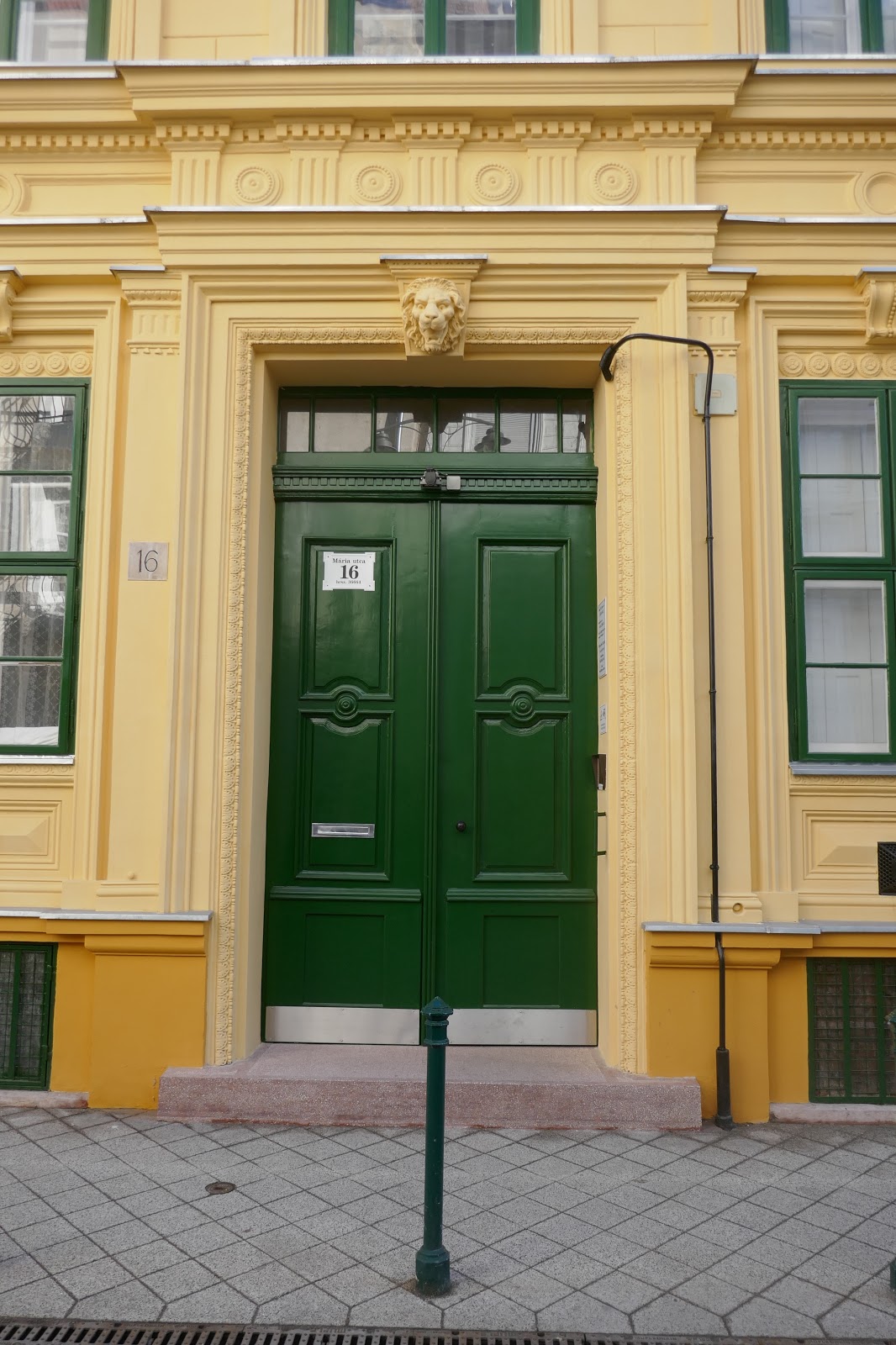
When I came back, it was not hugely cold even in Budapest. Going for a walk, we discovered that a bashed up old house around the corner has been renovated beautifully during our absence, so that now the friendly lions all over its facade are not difficult to make out:


 The building faces another that has yet to see the kind hand of the renovator. I admire it anyway and often imagine what those rooms at the top must be like and wonder whether shapes like those windowframes seemed shocking when they first appeared:
 Nearby, I was happy to see a gateway I've always loved - the building had been scaffolded before we went away:
 I don't know why the two birds decorating each side are not absolutely symmetrical - the central decorative panels are very slightly different:

 It is the ruling personality over the doorway that I'm especially fond of, a person who seems composed in equal measure of daftness and depressive gloom:
 This courtly fellow, taking the wintry sunshine, always brings the word "quixotic" to mind:
 On our first morning, we decided to have breakfast at the newly reopened Parisi Cafe, a wonderful old ballroom behind what was a bookshop and is now some sort of adventure experience for children, on Andrassy utca. We were glad to see that little seems to have changed since the last time we were there, although I believe the sofas used to be leather, whereas they are now covered in mauve nylon velvet, and some huge pots in the same colour have been brought in, which isn't an improvement. Still to be able to sit beneath a ceiling like this, drinking coffee, is a joy:
 and there is no cafe anywhere in Canberra where you can look up and see a golden face gurning down at you (is this an advantage? I suppose it depends on one's mood):
 We made our way down Andrassy utca then, past many, many caryatids and stone faces, not least this gentle lion at waist height:
 and then threaded our way parallel with Vaci utca, happy to be able to see these two facades, since the dreadful carpark that obscured them was demolished:

 and excited to see good progress on the wonderful Parisi udvar, the unrenovated interior of which featured in the opening scenes of the Gary Oldman film Tinker Tailor Soldier Spy:
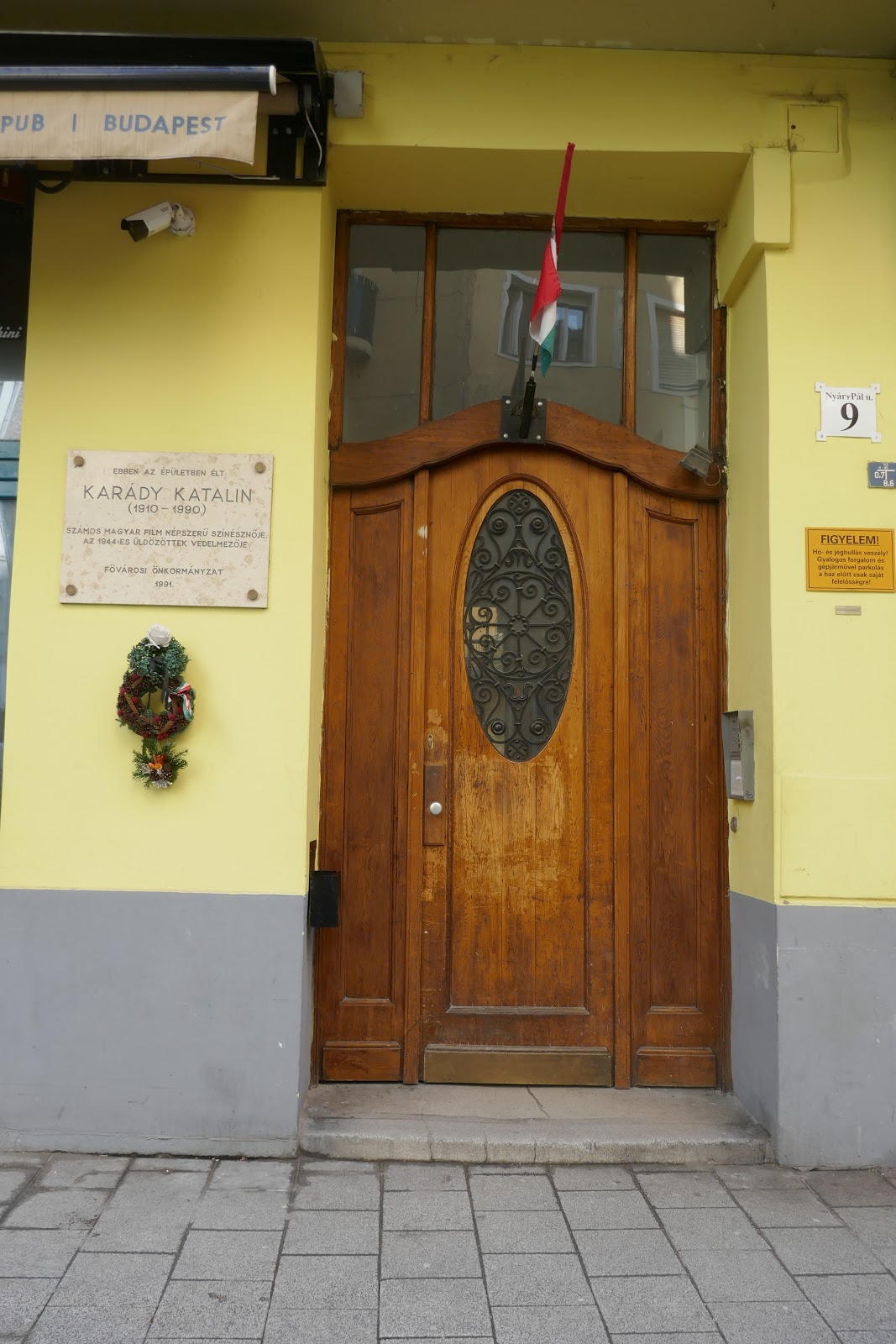
 passing the building where Katalin Karady used to live - I love being reminded of her and her courage. She was an actress who saved many Jewish victims of the Arrow Cross and I salute her bravery and wish I could believe I would behave even half so well as she in those terrible circumstances:
 We were on our way to the market to get some food. While I cannot claim there was quite the range of fruit and vegetables available that there is back in Canberra, it was all rather beautiful in a bountiful kind of way:


 and our fellow shoppers did not shame us with their blonde, bronzed health youthfulness, as most of those you share the pavement with in Australia - and especially Sydney - tend to do:

 And when it comes to smoked and salted products and sausages, Budapest certainly gives Australia a run for its money:


When I came back, it was not hugely cold even in Budapest. Going for a walk, we discovered that a bashed up old house around the corner has been renovated beautifully during our absence, so that now the friendly lions all over its facade are not difficult to make out:





Thursday, 24 January 2019
Digital Mysteries
Every now and again a flood of so-called comments arrives from Anonymous, usually about one particular post, often one that was written ages ago. The comments show absolutely no sign that the writers - (who/which are probably robots [and how long will it be before it will be considered as offensive to mention that difference as it is currently to mention that there is a difference between a woman and a transgender woman; rights for robots, AI can cry etc]) - have read a word of the piece in question.
These are typical of the genre:
“Everything is very open with a really clear description of the challenges. It was truly informative. Your website is very helpful. Thank you for sharing”
“Yeah bookmaking thios wasn't a speculative decision outstanding post!“
"I absolutely love your blog and find the majority of your posts to be just what I’m lookin for. Do you offer guest writers to write content for yourself? I wouldn’t mund creating a post or elaborating on some of the subjects you write concerning here. Again, awesome web log!”
“What a information of un-ambiguity and preserveness of precious know-how about unpredicted emotions”
“Incredible points. Outstanding arguments. Keep up the good work”
There is some kind of scam going on here, obviously, but what is it? Can anyone explain (ideally not Mr Anonymous, thanks all the same).
These are typical of the genre:
“Everything is very open with a really clear description of the challenges. It was truly informative. Your website is very helpful. Thank you for sharing”
“Yeah bookmaking thios wasn't a speculative decision outstanding post!“
"I absolutely love your blog and find the majority of your posts to be just what I’m lookin for. Do you offer guest writers to write content for yourself? I wouldn’t mund creating a post or elaborating on some of the subjects you write concerning here. Again, awesome web log!”
“What a information of un-ambiguity and preserveness of precious know-how about unpredicted emotions”
“Incredible points. Outstanding arguments. Keep up the good work”
There is some kind of scam going on here, obviously, but what is it? Can anyone explain (ideally not Mr Anonymous, thanks all the same).
Sunday, 6 January 2019
Signs and Portents
On the way up Mount Ainslie in Canberra, near where my house is, there is a gum tree that someone cut down several years ago. Its beheaded log lies beside the path, not far from the summit, and every time I see it, I think of the time when my brother fell mortally ill.
When the doctors first suggested my brother’s life might be much more limited than we had hoped it would be, I showed him a photograph of that tree trunk. What makes it noticeable is the fact that, although it is supposed to be defeated and appears to have been ripped from its roots and left to die, it has somehow managed to sprout a row of saplings out of its side and they are growing fairly quickly into full sized trees.
“Signs and portents”, my brother said when he looked at my picture.
I remembered that moment the other day, as I was coming down the mountain, having passed that tree - or trunk or set of saplings, depending on your perspective - again. A little while after, I ran into someone I often meet up there. We don't know each other, except in that context and, if we are in a hurry, we have to try to avoid each other as, each time we meet, we fall into long and interesting conversations for which we do not always have time.
That day I was not in a hurry, and I trust that she wasn't either, because, as usual, we talked and talked. She told me that, like me, she had recently lost a sibling - in her case, a sister. She said that she and her sister, together with a third sister, had all been going to classes to learn sign language before the sister who is now dead fell ill.
Following the sister's death, once they had pulled themselves together, the two remaining sisters went back to those classes. And my friend from the mountain said that at that first lesson back they were asked to describe their families using sign language. She described how she watched her remaining sister sign that she had only one sister and was shocked, thinking that her sister had made a mistake. "You've got two sisters", she signed in response, and it was only at that moment that it came to her that she didn't. Each of them only had one sister now. She finally understood.
When the doctors first suggested my brother’s life might be much more limited than we had hoped it would be, I showed him a photograph of that tree trunk. What makes it noticeable is the fact that, although it is supposed to be defeated and appears to have been ripped from its roots and left to die, it has somehow managed to sprout a row of saplings out of its side and they are growing fairly quickly into full sized trees.
“Signs and portents”, my brother said when he looked at my picture.
I remembered that moment the other day, as I was coming down the mountain, having passed that tree - or trunk or set of saplings, depending on your perspective - again. A little while after, I ran into someone I often meet up there. We don't know each other, except in that context and, if we are in a hurry, we have to try to avoid each other as, each time we meet, we fall into long and interesting conversations for which we do not always have time.
That day I was not in a hurry, and I trust that she wasn't either, because, as usual, we talked and talked. She told me that, like me, she had recently lost a sibling - in her case, a sister. She said that she and her sister, together with a third sister, had all been going to classes to learn sign language before the sister who is now dead fell ill.
Following the sister's death, once they had pulled themselves together, the two remaining sisters went back to those classes. And my friend from the mountain said that at that first lesson back they were asked to describe their families using sign language. She described how she watched her remaining sister sign that she had only one sister and was shocked, thinking that her sister had made a mistake. "You've got two sisters", she signed in response, and it was only at that moment that it came to her that she didn't. Each of them only had one sister now. She finally understood.
Tuesday, 1 January 2019
Getting a Bucketing & Early Morning Calls
This morning someone I know on Twitter responded to new year greetings with a yawn or two, as he had been kept awake by people in his neighbourhood - yahoos, as he called them, and hadn’t slept a wink. I said that sometimes on our street in Budapest we suddenly get woken by crowds of Spanish holiday makers who for some reason decide to take a stroll down our street at anywhere between 2 & 4.30 in the morning, singing & shouting & shrieking. I keep meaning to have a bucket on the balcony, I explained, filled with compost or such like, ready to chuck at them, but I’m never well enough organised & anyway I’m much too scared.
At the mention of buckets, another Twitter friend joined the conversation She had been reminded of a summer holiday she’d spent in a peaceful old house in Maine, on the water, with some friends, a couple of whom had two boys aged about 10-12. This was her story:
“The boys, liked to yell and scream and kick balls around the quiet waterfront lawn constantly - boys will be boys - but one sunny day they were out of control outside and would not move or stop when I repeatedly - and sweetly! - asked them to. So finally I got a big bucket, filled it with water, and walked calmly over to them when they were -unusually - standing still, and tipped it all over both of them. (I was younger and stronger then). They were stunned and amazed & outraged. As were their parents. (I was pretty shocked myself!) I told them, it’s only water. It won’t hurt you. You’ll soon be dry. And I reminded them that I had tried several times to ask them nicely. Etc. After that their parents kept a closer eye on them, they became more considerate, and we all had a happy holiday together. However....not sure tipping water from above on strangers below would yield such satisfactory results. (And no, it wasn’t on my ‘bucket list’. (groan) I don’t have one. And they didn’t exist back in those more innocent days.) 💦”
This led me to remember a night years ago we spent in an old hotel in France, near the sea. In the late afternoon, a couple of flash cars with folded down convertible roofs arrived, crowded with the kind of young creatures that I had read about & at last had the chance to see in the wild - a bunch of the jeunesse dorée (you can see similar types any day, swishing about near Five Ways, Paddington, Sydney). They piled into the pretty house across the road & proceeded to make an ever increasing racket, going on right through the night until 5.45 am. Even our children, never known to go willingly to bed, were weeping & asking us to get the neighbours to stop the party by 3 am.
But the neighbours wouldn’t. We went over several times but each time they told us to rack off. The hotel owner said they came every year & were the local gentry, so there was nothing that could be done (hang on, I thought you French had a revolution). We were stumped.
But we got our revenge, which was something.
Leaving the next morning, we first stopped our car outside the house of the offenders & leaned on the horn, continuing until every last occupant of the cars that had arrived the afternoon before had emerged onto verandas or balconies, moaning, clutching their hungover heads & begging us to stop.
What is the moral of these stories, I wonder? Become a hermit perhaps, or think of others, especially after dark.
A very happy new year.
At the mention of buckets, another Twitter friend joined the conversation She had been reminded of a summer holiday she’d spent in a peaceful old house in Maine, on the water, with some friends, a couple of whom had two boys aged about 10-12. This was her story:
“The boys, liked to yell and scream and kick balls around the quiet waterfront lawn constantly - boys will be boys - but one sunny day they were out of control outside and would not move or stop when I repeatedly - and sweetly! - asked them to. So finally I got a big bucket, filled it with water, and walked calmly over to them when they were -unusually - standing still, and tipped it all over both of them. (I was younger and stronger then). They were stunned and amazed & outraged. As were their parents. (I was pretty shocked myself!) I told them, it’s only water. It won’t hurt you. You’ll soon be dry. And I reminded them that I had tried several times to ask them nicely. Etc. After that their parents kept a closer eye on them, they became more considerate, and we all had a happy holiday together. However....not sure tipping water from above on strangers below would yield such satisfactory results. (And no, it wasn’t on my ‘bucket list’. (groan) I don’t have one. And they didn’t exist back in those more innocent days.) 💦”
This led me to remember a night years ago we spent in an old hotel in France, near the sea. In the late afternoon, a couple of flash cars with folded down convertible roofs arrived, crowded with the kind of young creatures that I had read about & at last had the chance to see in the wild - a bunch of the jeunesse dorée (you can see similar types any day, swishing about near Five Ways, Paddington, Sydney). They piled into the pretty house across the road & proceeded to make an ever increasing racket, going on right through the night until 5.45 am. Even our children, never known to go willingly to bed, were weeping & asking us to get the neighbours to stop the party by 3 am.
But the neighbours wouldn’t. We went over several times but each time they told us to rack off. The hotel owner said they came every year & were the local gentry, so there was nothing that could be done (hang on, I thought you French had a revolution). We were stumped.
But we got our revenge, which was something.
Leaving the next morning, we first stopped our car outside the house of the offenders & leaned on the horn, continuing until every last occupant of the cars that had arrived the afternoon before had emerged onto verandas or balconies, moaning, clutching their hungover heads & begging us to stop.
What is the moral of these stories, I wonder? Become a hermit perhaps, or think of others, especially after dark.
A very happy new year.
Subscribe to:
Posts (Atom)