Monday, 25 March 2019
March Faces
I’ve been continuing to photograph the faces on buildings and, if you’re interested, you can see some more of them here.

Wednesday, 20 March 2019
Modern Annoyances
The BooksInq blog led me to an interesting site the other day. It regularly does.
This site - called LitHub - had an article about 'voice' on it, written by someone called Tony Hoagland. In his article, Hoagland quoted a poem by Naomi Lazard. It is a poem that conjures up the sense I often have that shadowy figures somewhere in glass offices are making perverse decisions about all sorts of things that affect me, but without reference to whether I or anyone else might object:
We are sorry to inform you
the item you ordered
is no longer being produced.
It has not gone out of style
nor have people lost interest in it.
In fact, it has become
one of our most desired products.
Its popularity is still growing.
However, a top-level decision
has caused this product
to be discontinued forever.
Instead of the item you ordered
we are sending you something else.
It is not the same thing,
nor is it a reasonable facsimile.
While not as poetic - it is that 'forever' that I think makes the poem - my first experience of this particularly annoying aspect of modern consumerism came when I travelled to England from Australia to visit my brother. A friend in Australia had been to England many times and each time she had bought a new pair of a style of shoes that she liked in Dolcis. She asked me if I would buy her another similar pair when I was there.
I said I would, so when I spotted a big branch of Dolcis, I went into the shop and asked if I could find another pair of my friend's shoes. The assistant looked at my picture of the shoes and shook her head. She said she recognised the shoes but they didn't sell them any more. "Why not?" I asked. "They were too popular", came the reply
This site - called LitHub - had an article about 'voice' on it, written by someone called Tony Hoagland. In his article, Hoagland quoted a poem by Naomi Lazard. It is a poem that conjures up the sense I often have that shadowy figures somewhere in glass offices are making perverse decisions about all sorts of things that affect me, but without reference to whether I or anyone else might object:
We are sorry to inform you
the item you ordered
is no longer being produced.
It has not gone out of style
nor have people lost interest in it.
In fact, it has become
one of our most desired products.
Its popularity is still growing.
However, a top-level decision
has caused this product
to be discontinued forever.
Instead of the item you ordered
we are sending you something else.
It is not the same thing,
nor is it a reasonable facsimile.
While not as poetic - it is that 'forever' that I think makes the poem - my first experience of this particularly annoying aspect of modern consumerism came when I travelled to England from Australia to visit my brother. A friend in Australia had been to England many times and each time she had bought a new pair of a style of shoes that she liked in Dolcis. She asked me if I would buy her another similar pair when I was there.
I said I would, so when I spotted a big branch of Dolcis, I went into the shop and asked if I could find another pair of my friend's shoes. The assistant looked at my picture of the shoes and shook her head. She said she recognised the shoes but they didn't sell them any more. "Why not?" I asked. "They were too popular", came the reply
Thursday, 14 March 2019
Beware of the Dog
Among the pictures I was marvelling at in London’s National Gallery the other day was this one -
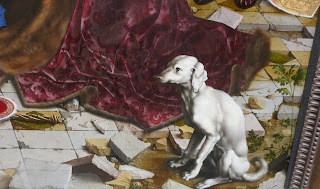 My main interest was the dogs, but it turned out I missed a hidden angel - & so much more. Luckily a BBC Radio 4 programme explained many interesting things about the painting & it can be listened to here

 This picture I didn't even like, except for the dog. I suppose I ought to have been interested because the painter is female, which as we all know is unusual because of the horrible male dominated art world, blah, blah, blah:
Although I'm not usually wild about Gainsborough, this one I thought lovely - and, at the time, idealised, but since then I have spent ten days in various rural places and discovered that rural England really is this lovely:
The dogs just added to the image's appeal:

 This couple doesn't appeal to me at all, but their dog redeems them; sometimes I think that is the function of dogs, which is perhaps why so many terrifying people loitering in city streets keep dogs. My cousin's husband believes there is a shop somewhere that sells canine accessories especially for the dogs of itinerants - a collar and lead made out of grubby string, that kind of thing, or possibly a kennel owner who has a long queue of waiting clients for his line of slightly depressed, sandy grey, uncertain breed puppies, each one provided with a rope collar and lead as part of the package:
 Stubbs is famed for his horses, but this picture includes a pretty good stab by him at a dog as well

 Not that I am arguing about Stubbs's status when it came to painting horses; he was and remains the king in that field:
 There is a dog in this picture, but even without one it is extremely intriguing. It seems to be a painting out of its time, faintly surreal and more 1920s than 1750, and I have to add that the inclusion of a third Gainsborough in one post seems to be undermining my claim that I don't like Gainsborough:
 This painting I definitely wasn't interested in, beyond the chubby pup:
 This one appealed to me for its subject matter, and the dog was just an added bonus:

 This one has a background that hints at intrigue and makes one curious - but the dog, ugly as it is, was once again the clincher for me:
 It may seem wrong and frivolous to be focussing on dogs, given the National Gallery's collection has so much more of spiritual edification to offer. I offer as justification the fact that Crufts, the dog show, has just taken place in Birmingham. Of course, this is a time-limited (that dreadful Brexit jargon, it seems to slip into one's brain by osmosis, eurgh eurgh eurgh) justification and I will have to come up with something better when I continue to focus on canines, both back at the National and everywhere else I go to see paintings.
All right, I admit it - I like looking at paintings of dogs.
 |
| The adoration of the Kings, Jan Gossaert, 1510-15, (Caspar, one of the Three Kings, kneels before the Virgin. Melchior stands behind him, and the black king is Balthasar. The dove of the Holy Spirit descends from the star which guided the kings. Shepherds stand to the right and more appear in the distance.) |


 |
| Portrait of a Woman, 1551, by Catharina van Hemessen (The woman carries a small dog under her arm. She is probably from Antwerp in the Low Countries, where the artist painted many similar portraits of women. The sitter's exact identity is unknown.) |
Although I'm not usually wild about Gainsborough, this one I thought lovely - and, at the time, idealised, but since then I have spent ten days in various rural places and discovered that rural England really is this lovely:
 |
| The Market Cart, 1786, by Thomas Gainsborough, (A girl and three younger children are shown returning home from market. Their wagon is laden with fresh produce. The boy gathering sticks for fuel ont he right was included as an afterthought. The position of the horse's head was also altered, making it strain forwards: the old position can be seen where the paint has become transparent with age) |


 |
| Mr & Mrs William Hallett ("The Morning Walk"), 1785, Thomas Gainsborough, (Gainsborough portrayed William Hallett (1764-1842) & Elizabeth Stephen (1763-1833) shortly before their marriage on 30 July 1785. They may be wearing their wedding clothes. Mrs Hallett's silk dress; the white fur of the Pomeranian sheep dog; and the foliage are evoked with the light brushstrokes Gainsborough used in the last phase of his career) |

 |
| The Milbanke and Melbourne Families, about 1769, George Stubbs (Elizabeth Milbanke, left, married Peniston Lamb, far right, later First Viscount Melbourne, shortly before this group portrait was painted. She is shown seated in a carriage, perhaps because she was pregnant at the time. The other sitters are, from left, her father Sir Ralph Milbanke and her brother John Milbanke) |


 |
| Whistlejacket, 1762 George Stubbs, (The racehorse Whistlejacket was painted life size for his owner, the second Marquess of Rockingham, in celebrtation of the Arabian-bred stallion's superb proportions and beautiful appearance. Rockingham's interest in classical sculpture may have inspired this arresting and unusual presentation) |

 |
| Mr and Mrs Andrews by Thomas Gainsborough (Robert Andrews married Frances Carter in 1748. The couple pose under an oak tree in a field where sheaves of ripe corn have been harvested. The painting of Mrs Andrew's lap is unfinished; the space may have been reserved for a child for Mrs Andrews to hold) |

 |
| Portrait of Don Justion de Neve, 1665 by Murillo (The sitter was a canon of Seville Cathedral and a friend and patron of the artist. He obtained a major commission for Murillo, the decoration of the church of Santa Maria la Blanca in Seville) |

 |
| Christ Healing the Paralytic at the Pool of Bethesda, 1667-70, Murillo, (Christ, with three apostles, healed a paralysed man at the pool of Bethesda, (John 5: 2-8) The painting is one of six works by Murillo illustrating the Acts of Charity. They were made for the church of the Confraternity of the Caridad in Seville) |


 |
| Queen Mariana of Spain in Mourning, 1666, by Juan Bautista Martinex del Mazo, (Queen Mariana was the wife of Philip IV. She acted as Regent from his death in 1665 until 1677, when their son Charles II, reached majority. Charles is shown as a young boy in the background. The widow's dress Mariana wears in this portrait resembles a nun's habit) |

All right, I admit it - I like looking at paintings of dogs.
Monday, 11 March 2019
The World as it Was and Ways of Painting the Virgin Mary
I was in London the other day and intended to go to the National Portrait Gallery to look at an exhibition of miniatures that I have read is very good. However, I thought I would first go next door to the National Gallery and spend a few minutes worshipping at the altar of one of my favourite paintings - the self-portrait of van Eyck that is housed in the gallery's Sainsbury wing.
But when I reached the part of the gallery where the van Eyck used to hang, everything had been swapped around. It was wonderful. I was forced to look at a whole lot of pictures I either hadn't noticed before or had never seen at all - perhaps they were in storage and not on display at all until this rehang.
I discovered so many beautiful paintings. The first is this Virgin and Child by Giovanni Battista Cima da Conegliano, which was painted, they think, somewhere between 1496 and 1499.


It seems to me that the Virgin is not strongly characterised in this picture, unlike John the Baptist - it is his image that makes the painting particularly endearing to me:


The next picture that captured my attention is this one of Christ appearing to the virgin after his death. It was painted by Juan de Flande between 1499 and 1500. I like the big blocks of pink and blue and the intricate detail of the floor tiles and the host of souls behind Jesus, I like the Virgin and the speech scrolls, but above all I like the pigeons:


Mary herself is not a very fully formed character here, I don't think, although the woodwind blowing angel over her shoulder looks full of mischief:


In memory of my brother, I also include the view from Saint Ivo's window:

Saturday, 9 March 2019
Reading - January 2019
I discovered Rachel Cusk last year, and spent most of an overnight stay in St Florian reading her recent trilogy, while my husband tossed and turned, disturbed by monastery bells. Now I have read The Country Life, Arlington Park, The Temporary and In the Fold as well. I am looking forward to reading everything she writes
Interviewed about that recent trilogy, (Outline, Kudos and Transit) Cusk has declared the death of character. While I think such a statement is ridiculous in general, inasmuch as it applies to her own enormous but particular talent it is probably sensible. That is to say, character is not her strength. Nor is plot. What she is good at is analogy and what she is truly brilliant at is clear, careful, detailed observation. Her descriptive writing is, as someone I know put it, "forensic".
As I read most of the books that I have read by Cusk on a Kindle, I have an electronic list of all the parts of them that I highlighted because I thought them so strikingly good. Looking through them, I see that Cusk can be very, very funny, but, to reiterate, the thing I especially admire in her work is her ability to describe with perfect accuracy phenomena that I have observed and long wished to describe, without ever finding the words.
Rather than download my full and very lengthy collection of admirable quotes from Cusk's writing, I have chosen just one as an example, taken from In the Fold. In it, Rachel Cusk describes the kind of busy road one drives along so often in overcrowded Britain, the kind that slices through an area of housing that was never built with motor vehicles in mind. Her careful - forensic? - choice of words means an everyday scene that on the face of it is dull and ugly, a scene that many writers would simply ignore, is evoked as the unbearable place to live that such places are in reality for so many:
"There the coast road passed through, a fuming, hooting, rattling cascade of metal the narrow, decorous terraces struggled to contain. Great lorries like dinosaurs manoeuvred on the small roundabouts. Dirty trucks freighted with skips and scaffolding roared past, driven by men who gazed blankly through their spattered windscreens. Beside them the pavements and brick walls of front gardens looked miniature: the gardens and the facades of the houses shook like toys as the lorries passed and the daffodils seemed to jolt from side to side in the grass. The houses looked so vulnerable next to the pounding road that it was difficult to believe in the world in which they had been constructed. Some of the terraces were only fifty or sixty years old but they seemed rooted in a past that had become meaningless. Great weights hurtled back and forth at high velocity past the little, unaccustomed rows of houses, four feet from their front gates."
Helen Garner shares Rachel Cusk's ability to observe the physical world and the people she meets “forensically” and then to translate her observation into words. Although she is one of my favourite writers, given that I don’t like the intrusive nature of biographies, I don’t quite know why I borrowed Bernadette Brennan’s prizewinning biography of Garner from the library. I must admit that, within its genre, it is an excellent book and almost as readable as Garner’s own works. However, by the end, I felt that I had been nosily rummaging about in the subject’s underwear drawer and, unsurprisingly, had emerged with a slight sense of disappointment.
Until I read the biography, there was only one element of Garner’s work that I did not admire - that was a slight tendency to overblown emotion, tipping into sentimentality. Unfortunately, the picture of Garner that emerges from the book suggests that she is capable of an impulsive emotional volatility. This made me suspect that the sentimentality I detected in some of the work might be the mere tip of the iceberg. I was left with a disturbing impression of someone more narcissistic and less wise than I had imagined.
I was also shocked that Garner identified with Anu Singh, the murderer of Joe Cinque and that she does not believe evil exists. To me the story of Joe Cinque’s death is a story of how evil does exist, but only when we make the choice to embrace it. In my view, every day of our lives is a day in which we make countless decisions about whether to be good or not - impatience, my besetting fault, is a small concession to evil, because it usually entails a choice not to be kind. Kindness is a denial of evil and evil is a decision to love yourself instead of others. I’m shocked that Garner does not recognise this, as I thought her writing was at heart deeply moral.
Forensic is not a word one would,use about Bill Shorten - although ruthless might fit the bill. David Marr’s Quarterly Essay about the man who I am almost convinced will become Australia’s next Prime Minister at the federal election due in May is not very edifying. Our probable next leader is a man who understands power, who wants to be Prime Minister, but who seems to believe in nothing. You need to be tough in politics, but this person appears to have no loyalty to anyone or anything. He also does not seem very interested in ideas or the life of the mind. I suppose everything will muddle along though, just as before, bug with a few more taxes and a lot more irritating initiatives to remodel society in the shape of whichever new identity interest group shouts loudest on the day. Marr is a good writer, capturing vignettes of party conference scenes and plotters’ meetings very well, but there is, inevitably, quite a lot of detail about the process of Shorten’s political career within the union movement and later the Labor Party that I found hard going.
I also read Cure by Jo Marchant. It describes a number of cases and studies that have demonstrated that placeboes are effective, even when those being given them know that they are placeboes. It is one of the most staggering things I have ever read, seeming to prove irrefutably that physical health is intimately tied up with mental state. Fascinating.
Interviewed about that recent trilogy, (Outline, Kudos and Transit) Cusk has declared the death of character. While I think such a statement is ridiculous in general, inasmuch as it applies to her own enormous but particular talent it is probably sensible. That is to say, character is not her strength. Nor is plot. What she is good at is analogy and what she is truly brilliant at is clear, careful, detailed observation. Her descriptive writing is, as someone I know put it, "forensic".
As I read most of the books that I have read by Cusk on a Kindle, I have an electronic list of all the parts of them that I highlighted because I thought them so strikingly good. Looking through them, I see that Cusk can be very, very funny, but, to reiterate, the thing I especially admire in her work is her ability to describe with perfect accuracy phenomena that I have observed and long wished to describe, without ever finding the words.
Rather than download my full and very lengthy collection of admirable quotes from Cusk's writing, I have chosen just one as an example, taken from In the Fold. In it, Rachel Cusk describes the kind of busy road one drives along so often in overcrowded Britain, the kind that slices through an area of housing that was never built with motor vehicles in mind. Her careful - forensic? - choice of words means an everyday scene that on the face of it is dull and ugly, a scene that many writers would simply ignore, is evoked as the unbearable place to live that such places are in reality for so many:
"There the coast road passed through, a fuming, hooting, rattling cascade of metal the narrow, decorous terraces struggled to contain. Great lorries like dinosaurs manoeuvred on the small roundabouts. Dirty trucks freighted with skips and scaffolding roared past, driven by men who gazed blankly through their spattered windscreens. Beside them the pavements and brick walls of front gardens looked miniature: the gardens and the facades of the houses shook like toys as the lorries passed and the daffodils seemed to jolt from side to side in the grass. The houses looked so vulnerable next to the pounding road that it was difficult to believe in the world in which they had been constructed. Some of the terraces were only fifty or sixty years old but they seemed rooted in a past that had become meaningless. Great weights hurtled back and forth at high velocity past the little, unaccustomed rows of houses, four feet from their front gates."
Helen Garner shares Rachel Cusk's ability to observe the physical world and the people she meets “forensically” and then to translate her observation into words. Although she is one of my favourite writers, given that I don’t like the intrusive nature of biographies, I don’t quite know why I borrowed Bernadette Brennan’s prizewinning biography of Garner from the library. I must admit that, within its genre, it is an excellent book and almost as readable as Garner’s own works. However, by the end, I felt that I had been nosily rummaging about in the subject’s underwear drawer and, unsurprisingly, had emerged with a slight sense of disappointment.
Until I read the biography, there was only one element of Garner’s work that I did not admire - that was a slight tendency to overblown emotion, tipping into sentimentality. Unfortunately, the picture of Garner that emerges from the book suggests that she is capable of an impulsive emotional volatility. This made me suspect that the sentimentality I detected in some of the work might be the mere tip of the iceberg. I was left with a disturbing impression of someone more narcissistic and less wise than I had imagined.
I was also shocked that Garner identified with Anu Singh, the murderer of Joe Cinque and that she does not believe evil exists. To me the story of Joe Cinque’s death is a story of how evil does exist, but only when we make the choice to embrace it. In my view, every day of our lives is a day in which we make countless decisions about whether to be good or not - impatience, my besetting fault, is a small concession to evil, because it usually entails a choice not to be kind. Kindness is a denial of evil and evil is a decision to love yourself instead of others. I’m shocked that Garner does not recognise this, as I thought her writing was at heart deeply moral.
Forensic is not a word one would,use about Bill Shorten - although ruthless might fit the bill. David Marr’s Quarterly Essay about the man who I am almost convinced will become Australia’s next Prime Minister at the federal election due in May is not very edifying. Our probable next leader is a man who understands power, who wants to be Prime Minister, but who seems to believe in nothing. You need to be tough in politics, but this person appears to have no loyalty to anyone or anything. He also does not seem very interested in ideas or the life of the mind. I suppose everything will muddle along though, just as before, bug with a few more taxes and a lot more irritating initiatives to remodel society in the shape of whichever new identity interest group shouts loudest on the day. Marr is a good writer, capturing vignettes of party conference scenes and plotters’ meetings very well, but there is, inevitably, quite a lot of detail about the process of Shorten’s political career within the union movement and later the Labor Party that I found hard going.
I also read Cure by Jo Marchant. It describes a number of cases and studies that have demonstrated that placeboes are effective, even when those being given them know that they are placeboes. It is one of the most staggering things I have ever read, seeming to prove irrefutably that physical health is intimately tied up with mental state. Fascinating.
Friday, 8 March 2019
Bristol and Birmingham Stone Faces
I was in Birmingham yesterday and I’m in Bristol today. I saw some nice faces on the facades of buildings and I put them on an Instagram account I’ve just begun, as a way of feeding my fondness for photographing architectural decoration that I see. The account is called oldfacesoldplaces
Wednesday, 6 March 2019
Farce - French versus English
There is a new production of Moliere’s Tartuffe at London’s National Theatre and, while in London the other day, we went along. Tartuffe is usually described as a satire but this production played it mainly as a farce, and we enjoyed it a lot, (for more detail, look here).
A couple of days after seeing Tartuffe, we went to Bateman's, Rudyard Kipling’s house in Sussex and enjoyed another, more English form of farce.
Bateman's is a National Trust property, and when we arrived we were asked if we were Trust members. When we said we weren't, the woman at the ticket office reacted with such astonishment, she might have been in a pantomime - can she really never have encountered others of our ilk?
Perhaps it was her amazement that led her to forget to mention that, although we were paying a lot of money to go in, we would not in fact be getting very good value, because of the time of year. Anyway, she did neglect to tell us this, so we made our way down through the walled kitchen garden, where little was growing, although someone had planted a stick to which was fixed a laminated piece of paper, announcing that Ernest Shackleton had once been a visitor to the house.
We entered the house itself through a large shop, selling soaps and coffee cups and fudge and scented drawer envelopes and picnic rugs and all sorts of other things unrelated to Rudyard Kipling. We were asked to gather in what looked like the former scullery, to wait for our tour to begin. A group of people was already in there when we turned up, watched over by two women in puffer jackets, who turned out to be our guides.
After a bit of discussion between these two women about whether anyone else was coming, we set off. We were led through a short narrow corridor- a route that we were told was a special privilege not given to many visitors- and into a dark room, which we were informed was the front hall. There we peered at the vague outline of what one woman announced was the National Trust's oldest working clock, (British made and keeping much, much better time than the one facing it, a newer device, made in the Netherlands, so yah boo sucks, Europe).
I took this information on trust as it wasn't easy to make out the object and anyway we were moving on - into to yet another ill-lit room. This, apparently, was the Kiplings' sitting room. The blinds were down, as they had been in the first room, and, while one of our guides explained what the various objects that loomed out of the darkness were, the other held up a torch with a rather faint beam. We all peered in whichever direction was indicated, but I don't believe any of us made out more than vague outlines. At a certain point scratchy music burst upon us, as one of the women had managed to get a wind-up gramophone to operate. Then she picked up something woolen and shoved it somewhere in the shadows and the sound was muffled. There was no volume control on old record players, she explained, as she did this, and so you had to put a sock in the broadcasting horn to moderate the noise - hence the phrase, "put a sock in it".
We passed through more rooms, all in semi-darkness. We were not allowed into Kipling’s writing room, because of something to do with the floor. Instead we were invited to take turns at putting one eye to the door jamb, through which we each got a glimpse of a room in which all the furniture appeared to be piled up in a corner (conservation) and, once again, the blinds were down, obscuring the view that, we were told, sustained and inspired Kipling in his day.
Everyone accepted the conditions meekly, except my husband, who is Australian and not trained in "mustn't grumble" manners. When we reached the upstairs bedroom, which was plunged in semi-obscurity like the rest of the place, his patience gave out. What about pulling up the blinds, he suggested, to make things a little easier to see?
Our guides seemed mildly hurt by this suggestion and for the rest of the tour kept returning to their justifications, which boiled down to rules and the importance of observing them, without anything so impertinent as a questioning spirit. We were experiencing the National Trust's winter arrangements, apparently . They were ever so sorry, but t hey were prohibited from pulling up the blinds until the summer system, known as "free flow" came into force. Once that happened, the world would be our oyster, we would be able to come and go as we pleased, windows would be uncovered and everything would be illuminated.
Not being English, my husband wanted to know why we couldn't have the blinds up and do all these things now. Silly man, I thought, he doesn't understand the fundamentals of English farce - I mean life: rules, the more pointless the better, strictly adhered to, uncontestable, and rigidly applied.
The one area where extreme efficiency occurs in British existence is in the application of rules.
We trailed on through the house, but the mood was ruined. The wind had gone out of the two women's sails. They continued their pointless descriptions of things that could not be seen (they seemed not to understand that a torch held to a glass cabinet does not illuminate the objects inside but merely creates a bright reflection that bounces back and hurts the observer's eyes), but kept returning to the issue of "free flow" and their justifications, (which had no substance, if you didn't accept that a rule is a rule is a rule, however idiotic) for the window blinds being kept closed.
Since then we have visited more National Trust properties. We have even been sufficiently tamed to buy ourselves a membership of the organisation. What I have realised is that it is a quintessentially British organisation, staffed voluntarily by an army of people who love enforcing rules. Which is possibly the pastime enjoyed more than any other by inhabitants of the British isles.
Mind you, not everyone who volunteers is English. A couple of days after going to Bateman's, we went to have a look at Petworth, and there I witnessed a young female volunteer of Spanish origin, come rushing out into the courtyard to chastise someone for standing two feet within the gateway with a dog on a lead. The gusto with which she enforced regulations was a triumph of the local culture, her natural Latin laissez faire instincts clearly completely eclipsed by immersion in her new environment. It made me proud to be British.
But it also started me thinking. Many British who chose to vote to leave the European Union did so because they were sick of all its rules and regulations, but what if in fact that proliferation of rules and regulations turns out to have been the result of British membership? What if, with the United Kingdom gone, the massed ranks of bureaucrats in Brussels will breathe a sigh of relief and say to themselves, "Thank heavens they've disappeared; now we won't have to make up any more new rules to make life difficult for everyone." How embarrassing that would turn out to be.
A couple of days after seeing Tartuffe, we went to Bateman's, Rudyard Kipling’s house in Sussex and enjoyed another, more English form of farce.
Bateman's is a National Trust property, and when we arrived we were asked if we were Trust members. When we said we weren't, the woman at the ticket office reacted with such astonishment, she might have been in a pantomime - can she really never have encountered others of our ilk?
Perhaps it was her amazement that led her to forget to mention that, although we were paying a lot of money to go in, we would not in fact be getting very good value, because of the time of year. Anyway, she did neglect to tell us this, so we made our way down through the walled kitchen garden, where little was growing, although someone had planted a stick to which was fixed a laminated piece of paper, announcing that Ernest Shackleton had once been a visitor to the house.
We entered the house itself through a large shop, selling soaps and coffee cups and fudge and scented drawer envelopes and picnic rugs and all sorts of other things unrelated to Rudyard Kipling. We were asked to gather in what looked like the former scullery, to wait for our tour to begin. A group of people was already in there when we turned up, watched over by two women in puffer jackets, who turned out to be our guides.
After a bit of discussion between these two women about whether anyone else was coming, we set off. We were led through a short narrow corridor- a route that we were told was a special privilege not given to many visitors- and into a dark room, which we were informed was the front hall. There we peered at the vague outline of what one woman announced was the National Trust's oldest working clock, (British made and keeping much, much better time than the one facing it, a newer device, made in the Netherlands, so yah boo sucks, Europe).
I took this information on trust as it wasn't easy to make out the object and anyway we were moving on - into to yet another ill-lit room. This, apparently, was the Kiplings' sitting room. The blinds were down, as they had been in the first room, and, while one of our guides explained what the various objects that loomed out of the darkness were, the other held up a torch with a rather faint beam. We all peered in whichever direction was indicated, but I don't believe any of us made out more than vague outlines. At a certain point scratchy music burst upon us, as one of the women had managed to get a wind-up gramophone to operate. Then she picked up something woolen and shoved it somewhere in the shadows and the sound was muffled. There was no volume control on old record players, she explained, as she did this, and so you had to put a sock in the broadcasting horn to moderate the noise - hence the phrase, "put a sock in it".
We passed through more rooms, all in semi-darkness. We were not allowed into Kipling’s writing room, because of something to do with the floor. Instead we were invited to take turns at putting one eye to the door jamb, through which we each got a glimpse of a room in which all the furniture appeared to be piled up in a corner (conservation) and, once again, the blinds were down, obscuring the view that, we were told, sustained and inspired Kipling in his day.
Everyone accepted the conditions meekly, except my husband, who is Australian and not trained in "mustn't grumble" manners. When we reached the upstairs bedroom, which was plunged in semi-obscurity like the rest of the place, his patience gave out. What about pulling up the blinds, he suggested, to make things a little easier to see?
Our guides seemed mildly hurt by this suggestion and for the rest of the tour kept returning to their justifications, which boiled down to rules and the importance of observing them, without anything so impertinent as a questioning spirit. We were experiencing the National Trust's winter arrangements, apparently . They were ever so sorry, but t hey were prohibited from pulling up the blinds until the summer system, known as "free flow" came into force. Once that happened, the world would be our oyster, we would be able to come and go as we pleased, windows would be uncovered and everything would be illuminated.
Not being English, my husband wanted to know why we couldn't have the blinds up and do all these things now. Silly man, I thought, he doesn't understand the fundamentals of English farce - I mean life: rules, the more pointless the better, strictly adhered to, uncontestable, and rigidly applied.
The one area where extreme efficiency occurs in British existence is in the application of rules.
We trailed on through the house, but the mood was ruined. The wind had gone out of the two women's sails. They continued their pointless descriptions of things that could not be seen (they seemed not to understand that a torch held to a glass cabinet does not illuminate the objects inside but merely creates a bright reflection that bounces back and hurts the observer's eyes), but kept returning to the issue of "free flow" and their justifications, (which had no substance, if you didn't accept that a rule is a rule is a rule, however idiotic) for the window blinds being kept closed.
Since then we have visited more National Trust properties. We have even been sufficiently tamed to buy ourselves a membership of the organisation. What I have realised is that it is a quintessentially British organisation, staffed voluntarily by an army of people who love enforcing rules. Which is possibly the pastime enjoyed more than any other by inhabitants of the British isles.
Mind you, not everyone who volunteers is English. A couple of days after going to Bateman's, we went to have a look at Petworth, and there I witnessed a young female volunteer of Spanish origin, come rushing out into the courtyard to chastise someone for standing two feet within the gateway with a dog on a lead. The gusto with which she enforced regulations was a triumph of the local culture, her natural Latin laissez faire instincts clearly completely eclipsed by immersion in her new environment. It made me proud to be British.
But it also started me thinking. Many British who chose to vote to leave the European Union did so because they were sick of all its rules and regulations, but what if in fact that proliferation of rules and regulations turns out to have been the result of British membership? What if, with the United Kingdom gone, the massed ranks of bureaucrats in Brussels will breathe a sigh of relief and say to themselves, "Thank heavens they've disappeared; now we won't have to make up any more new rules to make life difficult for everyone." How embarrassing that would turn out to be.
Subscribe to:
Posts (Atom)