I read The Fatal Shore by Robert Hughes a few years ago. In light of the current widespread unrest about slavery, I took it down again from the shelf today, to see whether it would be possible to argue that those transported to the penal colony that was the start of modern Australia could be described as slaves of a sort.
I quickly got distracted by all the many interesting things it has to say - for instance, the astonishing information that in London:
"around St Martin's, St James's and St Giles-in-the-Fields, there were large open pits filled with the rotting cadavers of paupers whose friends could get them no better burial; they were called 'Poor's Holes' and remained a London commonplace until the 1790s."
Passages like that ring alarm bells about trying to judge activities in the past by the standards of today. Human life generally was valued very differently from today.
And then I came across a passage filled with such prejudice that my outrage flared. Here it is:
They "are the most wild, ignorant and savage race that were ever favoured with the light of Civilisation; men that have been familiar with ... every horrid Crime from their Infancy. Their minds, being destitute of every Principle of Religion and Morality, render them capable of perpetrating the most nefarious Acts in cool Blood. As they never appear to reflect upon Consequences, but to be ... always alive to Rebellion and Mischief, they are very dangerous members of Society. No Confidence whatever can be placed in them ... They are extremely superstitious, artful and treacherous, which renders it impossible for the most watchful and active Government to discover their real Intentions."
What a disgusting piece of racial hatred. We should all rise up in disgust when we realise that this was written by a representative of the Church of England, the Reverend Samuel Marsden, (1764-1838), who became the chief Anglican clergyman in New South Wales.
He was writing about the Irish, by the way.
Saturday, 13 June 2020

Thursday, 11 June 2020
But Seriously This Time
I remember going as a very small child with my parents to see a film called It's a Mad, Mad World. We didn't actually see the film as there was a queue round the block for it when we got to the cinema and we watched something stupid instead, set in Africa. None of it made any sense to me but my attention was caught by an affecting scene in which a small girl of about my age ran touchingly toward her long lost father. I proceeded to imagine myself doing this up and down our front hall when we got home, until I was told to stop making so much racket clattering my shoes (the part I was most enjoying).
Anyway, perhaps if I'd gone to see It's a Mad, Mad World, I would have internalised sooner the message of the title. Instead, I continue to go through life saying, "The world's gone mad" with increasing regularity.
But, seriously, this time it actually has - or the western part of the world at least, where we are facing a pandemic involving an unusually infectious and contagious virus and have been warned for months by all those who claim to know about medicine and science that it is very important, if we want to save as many lives as possible, that we stay away from other people, avoiding all crowded places. Those who have broken these rules in even the smallest way have been pilloried in the press.
And then, following the killing somewhere in America of an innocent, (until proven guilty) man by a police officer, herd immunity became the new weapon of choice - at least I'm assuming that was the central motivation in the minds of the individuals who took part in the subsequent herd stampede. Despite the fact that the police officer involved has been charged with the innocent (until proven guilty) man's death and faces trial, and therefore the system is working exactly as it should in such a case, large numbers of people in America and elsewhere have decided this is precisely the right moment to pour onto the streets and launch a revolution against racism. Racism, they argue is endemic in all countries where white people are the majority indigenous population and it must be destroyed now. No matter how pressing the problem of the virus, or anything else for that matter, this is the precise time when it must be addressed as the first priority of the governments and societies of all countries where white caucasians are the majority inhabitants. It simply cannot wait, (although it can wait for as long as you like in China, the Middle East, India and all other countries where the majority population is not predominantly white caucasian, apparently).
Of course, with an alacrity unknown hitherto, local authorities in Britain responded by launching themselves instantly into persuading the participants of rallies that this was not the right time to launch a revolution, however much their cause might or might not have right on its side. The representatives of medicine and science enjoined the population to wait until the virus that was picking off the old and frail had subsided before going out to voice their concerns. The law courts understood the paramount importance of getting rid of the virus and ruled that in the circumstances the right to demonstrate needed to be judged as secondary to the right of citizens to protection from the chance of a rise in deaths via an increase in the spread of disease that demonstrations might cause.
Oh.
No, I've just checked that isn't what happened. Instead, medical experts advised that it was in the interests of public health to go out and demonstrate, provided people only went out to demonstrate against racism:

Here's some nice magical thinking from the council member for the 7th district of New York City, to back the experts up :

While local authorities did indeed act with unprecedented speed, their activity was not designed to protect the public from the immediate health crisis. Instead, it was decided that the possible damage done to the mental health of a small sector of their constituents by statues was of the most urgent importance. During an epidemic of a dangerous virus that had led to a lockdown that was destroying the economy, the conclusion was reached that it was time to work out which statues, street names and building titles might remind people that there was a shameful period during which Christian societies strayed from their values and decided that, if everyone else was practising slavery, they would too. Such reminders were so hurtful that the Mayor of London even went so far as to set up a committee immediately to look into the problem. Clearly in his view this was not only a more urgent problem than tackling the epidemic of coronavirus but also more urgent than tackling the epidemic of knife crime in the city he rules - an epidemic that leads annually to the deaths of far, far too many mainly black people. Black lives matter anyone?
I have to admit that there was absolutely no surprise in the fact that the UK police stood about while the mob ruled, given they've done that for years. Ask girls in Rotherham and Rochdale and Telford, to name but a few. My impression for a long time is that nowadays the only time the British police force ever shows any energy is when learning to do pathetic bits of break dancing, accusing people of hate crime (a category that ought not to even exist - either you have been insulted in which case bad luck, take no notice, or you have been physically attacked, in which case it is assault) or using drones to pursue people who are clearly no threat to anyone, least of all themselves, as they stroll in the Peak District National Park.
But that was all in the United Kingdom. I did expect better from the other country I am a citizen of. While I wasn't surprised that the Australian equivalent of the BBC chose to end its version of Question Time with a monologue from the son of a children's book illustrator and a native title bureaucrat, who spent his childhood comfortably in Perth, the city where he studied for his first degree, before moving on from there to Sydney to one of the best drama schools in the world and then acting in a widely syndicated and very popular (no, I don't know why it is either) televison soap opera. This young chap is full of anger that he isn't treated properly. He identifies as an indigenous person, but he is angry because he is given acting roles where he plays indigenous characters and he is furious about an incident involving an indigenous sporting hero who was racially abused, an incident that this young chap (and many others) has taken to be a sign that racism is widespread and, presumably, all white Australians would like to be racially abusive - an interpretation of a single incident that I would argue is in itself racist. Anyway, this young chap is very angry and he's not afraid to demonstrate how angry he is and one reason he is angry is that he believes that white Australians don't like to see "blackfellas" being angry. The trouble is not liking to see people angry has nothing to do with skin colour. It has everything to do with finding anger a worrying precursor to physical violence, particularly if you are a woman
As I say, that didn't surprise me. Public broadcasters everywhere are entirely hostage to whatever the prevailing politically correct wind happens to be - and they also love adding to the strength with which it blows. However, I did expect more from the Australian judicial system. Therefore, when the NSW Appeals Court made a lightning fast decision last week, (bearing in mind that most plaintiffs experience a speed of process that could charitably be described as snail like) which, with five minutes to spare before a demonstration was scheduled to begin (amazing that), allowed people to pour into the streets lawfully in packed, sweaty numbers to shout that black lives matter, I did feel a moment of despair.
But then I remembered my five-year-old self clattering up and down the front hall in our house all those years ago and I realised that all we are witnessing is the pervasive human impulse to make a lot of noise.
PS The revolution may end up eating itself
PPS Meanwhile Christians wait:

Anyway, perhaps if I'd gone to see It's a Mad, Mad World, I would have internalised sooner the message of the title. Instead, I continue to go through life saying, "The world's gone mad" with increasing regularity.
But, seriously, this time it actually has - or the western part of the world at least, where we are facing a pandemic involving an unusually infectious and contagious virus and have been warned for months by all those who claim to know about medicine and science that it is very important, if we want to save as many lives as possible, that we stay away from other people, avoiding all crowded places. Those who have broken these rules in even the smallest way have been pilloried in the press.
And then, following the killing somewhere in America of an innocent, (until proven guilty) man by a police officer, herd immunity became the new weapon of choice - at least I'm assuming that was the central motivation in the minds of the individuals who took part in the subsequent herd stampede. Despite the fact that the police officer involved has been charged with the innocent (until proven guilty) man's death and faces trial, and therefore the system is working exactly as it should in such a case, large numbers of people in America and elsewhere have decided this is precisely the right moment to pour onto the streets and launch a revolution against racism. Racism, they argue is endemic in all countries where white people are the majority indigenous population and it must be destroyed now. No matter how pressing the problem of the virus, or anything else for that matter, this is the precise time when it must be addressed as the first priority of the governments and societies of all countries where white caucasians are the majority inhabitants. It simply cannot wait, (although it can wait for as long as you like in China, the Middle East, India and all other countries where the majority population is not predominantly white caucasian, apparently).
Of course, with an alacrity unknown hitherto, local authorities in Britain responded by launching themselves instantly into persuading the participants of rallies that this was not the right time to launch a revolution, however much their cause might or might not have right on its side. The representatives of medicine and science enjoined the population to wait until the virus that was picking off the old and frail had subsided before going out to voice their concerns. The law courts understood the paramount importance of getting rid of the virus and ruled that in the circumstances the right to demonstrate needed to be judged as secondary to the right of citizens to protection from the chance of a rise in deaths via an increase in the spread of disease that demonstrations might cause.
Oh.
No, I've just checked that isn't what happened. Instead, medical experts advised that it was in the interests of public health to go out and demonstrate, provided people only went out to demonstrate against racism:


While local authorities did indeed act with unprecedented speed, their activity was not designed to protect the public from the immediate health crisis. Instead, it was decided that the possible damage done to the mental health of a small sector of their constituents by statues was of the most urgent importance. During an epidemic of a dangerous virus that had led to a lockdown that was destroying the economy, the conclusion was reached that it was time to work out which statues, street names and building titles might remind people that there was a shameful period during which Christian societies strayed from their values and decided that, if everyone else was practising slavery, they would too. Such reminders were so hurtful that the Mayor of London even went so far as to set up a committee immediately to look into the problem. Clearly in his view this was not only a more urgent problem than tackling the epidemic of coronavirus but also more urgent than tackling the epidemic of knife crime in the city he rules - an epidemic that leads annually to the deaths of far, far too many mainly black people. Black lives matter anyone?
I have to admit that there was absolutely no surprise in the fact that the UK police stood about while the mob ruled, given they've done that for years. Ask girls in Rotherham and Rochdale and Telford, to name but a few. My impression for a long time is that nowadays the only time the British police force ever shows any energy is when learning to do pathetic bits of break dancing, accusing people of hate crime (a category that ought not to even exist - either you have been insulted in which case bad luck, take no notice, or you have been physically attacked, in which case it is assault) or using drones to pursue people who are clearly no threat to anyone, least of all themselves, as they stroll in the Peak District National Park.
But that was all in the United Kingdom. I did expect better from the other country I am a citizen of. While I wasn't surprised that the Australian equivalent of the BBC chose to end its version of Question Time with a monologue from the son of a children's book illustrator and a native title bureaucrat, who spent his childhood comfortably in Perth, the city where he studied for his first degree, before moving on from there to Sydney to one of the best drama schools in the world and then acting in a widely syndicated and very popular (no, I don't know why it is either) televison soap opera. This young chap is full of anger that he isn't treated properly. He identifies as an indigenous person, but he is angry because he is given acting roles where he plays indigenous characters and he is furious about an incident involving an indigenous sporting hero who was racially abused, an incident that this young chap (and many others) has taken to be a sign that racism is widespread and, presumably, all white Australians would like to be racially abusive - an interpretation of a single incident that I would argue is in itself racist. Anyway, this young chap is very angry and he's not afraid to demonstrate how angry he is and one reason he is angry is that he believes that white Australians don't like to see "blackfellas" being angry. The trouble is not liking to see people angry has nothing to do with skin colour. It has everything to do with finding anger a worrying precursor to physical violence, particularly if you are a woman
As I say, that didn't surprise me. Public broadcasters everywhere are entirely hostage to whatever the prevailing politically correct wind happens to be - and they also love adding to the strength with which it blows. However, I did expect more from the Australian judicial system. Therefore, when the NSW Appeals Court made a lightning fast decision last week, (bearing in mind that most plaintiffs experience a speed of process that could charitably be described as snail like) which, with five minutes to spare before a demonstration was scheduled to begin (amazing that), allowed people to pour into the streets lawfully in packed, sweaty numbers to shout that black lives matter, I did feel a moment of despair.
But then I remembered my five-year-old self clattering up and down the front hall in our house all those years ago and I realised that all we are witnessing is the pervasive human impulse to make a lot of noise.
PS The revolution may end up eating itself
PPS Meanwhile Christians wait:

Wednesday, 10 June 2020
No, Sorry, Not That One
Yesterday, I thought WS Merwin might have produced the poem for our times. After reading the news from the United Kingdom this morning, I'm sad to say that I was quite wrong - Philip Larkin did it. I used to think he'd been too gloomy. Now I'm not so sure:
Going, Going:
You try to get near the sea
Going, Going:
I thought it would last my time—
The sense that, beyond the town,
There would always be fields and farms,
Where the village louts could climb
Such trees as were not cut down;
I knew there’d be false alarms
In the papers about old streets
And split level shopping, but some
Have always been left so far;
And when the old part retreats
As the bleak high-risers come
We can always escape in the car.
Things are tougher than we are, just
As earth will always respond
However we mess it about;
Chuck filth in the sea, if you must:
The tides will be clean beyond.
—But what do I feel now? Doubt?
Or age, simply? The crowd
Is young in the M1 cafe;
Their kids are screaming for more—
More houses, more parking allowed,
More caravan sites, more pay.
On the Business Page, a score
Of spectacled grins approve
Some takeover bid that entails
Five per cent profit (and ten
Per cent more in the estuaries): move
Your works to the unspoilt dales
(Grey area grants)! And when
You try to get near the sea
In summer . . .
It seems, just now,
To be happening so very fast;
Despite all the land left free
For the first time I feel somehow
That it isn’t going to last,
That before I snuff it, the whole
Boiling will be bricked in
Except for the tourist parts—
First slum of Europe: a role
It won’t be hard to win,
With a cast of crooks and tarts.
And that will be England gone,
The shadows, the meadows, the lanes,
The guildhalls, the carved choirs.
There’ll be books; it will linger on
In galleries; but all that remains
For us will be concrete and tyres.
Most things are never meant.
This won’t be, most likely; but greeds
And garbage are too thick-strewn
To be swept up now, or invent
Excuses that make them all needs.
I just think it will happen, soon.
Tuesday, 9 June 2020
Thanks by WS Merwin
This morning I came across a poem by WS Merwin that seems to me to be a thing worth reading and rereading in these angry times:
over telephones we are saying thank you
in doorways and in the backs of cars and in elevators
remembering wars and the police at the back door
and the beatings on stairs we are saying thank you
in the banks that use us we are saying thank you
with the crooks in office with the rich and fashionable
unchanged we go on saying thank you thank you
Thanks
Listen
with the night falling we are saying thank you
we are stopping on the bridges to bow for the railings
we are running out of the glass rooms
with our mouths full of food to look at the sky
and say thank you
we are standing by the water looking out
in different directions.
with the night falling we are saying thank you
we are stopping on the bridges to bow for the railings
we are running out of the glass rooms
with our mouths full of food to look at the sky
and say thank you
we are standing by the water looking out
in different directions.
back from a series of hospitals back from a mugging
after funerals we are saying thank you
after the news of the dead
whether or not we knew them we are saying thank you
looking up from tables we are saying thank you
in a culture up to its chin in shame
living in the stench it has chosen we are saying thank you
after funerals we are saying thank you
after the news of the dead
whether or not we knew them we are saying thank you
looking up from tables we are saying thank you
in a culture up to its chin in shame
living in the stench it has chosen we are saying thank you
over telephones we are saying thank you
in doorways and in the backs of cars and in elevators
remembering wars and the police at the back door
and the beatings on stairs we are saying thank you
in the banks that use us we are saying thank you
with the crooks in office with the rich and fashionable
unchanged we go on saying thank you thank you
with the animals dying around us
our lost feelings we are saying thank you
with the forests falling faster than the minutes
of our lives we are saying thank you
with the words going out like cells of a brain
with the cities growing over us like the earth
we are saying thank you faster and faster
with nobody listening we are saying thank you
we are saying thank you and waving
dark though it is
our lost feelings we are saying thank you
with the forests falling faster than the minutes
of our lives we are saying thank you
with the words going out like cells of a brain
with the cities growing over us like the earth
we are saying thank you faster and faster
with nobody listening we are saying thank you
we are saying thank you and waving
dark though it is
Monday, 8 June 2020
This Lockdown I Have Been Mostly Eating These Things
During lockdown, I found myself getting strangely interested in cooking new things. Which meant we had some pretty disgusting meals, which I will not talk any further about, and we had some wonderful ones as well.
In the realm of things that could easily have been disgusting but turned out to be delicious was this recipe, which came from a book a Thai person gave me ages ago. I've made it twice now, once using hoi sin sauce instead of oyster sauce, as I didn't have any oyster sauce, once with actual oyster sauce. Both were delicious; both tasted approximately the same. As always I probably added far more garlic and chilli than the recipe demanded. We ate it with steamed Jasmine rice:


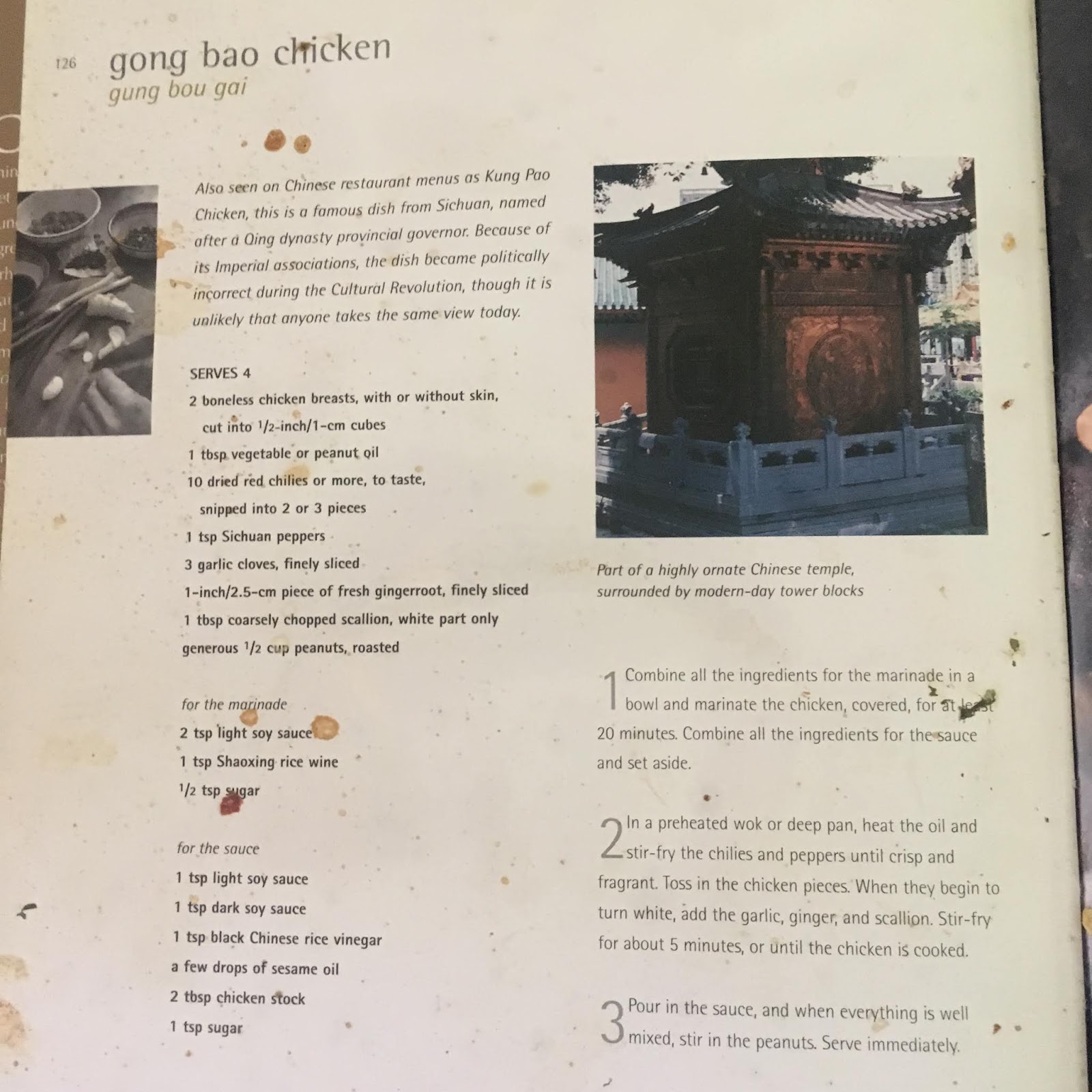
In the realm of can anything taste nasty if you scatter it with peanuts or cashews, came this dinner, which was a blend of two recipes from a book of Chinese recipes. I chose it in order to promote solidarity with the people of China, while all the while remaining firmly opposed to its horrible government, which caused me to be in lockdown trying out recipes in the first place:


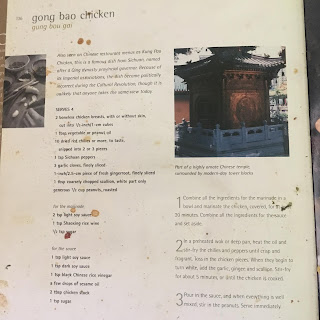
As you can see, I'm not a person anyone who wants to keep their recipe books clean should lend to.

Another night, I copied what some friends had done when we went round to their house once and cooked the asparagus and let it get cold and then ate it with mayonnaise. I made the mayonnaise using a gadget I bought in an Italian motorway stopping station, which involves a glass jar and a lid that has a handle that can go up and down and which, on the bottom of the lid, extends into the jar with a spring on the end of it. The lid has a dip and a tiny hole so that you can pour oil into it and it only goes into the mayonnaise mixture a drop at a time, as it is supposed to. While I made the mayonnaise, I felt nostalgic for the days when we went down Italian motorways and stopped off in motorway stopping stations, (not to mention stopping off overnight at little towns we had never heard of and meandering about, exploring all the many wonders of Europe, sob):

One day, miraculously, fresh tuna appeared at the local market. Normally, you see almost nothing but river fish in Hungary, for obvious geographical reasons. While I should learn to like it, whenever I look at the various freshwater fillets, I think of Queen Marie of Romania's last words, which were, supposedly, "Goodbye, my dear muddy people." Too me, mud and river fish are intimately associated. Anyway, the tuna came from Spain, so I thought I was helping that economy, which I imagine has taken quite a hit from the pandemic. I made a cucumber and tomato and lemon salad to go with it, plus tiny potatoes, boiled, with butter and mint added at the end:


One of my daughters gave me this book a few years ago, and I was a bit sniffy about its garish cover. However, I was wrong, wrong, wrong, as it is very trusty. I have never made a bad meal from its recipes, although, as usual (and especially in lockdown where you had to make do and mend with whatever you had available) I tend to veer from the instructions quite a lot.
 This one I think was based on a recipe that might be called grilled yellow Vietnamese chicken, but as you can see I stir fried it, added snow peas since, miraculously, I had some and, as always, left out the sugar in the recipe, because I've never yet found that it made any savoury dish better, and added in lots of chilli, because I've never yet found that it didn't make things better, (well obviously not lasagna or duck, but you get the picture):


I probably used the same recipe with this one, and added the cashew relish, (again no sugar), but minus the cashews, as it turned out my husband had already eaten them.

 The sad thing is that my husband spent a short time in the army to help pay for university and developed a taste for reconstituted food. Most of what I cook is lost on him really - what he longs for is a packet, a sachet of dehydrated powder, or stew in a tin. But he tries to hide this fact from me as best he can.
In the realm of things that could easily have been disgusting but turned out to be delicious was this recipe, which came from a book a Thai person gave me ages ago. I've made it twice now, once using hoi sin sauce instead of oyster sauce, as I didn't have any oyster sauce, once with actual oyster sauce. Both were delicious; both tasted approximately the same. As always I probably added far more garlic and chilli than the recipe demanded. We ate it with steamed Jasmine rice:


During lockdown, asparagus appeared in the shop at the bottom of my building (the shop is run by one of my favourite people in the world, although, sadly, she is closing at the end of the year as she is tired; in the meantime, I love the fact that, if my husband goes down there, she tells him what I would buy and what I wouldn't, without any help from me - and she is always right).
We ate asparagus like this one night; I used a recipe I found on the internet somewhere:

Another night, I copied what some friends had done when we went round to their house once and cooked the asparagus and let it get cold and then ate it with mayonnaise. I made the mayonnaise using a gadget I bought in an Italian motorway stopping station, which involves a glass jar and a lid that has a handle that can go up and down and which, on the bottom of the lid, extends into the jar with a spring on the end of it. The lid has a dip and a tiny hole so that you can pour oil into it and it only goes into the mayonnaise mixture a drop at a time, as it is supposed to. While I made the mayonnaise, I felt nostalgic for the days when we went down Italian motorways and stopped off in motorway stopping stations, (not to mention stopping off overnight at little towns we had never heard of and meandering about, exploring all the many wonders of Europe, sob):

One day, miraculously, fresh tuna appeared at the local market. Normally, you see almost nothing but river fish in Hungary, for obvious geographical reasons. While I should learn to like it, whenever I look at the various freshwater fillets, I think of Queen Marie of Romania's last words, which were, supposedly, "Goodbye, my dear muddy people." Too me, mud and river fish are intimately associated. Anyway, the tuna came from Spain, so I thought I was helping that economy, which I imagine has taken quite a hit from the pandemic. I made a cucumber and tomato and lemon salad to go with it, plus tiny potatoes, boiled, with butter and mint added at the end:

After all that lightness, it was time for duck, with mashed potato and cabbage cooked with bacon, chicken stock, lemon and lots of black pepper. The duck was marinated in orange juice and hoi sin sauce and then the fat side was placed on a cold frying pan and heat turned on underneath until the skin was crisp. It was then put in the oven, along with the fat it had produced, plus slices of apple. I feel hungry just thinking about it:

This, I freely admit, looks fairly disgusting, but it is lasagna and was much nicer than it looks. Just the usual thing of making a white sauce and making what I think one should grandly call 'sugo' (a bolognaise sauce, more or less) and then putting the result together, with parmesan as and when needed. The important thing about this meal was that I grew the salad:

One of my daughters gave me this book a few years ago, and I was a bit sniffy about its garish cover. However, I was wrong, wrong, wrong, as it is very trusty. I have never made a bad meal from its recipes, although, as usual (and especially in lockdown where you had to make do and mend with whatever you had available) I tend to veer from the instructions quite a lot.


Sunday, 7 June 2020
Lockdown Location Location
I refuse to accept the phrase "the new normal", with its implication that we must accept a permanent, rather than a temporary, change to how we live and interact. All the same, with museums, art galleries, theatres and concert halls worldwide locked up or shut down, from the perspective of having access to art, drama and music, the person living in the centre of New York, London, Paris, Berlin, Rome or Broken Hill is, just at the moment, in exactly the same position.
At least that was the case until 5 June. But, hurray, the Vienna Philharmonic held a concert with a socially distanced audience at the Musikverein in Vienna - at last, there is light at the end of the tunnel.
At least that was the case until 5 June. But, hurray, the Vienna Philharmonic held a concert with a socially distanced audience at the Musikverein in Vienna - at last, there is light at the end of the tunnel.
Friday, 5 June 2020
Partially Lifted Lockdown Bulletins - Confounding Expectations
A lot of people believe that Australians and English people have the best senses of humour (a lot of English people would not include Australians, believing the trait is unique to them). While both Australians and English people certainly can be absolutely hilarious, they can also be the most unbelievably po-faced individuals on earth. I think most of the activities of the British police in connection with so-called "hate crime" bear this claim out, and anyone who has encountered a representative of Australia's quarantine bureaucracy will also agree that they are pretty short on humour.
In fact, there is probably a case to be constructed from the argument that nations with very good senses of humour are nations where a lot of the people actually have no sense of humour and those who make jokes are doing it as a reaction to that mob.
Leaving that aside, I think I can assert that Hungarians are not generally known for their sense of humour. Not that they have none, but it is not the first thing you think of when someone mentions the Hungarian nationality to you.
Or, in my case, it wasn't until now the first thing I thought of.
What has completely changed my perspective is the Instagram account of the Hungarian Museum of Fine Arts in Budapest. During lockdown, it has invited anyone who feels like it to send in photographs of themselves, plus friends and family, doing their best, using only what they have to hand in their houses, to create a tableau matching a painting in the museums collection. The results have been, for me, a complete revelation of a huge streak of not taking themselves seriously running through the heart of the Hungarian population.
Here are some examples:
1. I hate Cranach, but he seemed to inspire some people. I think the woman with pink tufts in her hair gets the Cranach woman's expression best.


2. I don't know these paintings but in the first one I love the inexactitude of the props, in the second I like the spirit of the whole thing, particularly the woman's sheer abandon and in the third the buckets for hats win my heart.


 3. This is so simple - a towel and a bit of eyeliner - highly ingenious.
 4. This one proved a popular subject. I'm torn between version 1 and 2, as in each the men are enjoying being frightful. I also love version 3 because they are clearly having so much fun, even though it isn't very true to the original.


7. I love the size mismatch in this:


 9. And finally the ones with children.


10. Oh, and I almost forgot St Jerome.

For more, go to this Instagram account.
In fact, there is probably a case to be constructed from the argument that nations with very good senses of humour are nations where a lot of the people actually have no sense of humour and those who make jokes are doing it as a reaction to that mob.
Leaving that aside, I think I can assert that Hungarians are not generally known for their sense of humour. Not that they have none, but it is not the first thing you think of when someone mentions the Hungarian nationality to you.
Or, in my case, it wasn't until now the first thing I thought of.
What has completely changed my perspective is the Instagram account of the Hungarian Museum of Fine Arts in Budapest. During lockdown, it has invited anyone who feels like it to send in photographs of themselves, plus friends and family, doing their best, using only what they have to hand in their houses, to create a tableau matching a painting in the museums collection. The results have been, for me, a complete revelation of a huge streak of not taking themselves seriously running through the heart of the Hungarian population.
Here are some examples:
1. I hate Cranach, but he seemed to inspire some people. I think the woman with pink tufts in her hair gets the Cranach woman's expression best.


2. I don't know these paintings but in the first one I love the inexactitude of the props, in the second I like the spirit of the whole thing, particularly the woman's sheer abandon and in the third the buckets for hats win my heart.


5. I love St Rocco, patron saint of people with sore legs, among other things. I'm very fond of the expression on the face of the man in the first one. The dog in the second is lovely.


6. I don't know why I like this one, but I do.

7. I love the size mismatch in this:

8. Here's another popular choice:


For more, go to this Instagram account.
Subscribe to:
Posts (Atom)