A few years ago in the Museum of Picardie in Amiens, I noticed these idiosyncratic carvings:
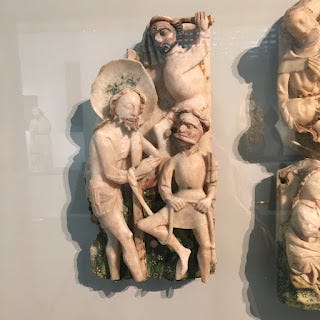
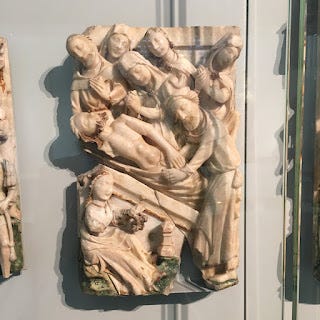
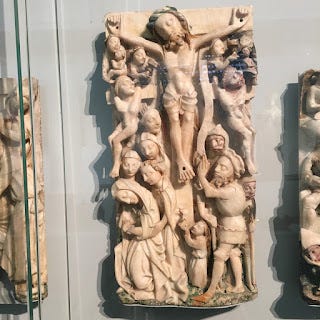
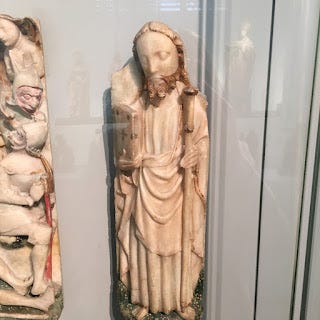
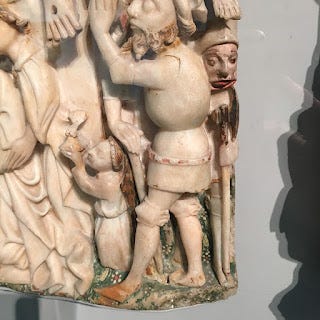
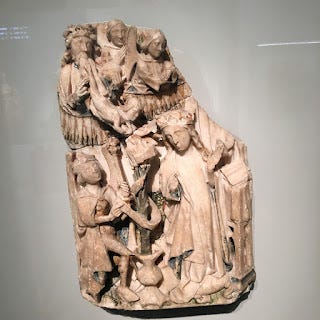
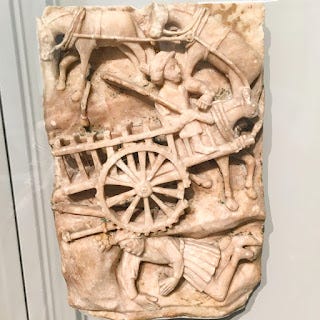
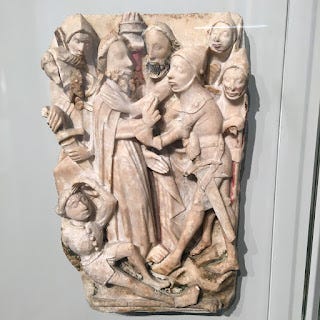
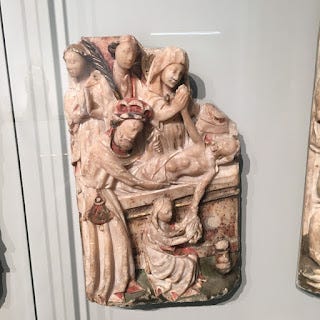
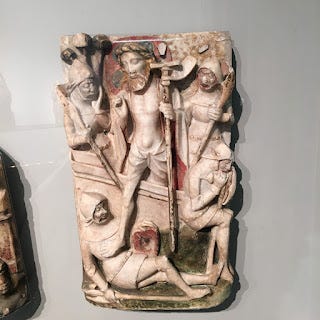
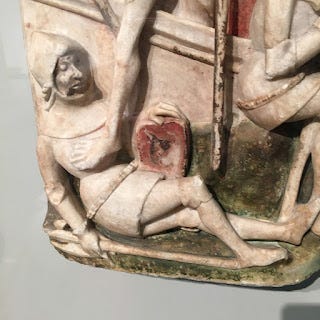
They were labelled variously as fragments of an altarpiece depicting Christ’s passion, found in 1837 in the ruins of the Church of Conty in the Somme, and depictions of various biblical scenes that seem to have come from 19th century private collections. They were said to date from the 15th century.
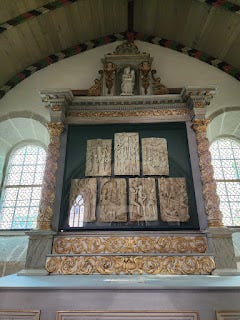
Some months later I went to Mass at the Eglise de Notre Dame de Croaz Batz in Brittany, (about which I will post in my section called “Mass Tourism” at some later date), and recognised, in an altarpiece in the church, works that looked as if they came from the same hand as those I’d seen in Amiens:
Finally, last year in Naples, in the Capo di Monte (what a gallery, what a collection), I spotted similar figures in an alabaster tryptych of the Passion of Christ, also from the 15th century:
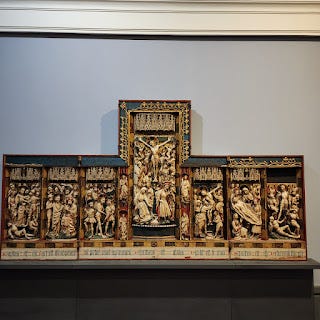
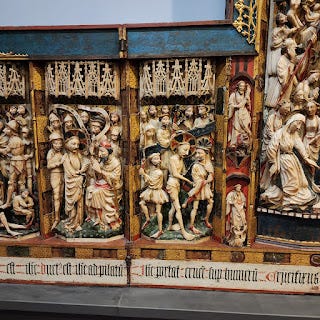
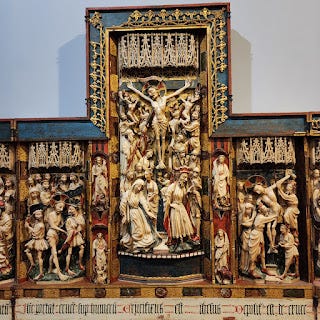
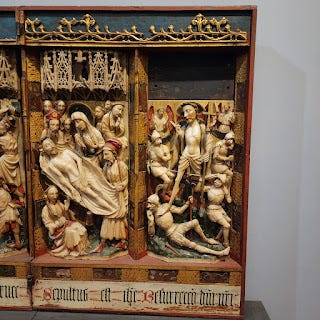
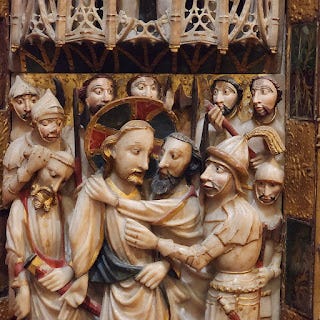
Each time I spotted them, what caught my attention about the carvings was the faces of the little figures depicted in them. They are faintly comic, although I don’t think this was the artist’s intention - and the fact that it was probably not his intention is what endears these works to me. Their lack of genius is attractive. Their slight naivety makes the sculptor seem human, rather than so extraordinary he no longer appears to be a fellow creature existing on the same plane as the rest of us - which is how I imagine Michelangelo whenever I see his works. Looking at these little scenes, by contrast, I catch a glimpse across the centuries of a moderately talented person who had the impulse to be creative, while being less than brilliant, a person who engaged in a struggle with mediocrity and didn’t entirely come out on top - a person, therefore, with whom I can identify.
And after the initial moment of interest, something else caught my attention, when I read the wall notes to these works. According to the curators at both the Museum of Picardy and the Capo di Monte, the person who made these things came from Nottingham.
Nottingham? That didn’t just catch my attention; it surprised me. We're talking about the fifteenth century - how did a bloke from Nottingham manage to get around to all these places in Europe before the invention of Ryanair?
But then I remembered one of the best detective stories I’ve ever read - The Leaves of Southwell - in which Nicolas Pevsner devotes himself to trying to understand who might have created “the leaves which adorn the capitals of the columns of Southwell Chapter House...eight miles west of Newark and fourteen miles north-east of Nottingham.”
To my astonishment when I read it, Pevsner explains that, in the thirteenth century, masons wandered Europe, plying their trade. He notes clear signs that whoever designed Bamberg Cathedral had seen and been impressed by Laon. He refers to a thirteenth century manuscript in the National Library in Paris written by Villard de Honnecourt in which the author explains “that he came from the north of France, looked round and drew at Rheims (aisle windows of the cathedral, ‘because I liked them best’) and Chartres, and even went as far from home as Lausanne and Hungary”. Pevsner also tells us that “the architect of Canterbury Cathedral choir, William of Sens, came from France specially to get the job as master mason to the cathedral” and that “the east parts of Westminster Abbey are so evidently influenced by Reims, that the name of the first master mason, Henry de Reyns, may very well be an anglicised form of Henry of Reims”.
So it was not in fact unusual for a Nottingham man to be making work in far flung places. The thirteenth century was not, as I’d imagined, a time when people were utterly tied to place - and presumably nor was the fifteenth century. However, as Pevsner points out, writing in 1945, whereas “personality and genius are what have interested the West for the last hundred and fifty years, more than all else in the contemplation of works of art”, at the time the Southwell leaves were made - and also at the time that my Nottingham friend was working - the names of individual carvers were not recorded. This prompts Pevsner to ask “Was there such a thing as an artist, as a sculptor in the thirteenth century”, given how “surprisingly few names of artists and architects of the Middle Ages have come down to us...Perhaps their work was but regarded as competent craft.”
And so the great paradox: we do not know the names of many of the individuals involved in stonemasonry in the Middle Ages and yet their works - above all every aspect of European cathedrals - are generally regarded as among the greatest treasures of European civilisation.
And, of course, as Simon Winder points out at the start of his book Germania, the only reason the work of artists involved in the creation of cathedrals has survived to be admired, where so much other artistic product has vanished, is the fact that they worked in stone:
“What survives from the real Middle Ages” says Winder, “is a range of, in practice, quite arbitrary objects, based on luck and the durability of their materials...Clothing, even precious clothing, has rotted, tapestries have faded, paint has worn away. Much of the texture and visual meaning of the Middle Ages is therefore lost...The massive exception to this decay and disappearance is stone, the stone which gives each cathedral or Schloss such seeming solidity.”
Alabaster isn’t the most enduring variety of stone, but it is enduring enough to have allowed the hardworking aspirant from Nottingham to be thought about six centuries later; and his works are wondrous, in their own modest way - or, at the very least, charming.

A lovely post, Zoe – delighted to find you writing about Nottingham alabaster. I love those pieces, and think they're among the most beautiful survivals of the Middle Ages. There's a wonderful Coronation of the Virgin in the Barber Institute in Birmingham.
ReplyDeleteRe stonemasons, I'm reading two books on stone carving, for review (the Lit Rev). And you might be interested in this extraordinary novel, which I wrote about a while back –
https://nigeness.blogspot.com/2019/02/the-white-cutter.html
I got very excited about the Barber Institute but when I looked it up, I was told it is closed for refurbishment. After my disappointment today about Birmingham Art Gallery, I am worried.
Delete